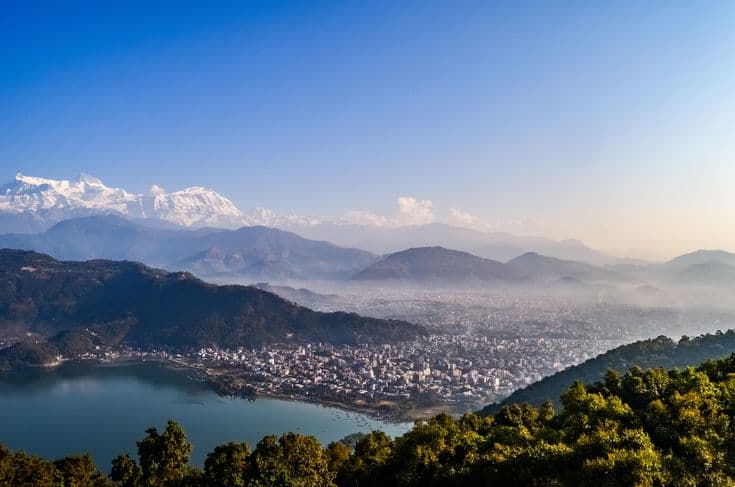
Pokhara sits at about 820 metres in Kaski district, Gandaki Province, roughly 200 kilometres west of Kathmandu. It is Nepal's second tourist city, the road and air gateway to the Annapurna trekking region, and one of very few cities anywhere with an 8,000-metre peak visible from a lakeside cafe table on a clear morning.
The geography that explains everything else
The valley is unusually low for its position. Less than fifty kilometres north the ground rises to Annapurna I at 8,091 metres, which means the horizontal distance from a warm subtropical town to permanent snow is shorter here than almost anywhere on earth. That single fact produces the views, the paragliding, the rainfall and the trekking industry.
The Seti river runs through the middle of the city in a gorge so narrow that in places you can stand on a bridge and not see the water beneath it. Limestone underneath gives the valley its caves. Nine lakes lie across the floor, the three largest being Phewa, Begnas and Rupa, and in 2016 they were designated together as a Ramsar wetland site. Our guide to how the Himalaya formed explains why the drop is so abrupt.
What people actually do here
Most visitors give Pokhara two or three days at the front or back of a trek. A workable version of that: a dawn drive to Sarangkot for the Annapurna sunrise, a morning paraglide down to the lake, an afternoon rowing on Phewa and a walk up to the World Peace Pagoda on the far shore. Add the International Mountain Museum if the weather closes in, and the Gupteshwor cave and Davis Falls if you want the standard taxi circuit.
The better version slows down. Cycle out to Begnas and Rupa for a day away from the tourist strip, or walk a section of the Australian Camp ridge. Our case for fewer stops and a richer trip applies to Pokhara more than anywhere else in Nepal, because the town rewards a fourth day and punishes a rushed one.
Trekking out of Pokhara
Every classic Annapurna route starts within a half-day drive of the city. Poon Hill takes three to four days, Annapurna Base Camp around seven to twelve, and the full Annapurna Circuit two to three weeks. Permits for all of them are issued in Pokhara, which is the practical reason most trekkers arrive the day before rather than the morning of departure.
The Annapurna Conservation Area permit and the trekker registration card are both obtained here, charged per person and payable on the spot, with different rates for visitors from Nepal, from SAARC countries and from elsewhere. Take passport photographs and your passport. The details are in our Annapurna Conservation Area guide.
Getting here, including the new airport
Pokhara International Airport opened in January 2023 on the east side of the city, replacing the old strip beside the lake. Domestic flights from Kathmandu take about twenty-five minutes and are the fastest way in when the weather cooperates. The road is roughly 200 kilometres of the Prithvi Highway and takes six to eight hours by tourist bus, longer by local bus, and it follows the Trishuli river for much of the way, which is why so many people raft it en route.
| Detail | Pokhara |
|---|---|
| District | Kaski |
| Province | Gandaki |
| Elevation | About 820 m |
| From Kathmandu | About 200 km; 6 to 8 hours by road, 25 minutes by air |
| Airport | Pokhara International, opened January 2023 |
| Peaks visible | Annapurna I at 8,091 m, Machapuchare at 6,993 m, Dhaulagiri at 8,167 m on the clearest days |
| Best season | October and November for mountain clarity; March to May for warmth and flowers |
| Permits issued | Annapurna Conservation Area permit and trekker registration card |
Clarity is the thing to plan around. From late September to November the air is washed clean and the mountains are out most mornings. December and January are clear but cold at dawn. From late May the haze builds until the monsoon arrives and the peaks disappear for weeks, which does not stop Pokhara being pleasant, only being photogenic. Our seasons guide covers the wider region, and the Machapuchare guide explains the peak everyone photographs from the lake.
Frequently Asked Questions
How many days should I spend in Pokhara?
Two days covers the standard sights. Three or four lets you add a cycle day to the eastern lakes or a night out on a ridge, which is what most people say they wish they had done. Trekkers should allow one full day before departure for permits and kit.
Can you see Annapurna from the city itself?
Yes, on a clear morning, from the lakeside and from anywhere with an open northern view. Machapuchare is the pointed peak that dominates the skyline. Cloud usually builds through the day, so the mountains are a breakfast event rather than an afternoon one.
Is the new airport open to international flights?
The airport opened in January 2023 and handles domestic services; international scheduling has been limited and has changed repeatedly since opening. Check current routes when you book rather than assuming a direct international arrival.
Where do I get my trekking permits?
In Pokhara, at the tourism office in the city, before you set out. Bring your passport and passport photographs. Fees are charged per person and differ for Nepali, SAARC and other nationalities.
Is Pokhara worth visiting if I am not trekking?
Yes. Paragliding, the lakes, the caves, the mountain museum and the food are enough for three days on their own, and the town is far calmer than Kathmandu. Many travellers who arrive to trek end up staying longer than planned without leaving the valley.