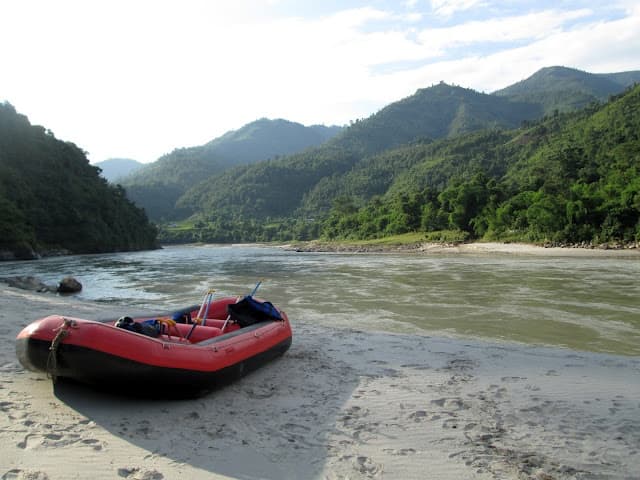
The Trishuli is the river almost every visitor to Nepal rafts, because the Prithvi Highway between Kathmandu and Pokhara runs beside it for the whole length of the commercial section. Trips last from half a day to three days, the water is graded III with harder sections in high flow, and you can be put in and picked up wherever suits your onward journey.
Why this river and not a better one
Honesty first: the Trishuli is not Nepal's finest whitewater. The Karnali, the Sun Koshi and the Marsyangdi are all bigger, wilder and more remote. The Trishuli wins on logistics. It sits on the road that everyone is already driving, it can be joined at breakfast and left before dinner, and it costs a fraction of an expedition river because there is no flight, no shuttle and no week of food to carry.
That road is also the drawback. You will hear buses. There is dust on the bank, roadside kitchens above some of the rapids, and construction in places. If your idea of a river trip is silence, read our Karnali expedition page instead and budget a week. If you want two hours of genuine whitewater on the way to Chitwan, this is the correct choice.
The rapids and the grade
The commercial section is graded III, rising towards III+ and IV in the high water of late September and October. It is a big-volume river rather than a technical one: broad wave trains, a few holes to avoid, and long calm pools where everyone swims and the guide tells stories. Beginners handle it. Children old enough to hold a paddle and follow instructions handle it with a family-oriented operator.
Water level does most of the work. Immediately after the monsoon the waves are large and continuous and swims are longer. By December the river has dropped and the same run reads as a gentle float with a few good rapids. Spring, from March to May, sits between the two and has the warmest air.
Where the trips start and finish
Put-ins cluster along the highway west of Kathmandu, with take-outs further down towards Mugling and the Chitwan turn-off. Because both ends are on the road, operators build the trip around where you are going next rather than around the river. A one-day trip finishing near Mugling puts you two hours from Sauraha or three from Pokhara.
Below the commercial section, the Trishuli meets the Kali Gandaki at Devghat, one of Nepal's most important confluence pilgrimage sites, and the combined river becomes the Narayani that runs along the edge of Chitwan. The whole system is mapped in our guide to Nepal's river systems.
Camping on the bank
Two and three-day trips camp on sand beaches, which is the part most people remember. Tents go up in the afternoon, there is time to swim or walk up a side stream, and dinner is cooked on the sand. It is also the cheapest night of accommodation you will have in Nepal, and one of the best. The catch is that beach camping only works when the water is low enough to expose the sand, so it is a post-monsoon and spring activity rather than a year-round one.
Fitting the Trishuli into a route
The classic use is as the second day of a Nepal trip, breaking the Kathmandu to Chitwan or Kathmandu to Pokhara drive. It also pairs neatly with Nuwakot Palace on the same river system north of the highway, giving a two-day loop of history and whitewater without returning to Kathmandu in between.
| Detail | Trishuli rafting |
|---|---|
| Location | Prithvi Highway corridor between Kathmandu and Mugling |
| Province | Bagmati and Gandaki |
| Grade | Class III, rising to III+ and IV in high water |
| Trip length | Half day to 3 days |
| Best season | September to November, and March to May |
| Avoid | Late June to early September, when monsoon flow is too high for beginners |
| Road access | Continuous, so put-in and take-out are flexible |
| Suits | First-time rafters, families, travellers already driving this route |
Costs are low by Nepali adventure standards and vary mainly with whether you camp and how many people share the raft. Our seasonal budget guide gives realistic ranges for adding activities like this to a route. If you are continuing to the lowlands afterwards, the Chitwan wildlife guide covers what a jungle stay actually delivers.
Frequently Asked Questions
Do I need to be able to swim?
Operators fit everyone with a lifejacket and helmet, and most will take non-swimmers on the standard Class III section. Say so when you book rather than at the riverbank, because it changes where the guide puts you in the boat and how they brief the swim position.
Is a one-day trip worth it?
Yes, if you are already driving the Prithvi Highway. You get two to three hours on the water for the price of a stop you were making anyway. If you have to travel specially from Kathmandu and return the same day, the driving outweighs the paddling.
When is the water biggest?
Late September and October, just after the monsoon. That is when the Trishuli is at its most exciting and also when beach camping is least reliable, because the sand bars are still under water.
Can children come?
Family trips run regularly, usually on the easier lower sections or on the neighbouring Seti river, which is gentler. Minimum ages are set by the operator and depend on the water level rather than a fixed rule.
What should I bring on the boat?
Clothes you do not mind soaking, footwear that stays on your feet, sunscreen and a dry bag for anything electronic. Everything else goes in the vehicle. Phones drown on the Trishuli every single day of the season.