
Chitwan National Park protects about 952 square kilometres of sal forest, tall grassland and river floodplain in south-central Nepal, at an altitude of only 100 to 800 metres. Gazetted in 1973 as the first national park in the country and inscribed as a UNESCO World Heritage Site in 1984, it holds the largest population of greater one-horned rhinoceros in Nepal, counted at 694 animals in the 2021 national census. The 2022 national tiger survey recorded 128 Bengal tigers inside the park, out of 355 nationwide.
Why was Chitwan the first national park in Nepal?
Because it was the place most obviously about to be lost. The Chitwan valley was a Rana hunting preserve for a century, and malaria kept it thinly settled. When the malaria eradication programme of the 1950s made the lowlands habitable, tens of thousands of families moved down from the hills, forest was cleared for farmland, and the rhino population collapsed to somewhere near a hundred animals within about fifteen years. The armed gaida gasti patrol was raised in 1959 as an emergency measure. Gazetting the park in 1973 was the permanent version of the same decision, and a battalion of the Nepal Army has been stationed inside ever since. The recovery from roughly a hundred rhinos to the current population is one of the few unambiguous conservation successes in South Asia.
What wildlife will you actually see in Chitwan?
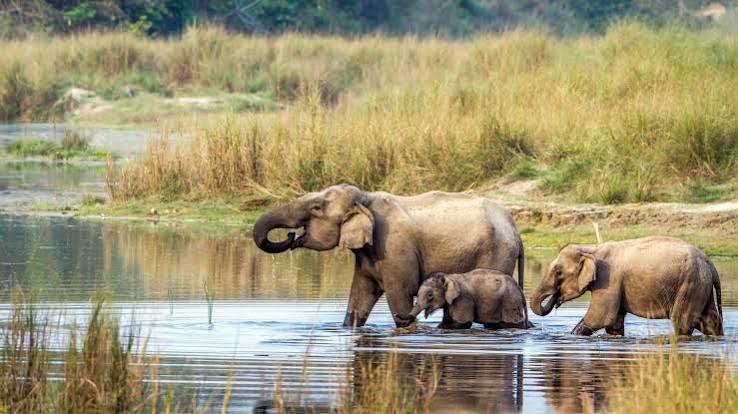
Rhino, almost certainly. Deer of three or four species, certainly. Tiger, probably not, and any guide who promises otherwise is selling something. Chitwan is a forest park rather than an open savannah, and dense sal and eight-metre elephant grass mean most sightings are close, brief and at ground level. The realistic target list is rhino, chital, sambar, hog deer, barking deer, wild boar, rhesus macaque, grey langur, mugger crocodile, gharial and something over five hundred recorded bird species. Sloth bear, gaur, leopard, wild dog and tiger are all present and all mostly invisible.
| Species | Status in Chitwan | Where to look | Best months |
|---|---|---|---|
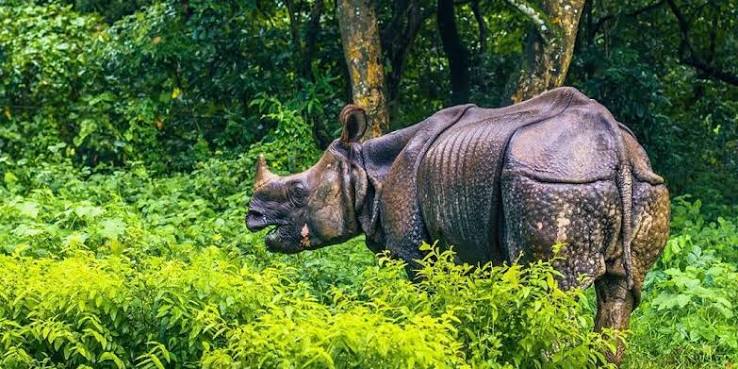
| Greater one-horned rhinoceros | 694 counted in the 2021 national census, the largest population in Nepal | Riverine grassland and wallows along the Rapti and Narayani | October to March, best just after the January grass cutting |
| Bengal tiger | 128 recorded in the 2022 national survey | Grassland edges and riverbanks in the western sector; tracks far more often than the animal | March to May, when cover thins and water concentrates |
| Asian elephant | Wild herds move seasonally between Chitwan and Parsa | Sal forest in the east of the park, near the Parsa boundary | Late winter and spring |
| Gaur | Chitwan holds the main population in Nepal | Sal forest and forest clearings, often on the Churia slopes | April to June, when they come down to water |
| Gharial | Restocked from the breeding centre at Kasara since the late 1970s | Sandbanks on the Narayani and Rapti rivers | December to February, hauled out to bask |
| Sloth bear | Present throughout, rarely seen | Sal forest with termite mounds; look for excavated mounds | March to May, and around dawn |
When is the best time to visit Chitwan for wildlife?
October to March is the standard answer and it is correct for comfort, with dry days, clear air and daytime temperatures that make a long jeep drive bearable. For visibility, the single best window is the two or three weeks after the annual grass cutting in January, when buffer-zone residents are permitted into the park for a set number of days to harvest thatch grass. The tall grassland is knocked flat, the sightlines open up for the first time since the monsoon, and rhino and deer stand exposed on ground where a month earlier you could not see three metres. From March the heat builds and animals concentrate at shrinking water sources, which improves odds for tiger and gaur at the cost of a hard midday. The monsoon from late June to September floods the floodplain, closes tracks and makes the park difficult to work.
How does a safari in Chitwan actually work?
Three formats do almost all the work. A jeep safari covers distance and reaches the interior tracks toward Kasara and the western grasslands, and it is the only realistic way to see the far side of the park in a day. A guided walk with two licensed naturalists is the format that produces the sharpest wildlife experience, because you hear things, and it is also the one with genuine risk attached, which is why the guide briefing on rhino and sloth bear behaviour is not a formality. A dugout canoe drifting down the Rapti at first light is the best way to see gharial, mugger and waterbirds, and it is silent, which matters. Park headquarters at Kasara holds the gharial breeding centre, which has been releasing captive-reared juveniles into the Narayani river system since the late 1970s in an attempt to hold a critically endangered species in Nepal.
Most visitors base themselves at Sauraha on the northern bank of the Rapti, which is the main gateway and where the licensed guides, the park office and the boats are. Bis Hajari Tal, the wetland complex in the buffer zone near Bharatpur, is a Ramsar-listed site in its own right and one of the better birding mornings in the district. It is a useful reminder that a great deal of the wildlife interest around Chitwan is outside the park boundary.
How does Chitwan connect to the rest of the Terai Arc?
Chitwan is not an island, and that is the whole point of how it is managed. Parsa National Park adjoins it directly to the east and was upgraded from wildlife reserve to national park in 2017, giving the elephant and tiger populations room to move. To the south the boundary meets Valmiki Tiger Reserve across the Indian border, and the combined block is treated as a single tiger conservation unit by both governments. Westwards along the Terai Arc Landscape run Banke National Park, gazetted in 2010, and Bardiya National Park, which together hold most of the rest of the tiger population in Nepal. The Barandabhar corridor running north from Chitwan toward the Mahabharat range is the fragile link that lets animals move out of the floodplain into the hills, and it is under permanent pressure from the East-West Highway and from settlement.
What are the real threats to Chitwan now?
Poaching is no longer the primary one, which is a remarkable sentence to be able to write about a rhino population. Nepal has recorded several twelve-month periods with no rhino poaching at all, the first of them in 2011, achieved through army presence, community informant networks and buffer-zone user groups who had a financial reason to care. The pressures now are habitat quality and connectivity. Invasive plants, notably mikania vine, smother grassland and riverine forest. Water extraction and changing river courses alter the wallows rhino depend on. Highway traffic and new infrastructure cut the corridors. And human-wildlife conflict remains real for the households on the boundary who lose crops to rhino and elephant and livestock to leopard, which is why the revenue-sharing mechanism in the buffer zone is a conservation tool rather than a courtesy.
FAQ
How many rhinos are there in Chitwan National Park?
The 2021 national rhino census counted 694 greater one-horned rhinoceros in Chitwan, the large majority of the national total. The population has recovered from roughly a hundred animals in the late 1960s.
What are the chances of seeing a tiger in Chitwan?
Low on any single visit. The 2022 survey recorded 128 tigers across 952 square kilometres of dense sal forest and tall grassland, and they are nocturnal and cover-loving. Three or four days in the park in the hot pre-monsoon months gives you the best odds; a single afternoon jeep drive gives you very little.
How many days do you need in Chitwan?
Two nights is the working minimum and gives you one full day for a jeep safari plus a dawn canoe and walk. Three nights lets you reach the western sector and Kasara without rushing, and materially improves your chances of the harder species.
When was Chitwan made a national park and a World Heritage Site?
It was gazetted as the first national park in Nepal in 1973 and inscribed as a UNESCO World Heritage Site in 1984.
Is walking safe inside Chitwan National Park?
Walking is permitted only with two licensed naturalist guides and it carries genuine risk, primarily from rhino and sloth bear at close range in thick cover. The pre-walk briefing on what to do in an encounter is the most important part of the day. Follow it exactly.