Parsa National Park covers roughly 627 sq km of Churia hill and sal forest immediately east of Chitwan, across Parsa, Makwanpur and Bara districts in south-central Nepal. It was gazetted as a wildlife reserve in 1984, extended in 2015 and upgraded to national park status in 2017, which makes it one of the youngest national parks in the country.
What Parsa protects that Chitwan does not
Parsa and Chitwan share a boundary and share animals; tigers, elephants and leopards move freely between them, and ecologically they function as one block. What differs is terrain. Chitwan is dominated by floodplain, alluvial grassland and big rivers. Parsa is mostly Churia hill country, the young sandstone and conglomerate ridge that forms Nepal's outermost Himalayan range, cloaked in sal forest and cut by seasonal streams.
That geology drives everything about the park. Churia rock is porous, so surface water drains away fast and the streams run dry for months. Wildlife concentrates around the few permanent sources and around waterholes the park maintains artificially through the dry season. It also means the forest here is drier and more open in places than Chitwan's, and the grassland component that rhinos need is largely absent.
The upgrade to national park in 2017 mattered practically as well as symbolically. It brought stricter protection to a block that had spent three decades as a reserve, and it recognised Parsa's function as the eastern anchor of the Terai Arc Landscape, the corridor system linking Nepal's lowland parks to each other and to protected areas in India. Our explanation of Nepal's protected area system sets out what changes when a reserve becomes a park.
Wildlife, and honest expectations
Nepal's 2022 national tiger survey recorded around 41 tigers in Parsa, a substantial rise from a decade earlier and a genuine conservation success given how little attention the park receives. Leopards are relatively common, and several guides working both parks report Parsa as the better bet of the two for a leopard sighting, in part because there are fewer tigers competing for space and fewer vehicles pushing cats off the tracks.
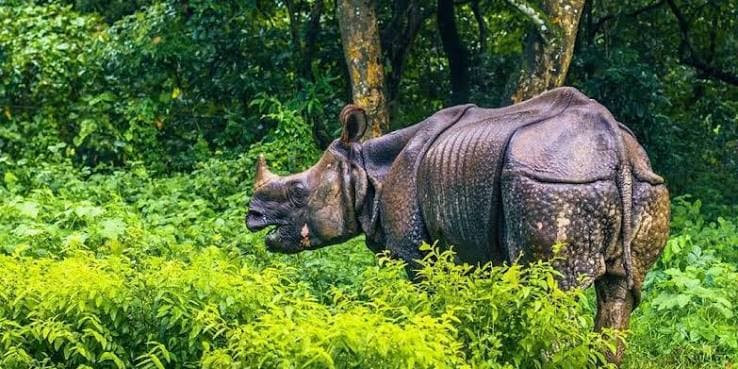
Wild elephant use the park heavily and move across the Indian border, sloth bear are present in reasonable numbers, and gaur, four-horned antelope, striped hyena and wild dog have all been recorded. Rhino are not a feature here; the habitat is wrong. Bird lists run into the several hundreds, with the giant hornbill among the species people specifically come for.
Set expectations properly. Parsa has less habituated wildlife, fewer roads and no network of jungle towers. Sightings per hour are lower than in Chitwan. What you get instead is forest without other vehicles in it. Some people will call that a poor trade and some will book on the strength of it. The Parsa park guide covers the wildlife in more detail, and Nepal's national parks compared shows where it sits against the others.
Access and the near-total lack of lodges
The park headquarters is at Adhabhar, on the East-West Highway, and the main entry points sit along that road. There is essentially no tourist accommodation inside or immediately outside the park. This is not an oversight waiting to be corrected; it reflects genuinely low visitor numbers, and it is the single biggest practical constraint on visiting.
The workable approach is to stay in Sauraha on the Chitwan side and run a day safari east into Parsa with an operator who already holds the permits and knows the tracks. The drive from Sauraha to the Parsa entrances takes a couple of hours on the highway, which means an early start and a long day, but it is the standard arrangement and it works. Alternatively, Birgunj and Hetauda both have hotels and are within reach, though neither is a pleasant base.
Simara has a small domestic airport with short flights from Kathmandu, and Bharatpur serves the Chitwan side. Most people arrive by road on the East-West Highway, which runs along the park's southern edge.
| Detail | Parsa National Park |
|---|---|
| Gazetted as wildlife reserve | 1984 |
| Upgraded to national park | 2017 |
| Area | About 627 sq km |
| Districts | Parsa, Makwanpur, Bara |
| Elevation range | About 435 m to 950 m |
| Headquarters | Adhabhar, on the East-West Highway |
| Tigers, 2022 national survey | Around 41 |
| Terrain | Churia hills and sal forest, little grassland |
| Nearest airports | Simara and Bharatpur |
| Accommodation | Effectively none inside; base in Sauraha |
| Best season | October to March |
When to go, and how to plan it
October to March, and within that window February and March are arguably better here than in Chitwan. The dry season concentrates animals at waterholes, and by late winter the undergrowth has thinned enough to see into the forest. October gives cleaner air after the monsoon but denser vegetation.
Avoid the monsoon entirely. Churia streams that are dry in April become dangerous in July, tracks wash out, and leeches make walking miserable. Between June and September a Parsa day trip is not a realistic proposition.
The sensible itinerary is three or four nights based at Sauraha, with two days inside Chitwan and one long day in Parsa. That gives you the easy wildlife first and the quiet forest second, which is the right order. The Chitwan page covers the base end of that trip, and the Chitwan wildlife guide covers what to book there. If you would rather go west than east, Banke offers a comparable low-traffic experience beside Bardia.
Frequently Asked Questions
Can you stay inside Parsa National Park?
There is effectively no visitor accommodation in or beside the park. Almost everyone bases in Sauraha on the Chitwan side and drives across for a day safari, or stays in Hetauda or Birgunj if travelling for other reasons.
Is Parsa better than Chitwan for wildlife?
Not for sightings per hour. Chitwan has more animals in more open habitat and far better infrastructure. Parsa has more leopards relative to tigers, almost no other vehicles and a genuinely wild feel. Do Chitwan for wildlife, Parsa for solitude.
How do I arrange a safari into Parsa?
Through an operator in Sauraha who runs the route regularly. They handle the permit, the vehicle and a licensed guide. Turning up at the gate independently without transport is not practical, as the tracks are long and there is no vehicle hire at the entrances.
When did Parsa become a national park?
In 2017, having been a wildlife reserve since 1984 and extended in 2015. That makes it one of the most recently declared national parks in Nepal.
Are there rhinos in Parsa?
Not as a resident population. The park is Churia hill and sal forest with very little of the alluvial grassland that rhino need, so the species that define a Chitwan visit are not what you come here for.
What is the best month to visit?
February and March. The dry season concentrates wildlife at the remaining water sources and the undergrowth has thinned, which improves visibility in what is otherwise fairly closed forest.