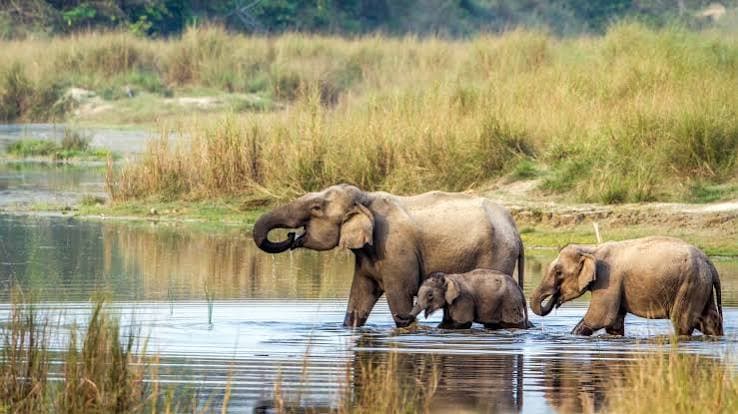
Chitwan National Park covers 932 sq km of sal forest, tall grassland and river floodplain in south-central Nepal, spread across four districts along the Indian border. Gazetted in 1973 as the country's first national park and inscribed by UNESCO in 1984, it holds Nepal's largest population of greater one-horned rhino and its largest tiger population.
What the wildlife numbers actually say
Chitwan is one of the few places in Asia where the headline species are counted properly and the counts are published. Nepal's 2022 national tiger survey put the country at 355 adult tigers, of which around 128 were in Chitwan. The 2021 rhino census counted 752 greater one-horned rhinos nationally, with just under 700 of them here. Those are the two figures worth carrying, and both represent recoveries from near-collapse in the 1960s.
Beyond the two headliners, the park holds wild elephant, sloth bear, leopard, gaur, four species of deer, and the gharial, a fish-eating crocodile that was down to a few dozen animals nationally before the breeding centre at Kasara began releasing juveniles into the Rapti and Narayani. More than 500 bird species have been recorded inside the park boundary, which is roughly half of everything on Nepal's national list.
What the numbers do not tell you is how often you will see any of it. Rhinos are close to guaranteed on a two-night stay; tigers are not. Most visitors leave without one. Set expectations accordingly and the trip improves. Our Chitwan wildlife guide goes deeper on which species are realistically visible in which month.
The four ways to see the park
A jeep safari covers the most ground and is the standard half-day or full-day option, running on forest tracks in the western and central sectors. A canoe trip down the Rapti in a dugout gets you level with gharials and marsh crocodiles basking on the bank, and is the best birding hour of any visit. A guided walking safari covers far less ground than a jeep and opens with a briefing on what to do if you meet a rhino or a sloth bear at close range, which tells you most of what you need to know about it. A jungle-tower night is the quietest option and the most likely to produce a tiger, though the odds remain long.
Elephant-back safaris have been steadily withdrawn under welfare pressure and are no longer offered by most reputable operators. If a lodge still pushes one, that tells you something about the lodge. Elephant bathing sessions have been withdrawn on the same grounds at most establishments.
Grassland cutting takes place in January, when local communities are allowed in to harvest thatch. For a fortnight afterwards sightlines across the phanta are the best they will be all year, and the visibility is a genuine reason to time a visit for late January or early February.
Sauraha, and the alternatives to it
Almost all independent travellers stay at Sauraha, on the northern bank of the Rapti opposite the park. It is a functioning tourist village with lodges from budget to comfortable, restaurants, ATMs, guide offices and a sunset strip on the riverbank. It is also busy, and in peak season it feels it.
Quieter bases exist. Ghatgain and Meghauli sit further west along the river with a handful of higher-end lodges and much less traffic. Kasara, near the park headquarters and the gharial centre, is quieter again. Choosing west over Sauraha costs more and gives up the walkable restaurant scene, but the safaris start from the same forest.
Getting to Chitwan
From Kathmandu the road runs roughly 150 km via Muglin and takes five to seven hours by tourist bus, longer if the Prithvi Highway is under repair, which it frequently is. From Pokhara it is a similar drive. Buddha Air and others fly Kathmandu to Bharatpur in about twenty minutes, and Bharatpur airport is around 20 km from Sauraha, which makes flying an easy way to save a day at the front or back of a trip.
October to March is the season. October and November give the clearest air and the best chance of seeing the Himalaya on the northern horizon; February and March are warmer with better grassland visibility. The park effectively shuts down for tourism during the monsoon between June and September, when tracks flood and the grass stands taller than a jeep.
| Detail | Chitwan National Park |
|---|---|
| Established | 1973, Nepal's first national park |
| Area | 932 sq km |
| Buffer zone | 750 sq km, declared 1996 |
| Districts | Chitwan, Nawalparasi, Parsa, Makwanpur |
| Elevation range | About 100 m to 815 m |
| UNESCO inscription | 1984 |
| Tigers, 2022 national survey | Around 128 |
| Bird species recorded | More than 500 |
| Nearest airport | Bharatpur, about 20 km from Sauraha |
| Road time from Kathmandu | 5 to 7 hours |
| Best season | October to March |
Chitwan or Bardia
This is the question worth asking before booking. Chitwan is easier to reach, has more rhinos, better infrastructure and a wider choice of lodges. Bardia, in the far west, has a comparable tiger density with a fraction of the visitors, more space between vehicles and a stronger sense of being somewhere remote. If it is your first safari in Nepal and you have three days, Chitwan is the pragmatic choice. If you have a week and want the forest to feel wild, take the flight to Nepalgunj instead. Our Bardia guide makes the case for the west, and Nepal's national parks compared lays the whole system out side by side.
Parsa, immediately east, shares the same forest block and the same animals with almost no visitors at all. It is a straightforward day trip from Sauraha, and the Parsa destination page explains what you get and what you give up. For how the parks, reserves and conservation areas fit together administratively, see our note on Nepal's protected area system.
Frequently Asked Questions
What are the chances of seeing a tiger in Chitwan?
Low on a short visit. Rhino sightings are close to routine over two nights, but tigers are shy and the forest is dense. Multiple days, early starts and time on a jungle tower improve the odds considerably without ever making it likely.
How much does entry cost?
The park charges a daily entry permit with separate rates for Nepali, SAARC and other foreign visitors, and jeep, canoe and guide fees are charged on top. Rates are revised periodically, so confirm the current figure with your lodge rather than relying on an older published price.
Can you still ride an elephant in Chitwan?
Reputable operators no longer offer elephant-back safaris or bathing sessions, and the practice has been progressively withdrawn under welfare pressure. Jeep, canoe and walking safaris are the standard options and give better wildlife viewing anyway.
How many days do you need?
Two nights is the practical minimum, giving you a full day of activities plus a morning. Three nights lets you mix a jeep safari, a canoe trip and a walk without rushing, and materially improves your chance of a good sighting.
When is the park closed?
It does not formally close, but the monsoon between June and September floods tracks, raises the grass above jeep height and makes most activities impractical. Very few lodges operate a full programme in those months.
Is Chitwan safe to walk in?
Only with licensed guides, and only on their terms. Walking safaris are run by two armed or stick-carrying guides who brief you on rhino and sloth bear encounters before you set off. Do not enter the park on foot alone.