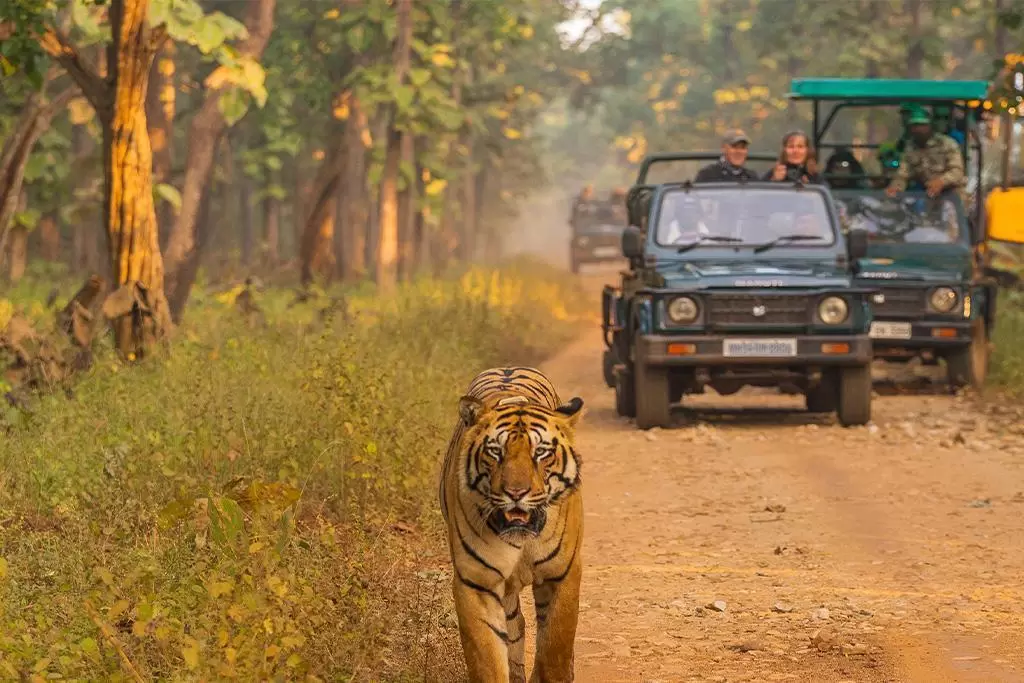
Bardiya National Park covers 968 square kilometres of sal forest, grassland and river floodplain in Bardiya district, Lumbini Province, in the far west of the Nepali Terai. It is the largest protected area in the lowlands and the best place in the country to look for a wild tiger, and it takes roughly three hours to reach from Nepalgunj airport.
| Detail | Figure |
|---|---|
| Park area | 968 square kilometres |
| Established | 1976 as a wildlife reserve, national park in 1988 |
| District and province | Bardiya, Lumbini |
| Main entry village | Thakurdwara, near park headquarters |
| Nearest airport | Nepalgunj, about 3 hours by road |
| Turn-off from the East-West Highway | Ambassa, about 13 km from Thakurdwara |
| Bird species recorded | over 400 |
| Best months | October to April, with February to April best for tigers |
Getting there
Nepalgunj is the gateway. Flights from Kathmandu take about an hour and run several times a day, and from the airport it is a two and a half to three hour drive west along the East-West Highway to Ambassa, then about 13 km north on a side road to Thakurdwara, where most lodges sit along the park boundary. Almost every lodge will arrange the pickup, and it is worth taking that rather than the local bus, which drops you at Ambassa with the last stretch still to do.
Overland from Kathmandu is a long day and a half by tourist bus, and the same road connects to the Indian border crossings at Nepalgunj and Mahendranagar. Anyone travelling on to the mountains can pair Bardiya with the western hills using our guide to flights, roads and permits in west Nepal.
Entry is charged per person per day at the park office in Thakurdwara, with a lower rate for Nepali and SAARC visitors, and there are separate charges for a vehicle and for the mandatory nature guide. You cannot enter the park unaccompanied. Lodges handle the paperwork if you ask.
The three ways to look for wildlife
A jeep safari covers ground. A vehicle with a guide runs the forest tracks and the riverbank towards the Karnali or into the Babai valley, and it is the way to see rhino, deer, elephant and a lot of country in a morning. It is also the only realistic option in the heat of April.
A guided walk is what Bardiya is known for. You go in on foot with two guides, one in front and one behind, on the understanding that the animals are not behind a barrier. It changes the experience completely: you hear the forest, you read tracks, and the guides brief you properly on what to do if you meet a rhino or a sloth bear, which is to get behind a tree. This is not a thrill-seeking exercise and it is genuinely well run, but it is not for everyone and there is no shame in taking the jeep.
The third is sitting still. A machan or a riverbank hide above a waterhole in the Babai valley, from mid-afternoon until dusk, is how most tiger sightings actually happen. It requires patience and produces nothing on most days. In the dry months, when the river shrinks to pools, it produces more than anything else.
What you can reasonably expect to see
Tigers first, because that is what people ask. Nepal's 2022 national survey counted 355 tigers, and Bardiya holds one of the two largest populations in the country alongside Chitwan, of the order of 125 animals. That density is high by any standard, and sightings are more frequent here than anywhere else in Nepal. They are still not guaranteed. Three or four days in the dry season gives a reasonable chance; a single afternoon gives a poor one. Our guide to the tigers of Bardiya covers the population and how the recovery happened.
Greater one-horned rhino are here after translocations from Chitwan beginning in the 1980s, and the population took heavy losses to poaching during the conflict years before recovering. Wild elephant herds move along the Karnali, including some notably large bulls. Gharial and mugger crocodile live in the Karnali and Babai, and Gangetic dolphin are occasionally seen in the Karnali, though a sighting is luck rather than planning. Swamp deer, hog deer, spotted deer, langur and rhesus macaque are everywhere. Over 400 bird species have been recorded, including Bengal florican and sarus crane in the grasslands; our birdwatching guide covers what to look for in the Terai.
Beyond the park boundary
The villages around Thakurdwara are mainly Tharu, the indigenous people of the Terai, and a village walk or a stay in a Tharu-run lodge is the other half of the visit. The longhouses, the painted walls and the fishing methods in the oxbows are not staged for visitors. Our guide to Tharu culture around Bardiya covers it, and the longer article on Bardiya National Park tells the story of the park itself, from royal hunting reserve to the tiger stronghold it became.
Banke National Park adjoins Bardiya to the east and the two are managed as one tiger landscape; see our Banke National Park guide. Rafting the Karnali is run in the post-monsoon months, with the classic multi-day trip finishing at Chisapani on the park boundary. If you are deciding between the lowland parks, our comparison of Nepal's national parks sets Bardiya against Chitwan and Shuklaphanta on access, cost and what you are likely to see.
When to go
October to December is comfortable, green and good for birds, with grass still high after the monsoon, which makes larger animals harder to see. January and February are cool with morning mist. February to April is the best window for tigers: the grass has been cut or burned as part of the park's grassland management, the Babai has dropped to pools and animals concentrate at water. April gets very hot, above forty degrees by afternoon, and the walks start at dawn for that reason.
From late June to September the monsoon floods the rivers, jungle walks stop, tracks become impassable and most lodges close or run a skeleton service. It is the one time not to come. For a wider view of timing across the region, see our guide to the west Nepal seasons.
Frequently Asked Questions
How do you get to Bardiya National Park?
Fly Kathmandu to Nepalgunj in about an hour, then drive two and a half to three hours west to Ambassa and 13 km north to Thakurdwara. Most lodges arrange the transfer. Tourist buses from Kathmandu take a long day and a half.
What are the chances of seeing a tiger at Bardiya?
Better than anywhere else in Nepal, but not guaranteed. Three or four days between February and April, using a mix of jeep safaris and afternoon waits at a waterhole, gives a reasonable chance. A single day rarely does.
When is the best time to visit Bardiya?
October to April overall. February to April is best for tigers, when the grass is low and the rivers have dropped. Avoid late June to September, when the monsoon floods the park and jungle walks stop.
Can you walk inside Bardiya National Park?
Yes, with two licensed guides. Bardiya is known for its walking safaris, and no one is permitted to enter the park unaccompanied. Jeep safaris and machan sittings are the alternatives.
How is Bardiya different from Chitwan?
Bardiya is larger, further from Kathmandu, much quieter and better for tigers. Chitwan is easier to reach, has more lodges and more infrastructure, and offers more reliable rhino sightings. Bardiya rewards a longer stay.
Do you need a permit to enter Bardiya National Park?
Entry is charged per person per day at the park office in Thakurdwara, with lower rates for Nepali and SAARC visitors, plus separate charges for a vehicle and for the compulsory guide. No advance application is needed.