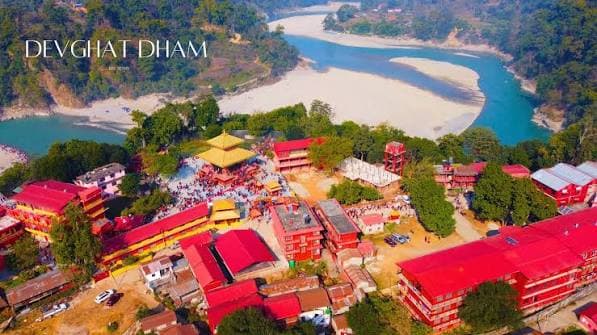
Devghat is a pilgrimage settlement at the point where the Trishuli and the Kali Gandaki meet to become the Narayani, a short drive north-west of Narayangadh in the central Nepal lowlands. It is known for its ghats, its cremation grounds, its ashrams full of people who have come here to spend their last years, and the mid-January bathing festival.
Why a confluence, and why this one
In Hindu geography the meeting of two rivers is a threshold, and bathing at one carries more weight than bathing at either river alone. Devghat is the confluence of two of Nepal's major systems: the Trishuli, draining the central hills, and the Kali Gandaki, which cuts the deepest section of its gorge between Dhaulagiri and Annapurna far to the north. Below the junction the combined river takes the name Narayani and runs south past Chitwan towards the Indian border.
The Kali Gandaki connection is what gives the place part of its standing. The riverbed upstream produces shaligram, the black ammonite fossils treated as aniconic forms of Vishnu, and they are collected from the gravel around Muktinath and traded down the length of the valley. How these river systems are organised, and why they matter well beyond religion, is set out in our guide to the Koshi, Gandaki and Karnali.
Devghat at a glance
| Detail | Devghat |
|---|---|
| Rivers | Trishuli and Kali Gandaki, joining as the Narayani |
| Settlement district | Tanahun |
| Province | Gandaki |
| Adjoining districts | Chitwan to the south, Nawalpur to the west |
| Nearest town | Narayangadh, a short drive south-east |
| Nearest airport | Bharatpur |
| From Sauraha in Chitwan | Under an hour by road |
| Largest festival | Maghe Sankranti, mid-January |
| Permit | Not required |
| Best months | October to March |
Which district is it actually in?
Sources disagree, and the reason is geography rather than carelessness. Three districts meet within a few kilometres of the confluence. The settlement, its ghats and most of the ashrams sit on the northern bank in Tanahun district, in Gandaki Province. Chitwan district and the city of Bharatpur lie immediately south across the water, in Bagmati Province, and Nawalpur is close to the west. Because almost everyone arrives from Narayangadh in Chitwan, and because Chitwan is the name visitors recognise, guidebooks routinely file Devghat there.
For practical purposes it does not matter: you approach from Chitwan whichever way the boundary runs. It matters if you are looking for it on a map or trying to work out which local authority runs the place.
The ashrams, and the people who retire here
What makes Devghat different from other bathing sites is the resident population. Elderly Hindus, widows in particular, move here to spend their remaining years within reach of the confluence, living in ashrams and dharamshalas along the paths above the water. Sadhus live here permanently as well. The result is a settlement whose daily rhythm is devotional rather than commercial: bells at dawn, people bathing, small shrines with a handful of attendants each, cooking smoke, and a great deal of sitting quietly.
It is a working religious community, not an attraction, and it is best approached as a visitor to somebody's home. Ask before photographing people. Cover your shoulders and knees, take shoes off where others do, and keep your voice down near the ghats. A cave shrine associated with Sita sits a short climb above the water, and local people will point you towards it and the other small temples scattered across the ridge.
Maghe Sankranti, and the crowd in mid-January
The site's largest day falls in mid-January, when the sun's northward turn is marked with a ritual bathe. Pilgrims arrive in very large numbers, the riverbanks fill, a fair sets up along the approach roads, and buses are added from across the region. Sesame and molasses sweets, yam and ghee are the foods of the day. It is a striking thing to see and it is also crowded, cold in the early morning and short of anywhere to stay, so plan transport and a bed well ahead or make it a day trip from Bharatpur. The way the date is fixed, along with the rest of the year, is covered in our festival calendar guide.
The cremation ghats
Cremations take place at the confluence and you may well arrive while one is under way. There is no barrier and no ticketing, which places the responsibility entirely on the visitor. Do not photograph a cremation or the family attending it, do not approach the pyre, and move away along the bank rather than standing and watching. If you are unsure whether you are too close, you are. Nobody will confront you, which is exactly why the discipline has to be your own.
Getting there, and what an ordinary day looks like
Narayangadh, on the junction of the main east-west and Kathmandu highways, is the gateway: buses and jeeps run from there up to Devghat, and a taxi takes well under an hour. Bharatpur has the nearest airport, with frequent short flights from Kathmandu. From Sauraha, the tourist village for Chitwan National Park, it is under an hour by road, which makes Devghat the obvious half-day addition to a safari itinerary; our Chitwan wildlife guide covers the park side of that pairing.
On an ordinary day outside the festivals you will find few other foreign visitors, a handful of pilgrims at the ghats, and shopkeepers mildly surprised to see you. There is very little in the way of tourist infrastructure, which is the point. Bring cash, expect simple food, and treat the settlement as a religious place rather than a highway town when it comes to what is on sale. For where Devghat sits among the country's other major pilgrimage sites, see our temples of Nepal overview.
Frequently Asked Questions
What should I wear, and what are the rules?
Cover your shoulders and knees, take your shoes off where others do, and keep your voice down near the ghats. This is a working religious community rather than an attraction, so ask before photographing anyone.
Is Devghat in Chitwan or Tanahun?
The settlement and its ghats are in Tanahun district, in Gandaki Province, with Chitwan immediately south across the water and Nawalpur to the west. Most visitors approach from Chitwan, which is why it is often listed there.
How do I get to Devghat?
From Narayangadh, a short drive away, by taxi, bus or jeep. Bharatpur has the nearest airport, and Sauraha in Chitwan is under an hour away by road.
What happens at Maghe Sankranti here?
Very large numbers of pilgrims come in mid-January to bathe at the confluence, a fair sets up along the approach roads, and sesame and molasses sweets, yam and ghee are the foods of the day. Arrange transport and a bed well ahead, or come for the day from Bharatpur.
Can visitors watch the cremations?
They take place in the open and there is no barrier, so restraint is the visitor's responsibility. Do not photograph a cremation or the family, do not approach the pyre, and keep well back along the bank.
Is it worth adding to a Chitwan trip?
Yes, as a half day. It is close to Sauraha, needs no permit, and shows a side of Nepal that a jungle lodge itinerary otherwise leaves out entirely.