
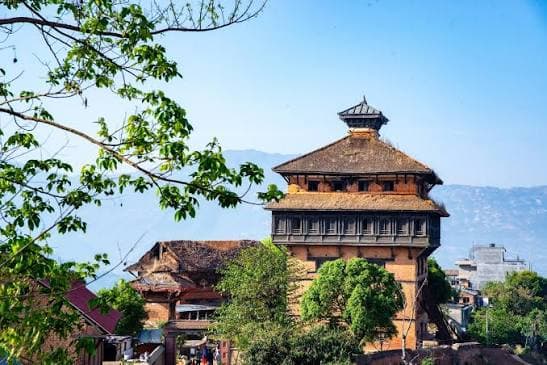
Nuwakot Palace, known as the Saat Talle Durbar or seven-storey palace, was completed in 1762 for Prithvi Narayan Shah of Gorkha. It stands on a ridge in Nuwakot district, Bagmati Province, about 70 kilometres northwest of Kathmandu above the Trishuli river, and it is the building from which the campaign to take the Kathmandu Valley was actually run.
Why Nuwakot mattered before Kathmandu did
Prithvi Narayan Shah took Nuwakot in 1744, in his first significant victory outside Gorkha. The position controlled the trade route running north from the Kathmandu Valley towards Kerung and Tibet, which meant holding it choked the valley kingdoms' most valuable commerce. For the next twenty-four years Nuwakot was the forward base of a long, patient siege economy rather than a single military campaign.
Kathmandu fell in 1768. Prithvi Narayan Shah died at Devighat, at the river confluence below Nuwakot, in 1775. So the whole arc of Nepal's unification, from first conquest to the founder's death, is contained within a few kilometres of this ridge, and almost nobody visits. Our guide to Prithvi Narayan Shah and the unification of Nepal covers the campaign in full, and the Malla three kingdoms explains what he was up against.
The building itself
The palace is a tall brick tower with projecting timber balconies and carved windows, topped with tiered roofs, in the Newar court style of the valley it was built to conquer. Around it stand the Ranga Mahal and the Garad Ghar, the guard house, forming a small walled compound rather than a single monument. The Bhairavi temple sits nearby and is still an active place of worship with its own festival.
The April 2015 earthquake damaged the upper storeys badly. Restoration has been under way since, in stages, using traditional brick and timber methods, and access to the interior has varied with the state of the work. Check locally before travelling if going inside matters to you; the compound and the views are open regardless.
What the ridge gives you
The palace looks down over the Trishuli gorge and out across terraced hills, with the Ganesh Himal visible to the north on clear days. It is an obviously military position: you can see everything approaching from three directions. Standing there does more to explain the geography of Nepal's unification than any museum panel.
The old bazaar below the palace has a short street of traditional houses and a few tea shops. There is very little tourist infrastructure, which means limited food and a small number of basic guesthouses, and most visitors come as a day trip from Kathmandu.
Getting there and what to combine it with
The drive from Kathmandu runs via Kakani and Trishuli Bazaar, taking around three hours depending on road works, on the same route that continues north towards Dhunche and Langtang. That makes Nuwakot a natural first stop on a Langtang trip rather than a separate excursion.
The other obvious pairing is the river. Trishuli rafting happens on the same water downstream, and further down still the Trishuli meets the Kali Gandaki at Devghat, a major pilgrimage confluence and a different place entirely from the Devighat below this ridge where the king died. For what came after unification, see our guides to the Anglo-Nepalese war and the Rana regime.
| Detail | Nuwakot Palace |
|---|---|
| Built | Completed 1762 |
| Built for | Prithvi Narayan Shah of Gorkha |
| District | Nuwakot, Bagmati Province |
| From Kathmandu | About 70 km; roughly 3 hours by road via Trishuli Bazaar |
| Storeys | Seven, hence Saat Talle Durbar |
| Key dates | Nuwakot taken 1744; Kathmandu taken 1768; Prithvi Narayan Shah died at Devighat 1775 |
| Condition | Damaged in the April 2015 earthquake; phased restoration since |
| Best season | October to March, for clear northern views and comfortable heat |
Entry is ticketed at the compound, charged separately for Nepali, SAARC and other visitors as at most heritage sites. Allow two hours on site and a full day for the round trip from Kathmandu. Go in the morning: the light is better on the brick, the northern view is open, and the afternoon drive back into the valley is slower than the outbound one.
Frequently Asked Questions
How long does the trip take from Kathmandu?
About three hours each way by road, so a comfortable day trip if you leave early. Roads through the hills north of the valley are frequently under repair, so add a margin rather than planning tightly around the return.
Can you go inside the palace?
Access has depended on the stage of post-earthquake restoration and has changed several times since 2015. The compound, the Ranga Mahal exterior and the views are reliably open; interior access is worth confirming locally before you set out.
Why is Nuwakot so important historically?
It was Prithvi Narayan Shah's first major conquest in 1744 and the base from which he controlled the trade route north out of the Kathmandu Valley for the following twenty-four years. Without Nuwakot the 1768 capture of Kathmandu does not happen.
Is there anywhere to stay?
A small number of basic guesthouses operate near the bazaar, and there is at least one restored heritage property in the area. Most people visit as a day trip or stay a night on the way north towards Dhunche.
What else is nearby?
Devighat, at the confluence below the town, and the Trishuli river itself. The road continues north to Dhunche for Langtang, which makes Nuwakot an easy first stop rather than a detour if you are heading that way.