
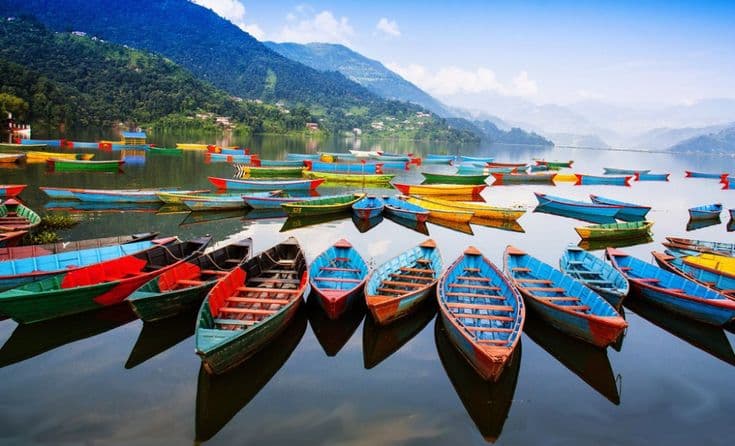
Phewa Lake lies at about 742 m on the western edge of Pokhara, in Kaski district of Gandaki Province, covering roughly 4.4 sq km. It is the largest lake in the Pokhara valley and the reason the city grew where it did: the Annapurna wall and the spike of Machapuchare stand directly north and land in the water on a still morning.
The reflection, and when it actually happens
The photograph everyone comes for needs three things to line up. The sky has to be clear of the haze that sits over the valley for much of the year. The air has to be still, which in practice means before about eight in the morning. And the mountains have to be out at all, which between May and September they frequently are not.
October to early December is the reliable window, with clear post-monsoon air and low humidity. March and April can be excellent early in the morning before the day's haze builds. January and February are clear but often have valley fog that burns off late. If the reflection matters, budget more than one morning; a single night in Pokhara is a coin toss.
Machapuchare at 6,993 m is the peak that dominates the view, closer to the lake than the higher Annapurna summits behind it and therefore looking larger. It has never been climbed to the summit and remains closed to mountaineering. Our guide to Machapuchare covers why, and the Annapurna massif explained sorts out which of the peaks on the skyline is which.
Tal Barahi and the boats
The small island near the eastern shore carries Tal Barahi, a two-tiered temple to a form of the goddess Durga and the most visited shrine in Pokhara. Ferries run continuously from the Lakeside jetties, the crossing takes a few minutes, and Saturdays are busy with local worshippers rather than tourists. It is a working temple, so dress reasonably and expect queues on festival days.
Rowing boats are hired by the hour along the Lakeside promenade, either self-rowed or with a boatman. The rowing boats are worth choosing over the motorised ones: they are quiet enough to drift close to the western shore where kingfishers, egrets and cormorants work the shallows, and the far end of the lake away from the hotels is genuinely peaceful. Rates are posted and negotiable outside peak season.
Two hours on the water is enough for most people: the island, a slow drift along the quiet western arm, and back. Life jackets are provided and should be worn; the lake gets choppy in the afternoon wind.
What the lake is doing hydrologically
Phewa is not entirely natural in its present form. The outlet at Pardi is dammed, which raised and stabilised the level and feeds a small hydropower scheme, and the lake's surface area has been measured differently at different times partly because of that regulation.
It is also shrinking. The Harpan Khola delivers a heavy sediment load into the western end, and the shallow arms have silted steadily over decades; encroachment on the shoreline has taken more. Published surface areas from the mid-twentieth century are noticeably larger than today's. Maximum depth figures vary between sources and are not worth quoting with confidence, but this is a shallow lake by any Himalayan standard, and its shallowness is why it warms, weeds and silts as readily as it does.
In 2016 Phewa was designated part of the Lake Cluster of Pokhara Valley Ramsar site along with Begnas, Rupa and six others, which recognised the whole valley system rather than any single lake. Our guide to Nepal's Ramsar sites explains what that designation obliges and what it does not.
Around the shore
The World Peace Pagoda sits on the ridge above the southern shore and is the standard half-day outing: cross by boat, climb forty-five minutes to an hour through forest, and look back down on the lake with the mountains behind it. It is the best single view of Phewa there is. Walk down the far side to Devi's Fall if you want a loop rather than a return.
Sarangkot, on the ridge north of the lake, is the sunrise viewpoint and the paragliding launch site. Taxis run up before dawn. Paragliding from Sarangkot down to the lakeshore is one of the more reliable adventure activities in Nepal, weather permitting, and lands near the eastern end of the lake.
Lakeside itself is a long strip of hotels, restaurants, bookshops and trekking agencies. It is commercial and makes no pretence otherwise, but it is also where every Annapurna trek begins and ends, which gives it a purpose beyond tourism. If the noise is not what you came for, Begnas is about half an hour east and much quieter.
| Detail | Phewa Lake |
|---|---|
| Elevation | About 742 m |
| Surface area | Roughly 4.4 sq km, and slowly shrinking |
| Rank | Largest of the Pokhara valley lakes; ranked second or third in Nepal depending on the source |
| District | Kaski |
| Province | Gandaki |
| Ramsar designation | 2016, as part of the Lake Cluster of Pokhara Valley |
| Island temple | Tal Barahi, reached by ferry from Lakeside |
| Nearest airport | Pokhara International |
| Road time from Kathmandu | 6 to 8 hours |
| Best months for mountain views | October to December, and March to April |
Getting there and how long to stay
Pokhara is a 25-minute flight from Kathmandu or a six to eight hour drive on the Prithvi Highway, with tourist buses leaving Kathmandu early each morning. The airport is close to the eastern end of the lake and a short taxi ride to Lakeside.
Two nights is the sensible minimum, which gives you two mornings to catch the mountains and a full day for the Peace Pagoda or Sarangkot. Three or four nights makes sense if you are also doing a short trek such as Poon Hill or resting after a longer one. Our guide to Kaski district covers the wider area, the Annapurna Conservation Area guide covers the permits you will need if you walk from here, and the seasons guide covers the trade-offs month by month.
Frequently Asked Questions
When can you see the Annapurna reflection in Phewa Lake?
Between about six and eight in the morning, before the wind picks up, in the clear months of October to December and March to April. Give yourself more than one morning, as haze and cloud regularly close the view.
How big is Phewa Lake?
Around 4.4 sq km, which makes it the largest of the Pokhara valley lakes. Published national rankings put it second or third behind Rara, depending on how Shey Phoksundo is measured. It has lost area over the last several decades to sedimentation from the Harpan Khola and to shoreline encroachment.
How much does a boat cost?
Rowing and motorised boats are hired by the hour from the Lakeside jetties at posted rates, cheaper if you row yourself, and negotiable outside the October to November peak. Life jackets are included and should be worn.
Is Tal Barahi temple worth visiting?
Yes, though it is small and the visit is short. It is a genuinely active shrine rather than a monument, busiest on Saturdays and festival days, and the ferry crossing takes only a few minutes from Lakeside.
How do I get from Kathmandu to Pokhara?
Fly in about twenty-five minutes, or take a tourist bus on the Prithvi Highway, which takes six to eight hours and longer when the road is under repair. Private cars cover the same route in a similar time.
How many nights should I spend in Pokhara?
Two at minimum, giving two chances at a clear mountain morning. Three or four is better if you want the Peace Pagoda, Sarangkot at sunrise, a paragliding flight and a day trip to Begnas without rushing.