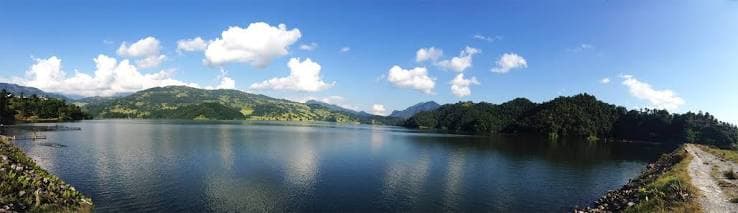
Begnas Lake lies about 15 km east of Lakeside Pokhara in Kaski district, at roughly 650 m. It is the second-largest of the Pokhara valley lakes after Phewa, covering around 3 sq km, edged by fish cages, terraced hillside and a small bazaar. It receives a small fraction of Phewa's visitors and feels like a different valley entirely.
How Begnas differs from Phewa
The obvious difference is volume of people. Phewa has a kilometre of hotels along one shore; Begnas has a bazaar at the outlet, a scatter of guesthouses on the hill above, and after that farmland. On a weekday out of season you can walk the eastern shore for an hour and meet fishermen and nobody else.
The mountain view is different too, and in some ways better. From the water and from the ridge above, the Annapurna range including Machapuchare and Annapurna II is visible across the valley, without the buildings that crowd the Phewa foreground. What Begnas lacks is the immediate drama of Phewa's reflection, because the lake sits lower and further from the range.
What Begnas has instead is working countryside. Rice terraces run down to the water, buffalo graze the margins, and the fish cages are a genuine local industry rather than scenery. If your reaction to Lakeside is that it could be anywhere, this is the antidote. Our notes on travelling Nepal with fewer stops make the case for basing here rather than day-tripping.
Fish, and why the water is managed
Begnas is the centre of cage aquaculture in Nepal, and the rectangular net enclosures visible from the shore are the reason. Government fisheries research at Begnas developed much of the technique now used across the country, and local cooperatives run the cages commercially. The fish appears on menus around the lake, and eating it here is one of the few genuinely local food experiences in the Pokhara valley.
The outlet at the western end is dammed with a sluice, built to regulate the lake for downstream irrigation. That means the level varies more than a natural lake's would, and in the dry season the shallow margins retreat noticeably. It also means the wetland fringe is smaller than it once was.
Begnas was included in the Lake Cluster of Pokhara Valley Ramsar designation in 2016 along with Phewa, Rupa and six other water bodies. The listing covers the valley system as a whole, which is the right unit given how the lakes are hydrologically linked. Our guide to Nepal's Ramsar wetlands explains what the designation means in practice.
Walks, boats and birds
The best half day here is the ridge walk. Panchabhaiya Danda, the wooded spine separating Begnas from Rupa Lake, is reached by a path climbing from the bazaar and gives you both lakes at once, with the Annapurna range behind. Two to three hours return at an easy pace. Sundari Danda, the hill above the northern shore, is the sunrise option.
Rupa Lake, smaller and quieter still, sits on the other side of that ridge and is worth the descent if you have the time. Very few visitors reach it. The Rupa Lake page covers what is there.
Wooden boats are hired at the bazaar by the hour, without the queue or the fixed tariff board of Phewa. Birds are the reward for going quietly: kingfishers, egrets, cormorants, herons and, in winter, duck on the open water. It is not Koshi Tappu, but it is pleasant birding within half an hour of a city. Our birdwatching guide covers what turns up in the middle hills through the year.
Begnas is also a trailhead. Short routes lead north into the hills towards Rupakot and on towards the Annapurna foothills, and the area is used as a gentle first or last day for longer walks. It is good cycling country too, with quiet sealed and gravel roads around the northern shore.
| Detail | Begnas Lake |
|---|---|
| Elevation | About 650 m |
| Surface area | Around 3 sq km, varying with the sluice |
| Rank | Second-largest in the Pokhara valley |
| District | Kaski |
| Province | Gandaki |
| Distance from Lakeside Pokhara | About 15 km, 30 to 45 minutes |
| Ramsar designation | 2016, as part of the Lake Cluster of Pokhara Valley |
| Neighbouring lake | Rupa, over the Panchabhaiya ridge |
| Local industry | Cage fish farming |
| Best season | October to April |
Getting there and where to stay
Local buses run from Prithvi Chowk in Pokhara to Begnas bazaar and take forty minutes to an hour depending on traffic. A taxi does it in about half an hour and costs little split between two or three people. Cycling from Lakeside is realistic on a decent bike, though the highway section is unpleasant.
Accommodation is a handful of guesthouses and small resorts, mostly on the hillside above the northern and eastern shores where the views are. Standards range from very simple to comfortable, and prices are noticeably lower than Lakeside. Book ahead in October and November; there are not many rooms.
October to April is the season, with October to December giving the clearest mountain views. The monsoon is green and quiet and the lake is at its fullest, which is not without appeal if you are not chasing a panorama. For the wider district, see our guide to Kaski and Pokhara; for identifying what is on the skyline, the Annapurna massif explained; and for the busier lake half an hour west, the Phewa Lake page.
Frequently Asked Questions
How far is Begnas Lake from Pokhara?
About 15 km east of Lakeside. A taxi takes around half an hour, a local bus from Prithvi Chowk forty minutes to an hour, and the ride is manageable by bicycle apart from the highway stretch.
Is Begnas better than Phewa?
It depends what you want. Phewa has the iconic reflection, the boats, the restaurants and the convenience. Begnas has quiet, working countryside, cheaper rooms and a ridge walk with two lakes and the Annapurna range in one view.
Can you swim in Begnas Lake?
People do swim, particularly from the quieter eastern shore, and the water is warmer than the high lakes. Stay clear of the fish cages and the sluice at the outlet, and be aware there are no lifeguards anywhere on the lake.
What is there to do at Begnas?
Hire a boat, walk the Panchabhaiya ridge to the viewpoint over Rupa Lake, cycle the quiet roads around the northern shore, watch birds along the margins, and eat the local farmed fish at the bazaar.
Where do you stay at Begnas?
In guesthouses and small resorts on the hillside above the northern and eastern shores, which have the views. There are few rooms in total, so book ahead in the October to November peak.
When is the best time to visit?
October to April, with October to December giving the clearest air and the best mountain views. The monsoon is green and almost empty of visitors, but the range is usually hidden.