Poon Hill is a 3,210-metre viewpoint above the village of Ghorepani in the Annapurna foothills, reached on a three to four day loop from Pokhara. It is the shortest trek in Nepal that puts two 8,000-metre mountains in front of you at sunrise, which is why it carries more first-time trekkers than any other route in the country.
What you actually see from the top
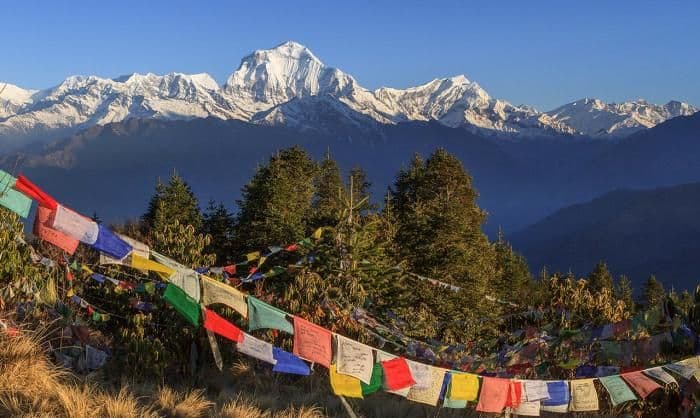
The panorama runs west to east across the Dhaulagiri and Annapurna ranges. Dhaulagiri I at 8,167 metres anchors the western end. Annapurna I at 8,091 metres, the first 8,000-metre peak ever climbed, sits behind the nearer wall. Machapuchare at 6,993 metres is the sharp fishtail in the middle, closer and therefore more dramatic than the giants behind it. Annapurna South, Hiunchuli, Nilgiri and Tukuche fill the gaps.
Sunrise is the point. The peaks turn from grey to pink to gold over about twenty minutes and then the light goes flat. You leave Ghorepani in the dark, climb for forty-five minutes to an hour, stand on a crowded platform in the cold with a few hundred other people, and it is still worth it. Our guides to the Annapurna massif and Dhaulagiri explain what you are looking at.
The route, day by day
The classic loop starts at Nayapul or Birethanti, follows the Modi Khola valley to Tikhedhunga, then climbs the stone staircase to Ulleri. That staircase is the crux of the whole trek: an unbroken flight of stone steps, quoted at anything from two to four thousand depending on who is counting, taken in the middle of the afternoon by most people who then remember it for years.
Day two continues through rhododendron forest to Ghorepani at roughly 2,860 metres. Day three is the pre-dawn climb to Poon Hill, then either a return to Nayapul or, better, a traverse east to Tadapani and down to Ghandruk. The Ghandruk finish adds a day, avoids retracing the staircase, and gives you a proper Gurung village at the end rather than a bus park.
Rhododendrons and the two seasons
The forest between Ulleri and Ghorepani is one of the best rhododendron stands in Nepal, and in late March and April it is entirely red and pink. That is the trade: spring gives you flowers and hazier mountains, autumn gives you sharp mountains and no flowers. October and November are the most reliable for views. December and January are clear, quiet and genuinely cold at Ghorepani. Monsoon months are wet, leeched and mostly cloud.
Permits, guides and how it is charged
Two documents are needed: the Annapurna Conservation Area permit and the trekker registration card, both issued in Pokhara or Kathmandu, both charged per person, with separate rates for Nepali, SAARC and other nationalities. Bring your passport and spare photographs. Nothing on this route requires a restricted-area permit, unlike the restricted districts of the far west.
In 2023 Nepal's tourism board announced that solo foreign trekkers should engage a licensed guide on routes like this one. Enforcement has been inconsistent and the rule has been reported differently at different checkposts, so confirm the current position at the permit office when you register rather than relying on a blog post. Our Annapurna Conservation Area guide covers the permit system in full.
| Detail | Poon Hill trek |
|---|---|
| High point | Poon Hill, 3,210 m |
| Overnight high point | Ghorepani, about 2,860 m |
| Trailhead | Nayapul or Birethanti, about 1,070 m |
| District | Kaski and Myagdi, Gandaki Province |
| Duration | 3 days as an out and back; 4 to 5 via Tadapani and Ghandruk |
| Road head from Pokhara | 1.5 to 2 hours by jeep or bus |
| Permits | Annapurna Conservation Area permit and trekker registration card |
| Best season | March to April for rhododendrons; October to November for clear peaks |
Accommodation is in teahouses the whole way, with no camping needed and no food to carry. Rooms are simple, hot showers are charged separately, and Ghorepani in high season fills by mid-afternoon, which is the real argument for starting each day early. Altitude is modest but 3,210 metres is high enough that a few people feel it; our acclimatisation guide is worth ten minutes before you go. For how this route compares with the alternatives, see Nepal's trekking regions compared.
Frequently Asked Questions
How fit do I need to be?
Fit enough to walk uphill for five hours on consecutive days. There is no technical ground and no altitude risk of consequence, but the Ulleri staircase is a genuine effort and the descent is hard on knees. Trekking poles help more than fitness does on the way down.
Can Poon Hill be done in three days?
Yes, out and back from Nayapul. Four or five days via Tadapani and Ghandruk is the better trip for almost everyone, because it avoids repeating the climb and finishes in a village worth an afternoon.
Do I need a guide?
The trail is obvious and teahouses are frequent, so navigation is not the issue. A 2023 rule directs solo foreign trekkers towards licensed guides on routes like this, and enforcement varies, so ask at the permit office when you register.
When do the rhododendrons flower?
Late March into April at Ghorepani's elevation, earlier lower down the valley. The exact fortnight moves each year with the winter, so treat any published date as approximate.
Is the sunrise crowded?
In October and November, very. Hundreds of people share the viewpoint on a clear morning. Arriving forty minutes before first light, rather than at first light, gets you a place at the rail.
What is the highest point I sleep at?
Ghorepani, at roughly 2,860 metres. Poon Hill itself is a morning climb from there, so you are only briefly at 3,210 metres.