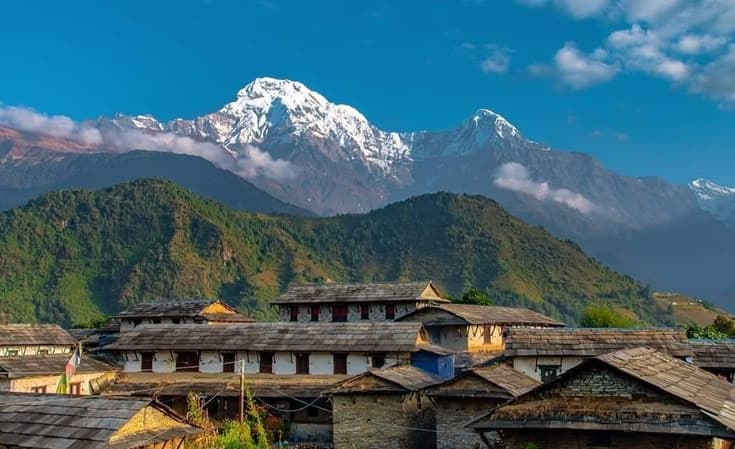
Ghandruk is a Gurung village at about 1,940 metres on a hillside in Kaski district, inside the Annapurna Conservation Area. Slate-roofed stone houses climb the slope in terraces, Annapurna South and Machapuchare fill the skyline to the north, and a jeep road now reaches within an hour's walk of the square.
A village, not a trekking stop
Most Annapurna villages exist because trekkers pass through them. Ghandruk existed first. It is one of the largest Gurung settlements in Nepal, with a farming and herding economy that predates tourism by centuries, and the layout shows it: houses face the sun and the fields rather than the trail, and the old core is a dense cluster of stone and slate rather than a line of lodges along a path.
Walk uphill through the lanes for twenty minutes and the tourist frontage falls away. Buffalo sheds, drying maize, water taps where people are actually collecting water. The village is stepped so steeply that the roof of one house is the yard of the one above it, which is the detail every photograph of Ghandruk is really about. The upper lanes are also where the stonework is oldest, laid dry without mortar and re-set by hand after each monsoon, and where you are most likely to be handed a glass of tea by somebody who has no interest in selling you anything.
The Gurung and the Gurkha connection
These hills are one of the principal recruiting grounds for the Gurkha regiments, and the connection is not historical trivia here. Pensions from British and Indian service built a significant share of the newer houses, and almost every family has someone who served or is serving. The small village museum documents the tradition, with uniforms, kit and photographs, and it is worth the half hour.
Our guide to Gurkha military history traces how a recruiting practice that began after the Anglo-Nepalese war became a two-century institution, and the war and the Treaty of Sugauli covers the conflict that started it.
Views, and when they are there
The northern skyline holds Annapurna South and Hiunchuli close in, with Machapuchare to the east. The proximity is what makes Ghandruk unusual: these are not distant peaks on a horizon, they are directly above the village, and the scale is difficult to register from a photograph. Mornings are clear far more often than afternoons in every season.
October to December is the most reliable window. Spring brings rhododendron on the ridges above the village and hazier air. The monsoon closes the views for weeks at a time but turns the terraces an intense green, and the village is at its most photogenic and least visited then. See the Machapuchare guide for the peak that dominates the eastern view.
Getting there, and where it leads
A jeep from Pokhara reaches Kimche in about two and a half to three hours on a road that is rough in places and closed after heavy rain. From Kimche it is a climb of forty-five minutes to an hour on stone steps to the village. Walking the whole way from Nayapul takes about four to six hours and is the more satisfying arrival.
Ghandruk is also a junction. North leads to Annapurna Base Camp via Chhomrong. West over the ridge to Tadapani and Ghorepani makes the better version of the Poon Hill loop. Many people come for one night from Pokhara and stay two.
| Detail | Ghandruk |
|---|---|
| Elevation | About 1,940 m |
| District | Kaski, Gandaki Province |
| Protected area | Annapurna Conservation Area |
| From Pokhara | 2.5 to 3 hours by jeep to Kimche, then a 45 to 60 minute climb |
| From Nayapul on foot | 4 to 6 hours |
| Permits | Annapurna Conservation Area permit and trekker registration card |
| Peaks in view | Annapurna South, Hiunchuli, Machapuchare at 6,993 m |
| Best season | October to December for views; March to April for rhododendron |
Accommodation is in community-run and family guesthouses, with a range from basic trekker rooms to a few restored stone houses with heated dining rooms. Both permits are required even for a one-night visit, because the village sits inside the conservation area boundary; details are in our Annapurna Conservation Area guide. Staying two nights rather than one is the single change that turns Ghandruk from a photo stop into a place you have been, which is the argument our slow travel guide makes at length.
Frequently Asked Questions
Can I reach Ghandruk without trekking?
Almost. A jeep gets to Kimche, leaving a climb of forty-five minutes to an hour on stone steps. There is no road into the village core itself, which is part of why it has kept its shape.
Do I need trekking permits for one night?
Yes. Ghandruk is inside the Annapurna Conservation Area, so the conservation area permit and the trekker registration card are both required regardless of how long you stay or how you arrive.
Is Ghandruk better than Ghorepani?
They do different jobs. Ghorepani is a trekking settlement with a sunrise viewpoint above it; Ghandruk is a real village with the mountains directly overhead. The loop that takes in both is the answer most people arrive at.
What is there to do for a second day?
Walk up towards Tadapani for the morning view, visit the museum, or take the path to the neighbouring hamlets across the valley. The village itself takes an unhurried hour or two on foot, more if anyone invites you in.
How cold does it get?
At 1,940 metres, cold enough for a jacket at dawn from November to February and comfortable in the middle of the day year round. Guesthouses are unheated apart from the dining room stove.