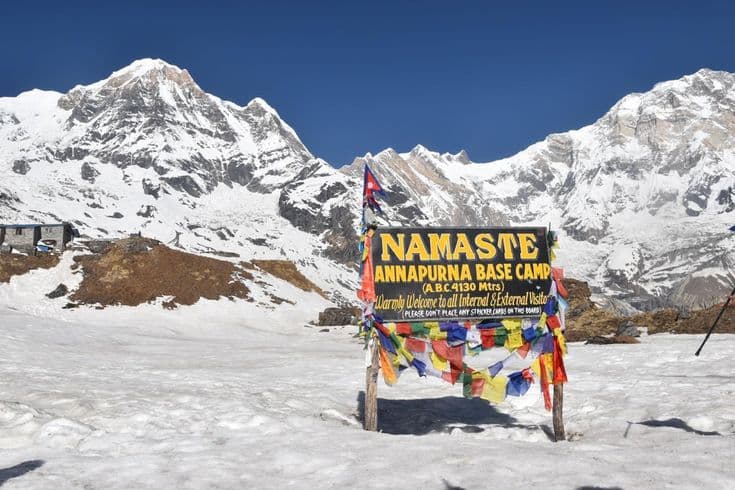
Annapurna Base Camp is a glacial basin at 4,130 m enclosed by a near-complete ring of peaks, reached on a seven to twelve day walk from Pokhara in Kaski district, Gandaki Province. The route climbs through Gurung villages and rhododendron forest before entering a narrow gorge that opens without warning into the sanctuary.
| Detail | Figure |
|---|---|
| Base camp elevation | 4,130 m |
| Machapuchare Base Camp | about 3,700 m |
| Nearest city | Pokhara, 822 m |
| District and province | Kaski, Gandaki |
| Protected area | Annapurna Conservation Area |
| Walking days | 7 to 12 depending on road head used |
| Common add-on | Poon Hill, 3,210 m |
| Best months | March to May, October to November |
Why this one suits first-time trekkers
The sanctuary is the shortest route in Nepal to a position that feels genuinely high. There is no pass to cross, the highest night is 4,130 m rather than 5,000 m, and you are never more than a day and a half from a road. The teahouses are the best-run in the country because the trail has carried walkers continuously for decades, and the food improves the further from base camp you are.
What it asks for instead is stairs. The Nepali hill path is a staircase of stone slabs, and the section from Chhomrong down to the Chhomrong Khola and back up the far side is a long stone staircase in each direction, done twice because you return the same way. Knees suffer more than lungs on this trek.
Getting to the trailhead
Pokhara is a 25 minute flight or a six to eight hour drive from Kathmandu. From Pokhara the trail can be joined at several points, and which one you choose sets the length of the trek. Nayapul is the traditional start and adds a hot low day. Kande gives the ridge route via Australian Camp and Ghandruk. A jeep can now reach Kimche, Ghandruk itself and, in dry conditions, Siwai, which puts you a day from Chhomrong and turns the sanctuary into a week.
You need the Annapurna Conservation Area permit and a TIMS card, both bought in Pokhara, both per person, both checked at Chhomrong. Neither requires advance application. Pokhara is also where to hire poles, a down jacket and a sleeping bag rather than flying them in from home. Our Kaski district guide covers the city end of the trip.
The route in and the gorge
The usual line runs Ghandruk to Chhomrong at about 2,170 m, then Bamboo, Dovan, Himalaya, Deurali, Machapuchare Base Camp at roughly 3,700 m and finally Annapurna Base Camp. From Chhomrong onwards you are in the Modi Khola gorge, a steep-sided trench of bamboo and then bare rock where the walls close in and you see very little sky. That is the point. The gorge is the door to the sanctuary, and the moment it opens above Machapuchare Base Camp is the reason people come.
Inside, the amphitheatre runs from Hiunchuli round through Annapurna South, Annapurna I at 8,091 m, Gangapurna and back to Machapuchare. The sun reaches the basin late and leaves it early. Nights are cold, the lodges are simple and there is no permanent settlement, only seasonal lodges. Sunrise on Annapurna I from the moraine behind the lodges is the standard photograph and it deserves the reputation.
Machapuchare, the fish-tail peak that dominates the approach, has never been summited and is closed to climbing. Our guide to Machapuchare explains why, and the wider unclimbed sacred peaks of Nepal puts it alongside the others.
Avalanche risk between Hinku and Deurali
This is the one real hazard on an otherwise gentle trek, and it is worth being blunt about. The gorge between Hinku Cave and Deurali is an avalanche path. After heavy snow, and in the spring melt, slides come down that section and have killed trekkers. Lodge owners at Chhomrong and Bamboo know the current conditions and will tell you to wait. Cross early in the morning when the snow is still frozen, never in the afternoon, and never in a whiteout. In a bad snow year the sanctuary is genuinely closed, whatever an itinerary says.
Poon Hill, hot springs and how to lengthen the trip
Two additions are worth the days. Ghorepani and Poon Hill at 3,210 m, usually done as a loop on the way in, give a wide dawn panorama across both the Annapurna and Dhaulagiri ranges from a viewpoint that takes 45 minutes to climb. It is the single best value morning in Nepali trekking, which is why it is crowded. If the Dhaulagiri side interests you more than the Annapurna side, read our Dhaulagiri guide before deciding.
The other is Jhinu Danda, an hour or so below Chhomrong, with the hot springs a further twenty minutes down on the bank of the Modi Khola. Almost everyone stops there on the way out, and after eight days of cold bucket washes it is not a hard sell.
When to go
October and November are dry, clear and busy, and lodges above Chhomrong fill by early afternoon. March to May brings the rhododendron forest between Ghandruk and Ghorepani into flower, warmer nights and more haze. December to February is cold but often perfectly clear, with snow in the sanctuary and a real avalanche risk on the approach. June to September is wet, leech-heavy below 2,500 m, and the mountains are usually hidden.
If you are weighing this against a longer objective, the Annapurna Circuit shares the same conservation area and permits, and our comparison of Nepal trekking regions sets both against Everest and Langtang on time, altitude and cost.
Frequently Asked Questions
How difficult is the Annapurna Base Camp trek?
Moderate. The highest night is 4,130 m and there is no pass, no scrambling and no exposure. The difficulty is sustained stone stairs for five to seven hours a day, particularly the descent and re-ascent at Chhomrong.
How many days does Annapurna Base Camp take?
Seven days is realistic using the jeep road to Siwai or Ghandruk. Ten to twelve days covers the fuller loop through Ghorepani and Poon Hill with a spare day for weather.
Do you get altitude sickness at Annapurna Base Camp?
It is possible but far less common than on higher routes, because 4,130 m is modest and the ascent from Chhomrong is spread over three days. The risk rises sharply if you rush from Bamboo to base camp in two days.
Is Annapurna Base Camp safe in winter?
It is walked through the winter, but the gorge above Hinku Cave is an avalanche path and heavy snowfall closes it. Take the advice of lodge owners at Chhomrong on the day rather than a fixed itinerary.
Can you see Annapurna I from base camp?
Yes. Annapurna I at 8,091 m closes the head of the sanctuary and is visible from the lodges, with the best light at sunrise. Machapuchare, Hiunchuli, Annapurna South and Gangapurna complete the ring.