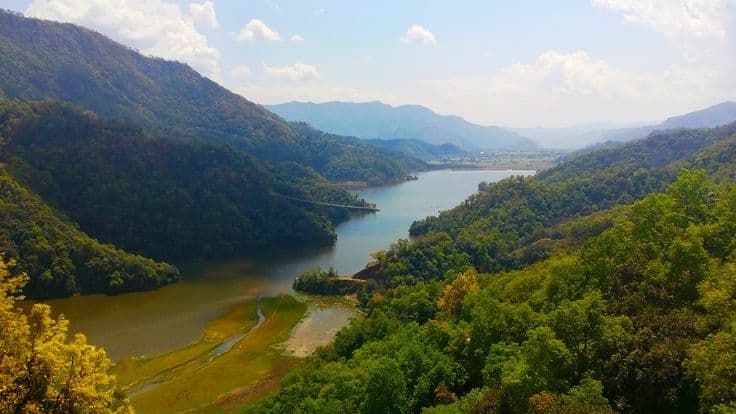
Rupa Lake lies about fifteen kilometres east of Pokhara in Kaski district, at roughly 600 metres, tucked behind the ridge that separates it from Begnas. It is the quietest of the Pokhara valley lakes, ringed by paddy terraces and reed beds rather than hotels, and it is reached from Lakeside by bicycle in under two hours.
Why nobody is here
Phewa has the boats and the bars. Begnas has a road, a bus and a row of fish restaurants. Rupa has a footpath, a few wooden canoes and farmers. The lake sits low between two ridges with no through road along its shore, so there is no reason to arrive unless you meant to. That is the whole appeal.
The water is shallow and warm, fringed with reeds that make it look smaller than it is. Buffalo come down to drink at the north end in the afternoon. The soundtrack is birds and the occasional motorbike on the ridge road above. If you have spent three days in Lakeside cafes, half a day here recalibrates what the Pokhara valley is actually like.
The Ramsar listing and what it protects
Rupa is one of nine bodies of water designated together in 2016 as the Lake Cluster of Pokhara Valley Ramsar site, alongside Phewa, Begnas and six smaller lakes. The listing recognises the group as a wetland system rather than a set of scenic ponds: they share the same catchment, the same seasonal bird traffic and the same threats from silt, fertiliser run-off and shoreline building.
Rupa is the one where the local response is most visible. The fishery co-operative that manages the lake operates an arrangement that returns part of the fishing income to upstream villages, on the reasoning that what happens on the hillside decides what arrives in the water. Our overview of Nepal's Ramsar wetland sites sets the Pokhara cluster against the country's other listed wetlands.
Birds, and when they are here
The reed beds are the reason birders make the trip. Wintering waterfowl arrive from November and stay to February, and the shallow margins hold egrets, herons, cormorants and several kingfisher species year round. Early morning is the only time worth setting out for, both because the birds are active and because the light on the water disappears once the valley heats up.
Bring binoculars and do not expect hides or boardwalks. This is a working farmed shoreline, not a reserve, and the birds are watched from the path. Our complete guide to birdwatching in Nepal covers the seasonal pattern nationally, and Ghodaghodi Lake in the far west is the lowland equivalent if you want a bigger wetland list.
The cycle route from Lakeside
The standard ride goes east out of Lakeside on the highway, turns off towards Begnas, climbs the Sundari Danda ridge that divides the two lakes, and drops to Rupa on the far side. It is around fifteen to twenty kilometres each way depending on the turn you take, with one real climb and a lot of village road. Any hire bike will do it; a mountain bike makes the ridge section more pleasant.
Riding both lakes in one loop is the best half day of outdoor activity in Pokhara that does not involve paying for anything. If you would rather not cycle, a taxi to Begnas and a walk over the ridge works, and the walk is the good part anyway. See Begnas Lake for the other half of the pair and Phewa Lake for the one everybody already knows. Our Kaski district guide takes the pair together in more depth.
| Detail | Rupa Lake |
|---|---|
| District | Kaski |
| Province | Gandaki |
| Elevation | About 600 m |
| Size | The smallest of the three main Pokhara valley lakes |
| Protection | Part of the Lake Cluster of Pokhara Valley Ramsar site, listed 2016 |
| Best season | November to February for wintering birds |
| From Lakeside | 15 to 20 km, roughly 1.5 to 2 hours by bicycle |
| Facilities | Minimal; a few tea shops, no lakeside hotel strip |
There is no entrance charge, no ticket office and no boat operator waiting. Take water and something to eat, because the tea shops keep unpredictable hours outside the main season. Our guide to Kaski district puts the lake in the context of the wider valley, and slow travel in Nepal makes the case for spending a full day here rather than ticking it in an hour.
Frequently Asked Questions
How do I get to Rupa Lake from Pokhara?
Cycle or drive east towards Begnas, then cross the Sundari Danda ridge to the Rupa side. By bicycle allow ninety minutes to two hours from Lakeside; by taxi it is about forty minutes to the Begnas end, followed by a walk over the ridge.
Can you swim or take a boat out?
Local wooden canoes work the lake and can sometimes be hired informally, but there is no organised boat rental of the kind Phewa has. Swimming happens, though the shallow reedy margins mean most visitors are content to walk the shoreline.
When are the migratory birds there?
From roughly November to February. Numbers peak in the coldest weeks, and early morning gives the best activity. Outside that window you still get resident kingfishers, egrets and cormorants.
Is Rupa worth visiting if I have already seen Phewa and Begnas?
Yes, if what you liked about them was the water rather than the restaurants. Rupa has almost no tourist infrastructure, which is exactly the difference. If you only have one free afternoon in Pokhara, Phewa is easier.
Is there an entrance fee?
No ticket is collected at the lake. Costs are limited to transport and whatever you buy at a tea shop.