Everest Base Camp sits at 5,364 m on the moraine below the Khumbu Icefall, in Solukhumbu district of Koshi Province. Most people walk in from the Lukla airstrip over nine or ten days, including two acclimatisation nights, and come back down in three or four, sleeping in Sherpa lodges the whole way. Nothing about the route requires rope, crampons or climbing experience.
| Detail | Figure |
|---|---|
| Base camp elevation | 5,364 m |
| Highest night on the trail | Gorak Shep, 5,164 m |
| Kala Patthar viewpoint | 5,545 m |
| Trailhead | Lukla, 2,860 m |
| District and province | Solukhumbu, Koshi |
| Protected area | Sagarmatha National Park |
| Round trip from Lukla | 12 to 14 days |
| Best months | March to May, October to November |
Getting to Lukla is the unreliable part
The flight from Kathmandu to Lukla takes about 35 minutes and is the shortest part of the journey on paper. In practice it is the part that goes wrong. During the two busy seasons the flights are moved out of Kathmandu altogether and operate from Manthali in Ramechhap, which means a four to five hour drive leaving Kathmandu around two in the morning. Aircraft fly in the early morning only, because cloud and the afternoon valley wind close the strip by late morning.
A cancelled day or two is ordinary rather than unlucky. Build two spare days into the end of the trip, not the start, because the queue to fly out of Lukla is where people miss international connections. If you want to avoid the flight entirely, drive to Salleri or Phaplu and walk in from there, adding roughly three days at each end and a gentler start to the altitude profile.
Entry is controlled by two permits bought on the way in rather than in advance: the Sagarmatha National Park ticket at Monjo, and the local rural municipality permit issued at Lukla. Both are charged per person and paid in Nepali rupees at the checkpoint, so carry cash from Kathmandu. There are ATMs at Namche Bazaar, but they run dry in season and charge heavily.
The walk, stage by stage
The standard northbound profile is Lukla to Phakding at 2,610 m, then a long climb to Namche Bazaar at 3,440 m, where almost everyone spends a second night. From Namche the trail contours above the Dudh Koshi to Tengboche at about 3,860 m, where the monastery holds an evening prayer that visitors may sit in on. Dingboche at 4,410 m is the second acclimatisation stop, followed by Lobuche at around 4,940 m and Gorak Shep at 5,164 m.
Base camp is a day trip from Gorak Shep: three hours out over the lateral moraine, two back, with almost no altitude gained. Most groups then climb Kala Patthar at dawn the next morning before starting down. The descent is fast because it is the same trail: Gorak Shep to Pheriche in one day, Namche the next, Lukla the day after that.
If you want the peaks in the order you will meet them, read our guide to Lhotse, Nuptse and Ama Dablam, which are the mountains you actually spend the fortnight looking at.
What you actually see at base camp
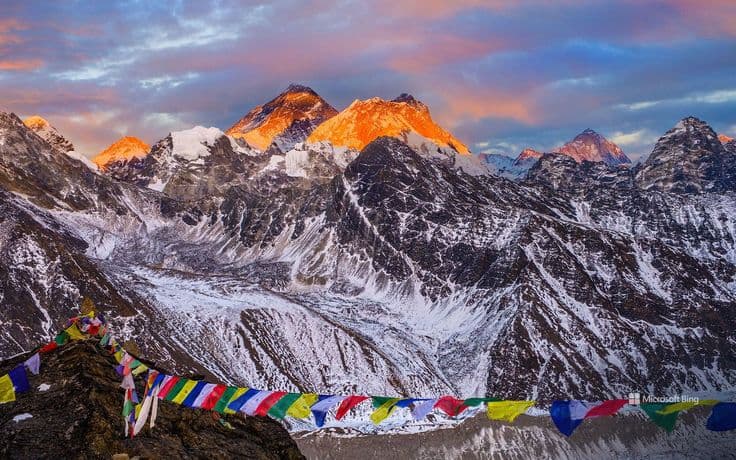
This is where expectations and reality part company. Base camp is a rubble field on glacier ice at the foot of the Khumbu Icefall, and the summit of Everest is not visible from it. The wall above you is Nuptse; Pumori and Khumbutse close the head of the valley. In April and May the site is a small town of expedition tents with generators, kitchen shelters and prayer flags, and in October it is empty gravel with a boulder and some flags on it. Both are worth the walk, but they are not the same visit.
The view of the summit pyramid comes from Kala Patthar, a rounded hill above Gorak Shep, best at first light before cloud builds. That hour, more than the base camp itself, is what most people photograph. The history of climbing on the mountain makes better sense once you have stood there and seen how little of Everest is visible from below.
Altitude, not fitness, is what ends trips
Roughly half of walkers feel some acute mountain sickness above 4,000 m, and the people who turn back are rarely the least fit. They are the ones who moved up too fast. Above 3,000 m the working rule is to raise your sleeping altitude by no more than 300 to 500 m a day and to take a rest night for every 1,000 m gained, which is exactly why the itinerary stalls at Namche and Dingboche.
Headache, poor appetite and broken sleep are normal. Breathlessness at rest, a wet cough, confusion or a loss of balance are not, and the only reliable treatment is to go down. Rescue helicopters do fly to Gorak Shep in good weather, but your travel insurance has to name helicopter evacuation and cover trekking at the altitudes on this route, or you will be asked to guarantee payment before the aircraft lifts. Our guide to acclimatisation in Nepal covers the symptom thresholds in more detail.
Lodges, food and what it costs in comfort
Every night is spent in a teahouse. Rooms are unheated plywood boxes with two beds and a shared bathroom; the only warm room is the dining room, where a stove burns yak dung after dark. Room rates are low and often waived if you eat in, because the kitchen is where lodges make their money. Charging a phone, using wifi and taking a hot shower are all charged separately and get steadily more expensive as you climb, because every litre of kerosene and every gas cylinder above Namche arrived on a porter or a zopkyo.
Menus are near enough identical the length of the valley. Dal bhat is the only meal that comes with refills, which is why guides eat it twice a day. Above Dingboche it is worth going vegetarian: meat is carried up unrefrigerated from the lower valley.
Which season to choose
October and November give the clearest air and the busiest trail, with cold, dry nights and settled mornings. March to May is warmer, hazier by afternoon, and coincides with the climbing season, so base camp is occupied and the icefall has a route through it. December to February is quiet and startlingly clear, but nights at Gorak Shep fall well below minus fifteen and a number of high lodges close. The monsoon from June to September brings cloud, leeches lower down and grounded aircraft.
Everest is one of eight peaks in Nepal above 8,000 m; if you are choosing between regions rather than seasons, compare it against the other eight-thousanders and consider Annapurna Base Camp, which reaches a spectacular position for two thirds of the altitude and half the time. The wider park itself, including the wildlife you rarely notice while walking, is covered in our Sagarmatha National Park guide.
Frequently Asked Questions
How many days do you need for Everest Base Camp?
Twelve to fourteen days of walking from Lukla and back, plus a day either side in Kathmandu and at least two spare days for weather. Anything advertised as much shorter has cut an acclimatisation night, which is where the risk lives.
Can you see Everest from Everest Base Camp?
No. The summit is hidden behind the west shoulder and Nuptse. The clear view of the summit pyramid is from Kala Patthar at 5,545 m, usually climbed at dawn on the morning after reaching base camp.
Do you need a guide to trek to Everest Base Camp?
Nepal now requires trekkers to walk with a licensed guide or porter-guide on its main trekking routes, and lodges and checkposts increasingly expect it. Beyond the rule, a guide is the person who notices you are deteriorating at 4,900 m before you do.
How fit do you have to be?
Fit enough to walk five to seven hours a day on rough ground for a fortnight, carrying a day pack. There is no scrambling and no exposure. Endurance and a tolerance for cold matter far more than speed or strength.
Is Everest Base Camp too crowded?
The trail below Namche is busy in October and April, and the lodges fill by mid-afternoon. If crowds are the deciding factor, the Manaslu Circuit reaches a comparable altitude on a restricted-permit trail that sees a fraction of the traffic.