
Shuklaphanta National Park covers 305 square kilometres in Kanchanpur district in the far west of Nepal, and it holds the largest single herd of swamp deer recorded anywhere in the world, counted repeatedly at more than two thousand animals on one grassland. The park takes its name from Shukla Phanta, an open grassland of roughly 54 square kilometres that is the largest continuous stretch of its kind in the country. It was gazetted as a wildlife reserve in 1976 and upgraded to national park status in 2017.
Where is Shuklaphanta National Park?
The park occupies the far southwestern corner of Nepal in Kanchanpur district, Sudurpashchim Province. The Mahakali river runs along its western side and forms the international boundary with India. To the south the park meets the Indian border directly, placing it in the same forest and grassland complex as Kishanpur Wildlife Sanctuary and the wider Dudhwa landscape in Uttar Pradesh. The Siwalik hills rise to the north.
A buffer zone of about 243 square kilometres surrounds the 305 square kilometre core. The terrain is almost entirely lowland. Stand in the middle of the main phanta and the horizon is grass and scattered trees rather than hills, which is unusual in Nepal and gives the place a character closer to an African floodplain than a Himalayan foothill park.
The area has been protected in one form or another since 1969, when it was set aside as a royal hunting reserve. Formal wildlife reserve status followed in 1976 and national park status in 2017. That long run of protection, in a corner of the Indo-Gangetic plain where nearly every comparable grassland was converted to rice, is the reason the wildlife here survived at all.
Why does Shuklaphanta hold the largest swamp deer herd on earth?
Swamp deer, called barasingha in Hindi, are grassland obligates. They need large, wet, seasonally flooded grassland with standing water nearby and they do not adapt to fragmented habitat. Across the northern Indian plain that habitat was drained and ploughed over the last century and the species collapsed into a few isolated pockets. Shuklaphanta kept a big, unbroken block of exactly the right grassland, and the deer kept using it.
The aggregation is genuinely extraordinary to witness. Counts on the main phanta have repeatedly exceeded two thousand animals, and the herd behaves as a single mass, moving as a front across open grass. Numbers vary between years and between survey methods, and the animals move between phantas and across the border into India, so a single count is a snapshot rather than a fixed population figure. What is not in doubt is that this is the largest known congregation of the species.
The rut is the peak. Through the cold months, roughly December into January, stags gather, spar and bellow, and the herd concentrates rather than disperses. If you are travelling specifically for the swamp deer, that is when to come, accepting thick ground fog until mid-morning as the price of admission.
What is a phanta and why does it need managing?
A phanta is an open grassland in the Nepali Terai, and it is not a permanent natural state. Left alone, grassland in this climate turns to scrub and then to woodland within a few decades. Every phanta that still exists is being held in place by disturbance of some kind, whether flood, fire, grazing or human cutting.
Park management therefore includes deliberate grassland maintenance. Each winter, buffer-zone communities are allowed into designated areas for a limited period to cut thatch grass, which they use for roofing, matting and rope, and controlled burning follows on some blocks. The result serves everyone. Villagers get a resource they would otherwise have to buy, the grassland is prevented from closing over, and by February the sightlines across the phanta open up dramatically for both the deer and the people watching them.
It is worth understanding this before you arrive, because a burnt-looking phanta in February is not neglect. It is the management cycle working, and the flush of new green that follows is precisely what pulls the deer and the hog deer into the open.
What other wildlife lives in Shuklaphanta?
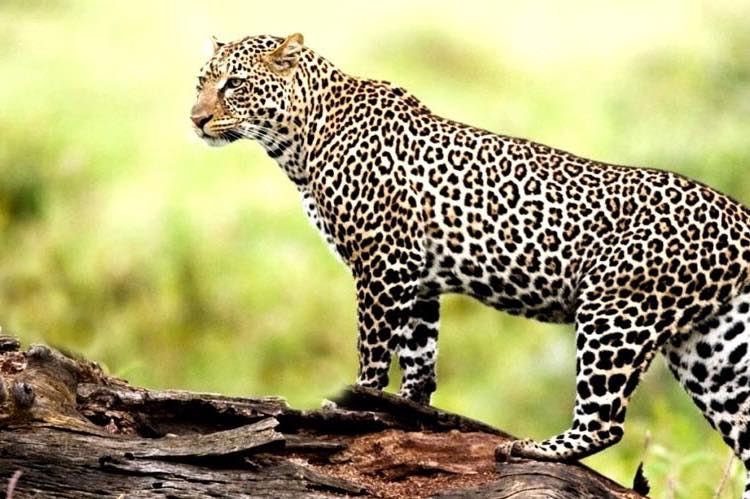
Tigers, for a start. The 2022 national survey counted 36 in Shuklaphanta, more than double the 16 recorded in 2018, and the open grassland gives better viewing odds than any hill forest park. Leopard, jungle cat and fishing cat are also present, and wild elephants move through from the Indian side, including bulls of exceptional size that have become locally famous.
The grasslands hold species that survive almost nowhere else in Nepal. The hispid hare, a secretive grassland specialist, is recorded here. So is the Bengal florican, a critically endangered bustard whose displaying males are one of the great sights of the Terai spring. Swamp francolin, the marsh mugger crocodile at Rani Tal, hog deer, spotted deer, sambar, nilgai and wild boar round out an unusually rich list for a small park.
Rani Tal, a shallow lake in the western part of the park with a viewing tower above it, is the classic spot for a first morning. Bring a scope if you have one. Distances on the phanta are long, and half of what is out there will be identifiable only through good glass.
When is the best time to visit Shuklaphanta National Park?
The season runs October to May, and each part of it offers something different.
| Period | Conditions | What it is best for |
|---|---|---|
| October to November | Clear warm days after the monsoon, grass still tall | Fresh green phanta, arriving raptors, comfortable driving |
| December to January | Cold mornings, heavy ground fog until mid-morning | The swamp deer rut and the largest single aggregations |
| February to March | Grass cut and burned, visibility at its annual best | Open sightlines, tigers, the start of Bengal florican display |
| April to May | Hot, reaching the low forties Celsius, water scarce | Animals tied to water, the best predator viewing |
| June to September | Monsoon, flooding, tracks closed or unreliable | Not a practical time to visit |
If you can only make one trip, February is the strongest single month. The grass is down, the deer are still herded, the florican are beginning to display and the heat has not yet arrived.
How do you get to Shuklaphanta National Park?
Dhangadhi is the practical air gateway, with daily flights from Kathmandu taking about an hour. From Dhangadhi the drive west along the East-West Highway to Bhimdatta, still widely called Mahendranagar, takes roughly two hours, and the park headquarters at Majhgaun is close by. Overland from Kathmandu the journey runs to fifteen hours or more and is only worth it if you are working your way west by road anyway.
Entry permits are issued at the park office and a licensed guide is required. Jeep safaris are the standard way to cover the phanta, since the distances are too great to walk and the grass too high to see over on foot. Machans and viewing towers at Rani Tal and on the main phanta are where most of the serious watching is done.
How does Shuklaphanta compare with Bardiya?
Bardiya is bigger, wilder in feel and better for tigers by raw numbers. Shuklaphanta is smaller, flatter and unmatched for grassland species, and it is the only place in Nepal where you will see a swamp deer herd on that scale. They are three to four hours apart by road, so the honest answer is to do both rather than choose, and a far-western itinerary that takes in Bardiya National Park alongside Shuklaphanta covers most of what the Terai has to offer.
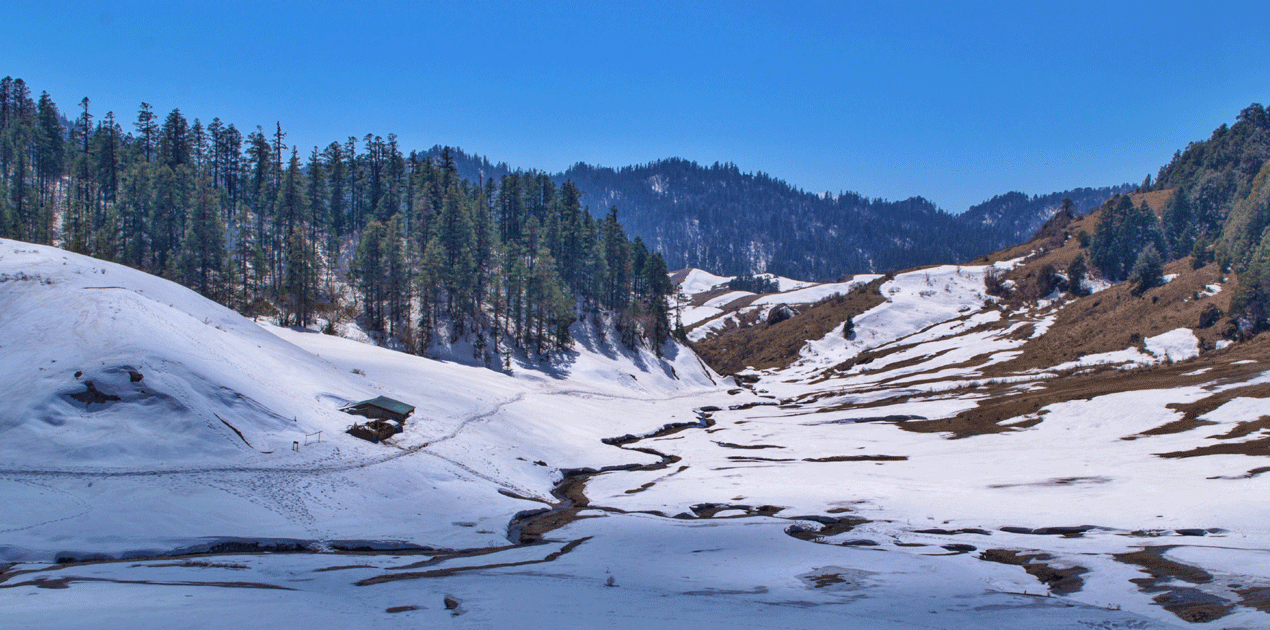
If you want to climb out of the heat afterwards, the region gives you options that few visitors take. The grassland plateau of Khaptad National Park sits in the hills a day away, and the trail towards Api base camp in Darchula puts you under a 7,132 metre peak with almost no other trekkers on it.
FAQ
How many swamp deer are there in Shuklaphanta?
Counts on the main phanta have repeatedly exceeded two thousand animals, which is the largest herd of the species reported anywhere in the world. The figure moves between years and between survey methods, and the deer cross into Indian grassland as well, so treat any single number as a snapshot rather than a fixed total.
When is the best month to see the swamp deer?
December and January for the rut, when stags gather and the herd is at its most concentrated, or February when the grass has been cut and visibility across the phanta is at its best. Both work; the fog in December can delay a morning start by an hour or two.
Are there tigers in Shuklaphanta National Park?
Yes. The 2022 national survey counted 36 tigers, up from 16 in 2018. Because much of the park is open grassland rather than closed forest, the odds of actually seeing one are better here than in most Nepali parks of comparable size.
How do you get to Shuklaphanta from Kathmandu?
Fly to Dhangadhi in about an hour, then drive roughly two hours west along the East-West Highway to Bhimdatta and the park headquarters at Majhgaun. Driving the whole way from Kathmandu takes fifteen hours or more and is rarely worth it unless you are travelling overland by choice.
Was Shuklaphanta once a hunting reserve?
It was. The area was set aside as a royal hunting reserve in 1969, became a wildlife reserve in 1976 and was upgraded to national park in 2017. Hunting has not been permitted there for decades; the only reserve in Nepal where licensed hunting still takes place is Dhorpatan.