Koshi Tappu Wildlife Reserve protects 175 square kilometres of shifting river islands, marsh and grassland on the Sapta Koshi floodplain in eastern Nepal, and it is the last place in the country where wild water buffalo survive. It was gazetted in 1976 and listed in December 1987 as the first Ramsar wetland site in Nepal. More than 480 bird species have been recorded within its boundary, which makes it the single most important site for waterbirds in the country.
Where is Koshi Tappu Wildlife Reserve?
The reserve lies in Sunsari, Saptari and Udayapur districts of Koshi Province, on the floodplain of the Sapta Koshi immediately upstream of the Koshi Barrage. Its shape is dictated by engineering as much as by ecology: the reserve occupies the land between the eastern and western flood embankments, a corridor of river that the barrage and its levees hold in place.
The name is literal. Tappu means island, and the reserve is a shifting archipelago of grass and sand islands within a braided river that rearranges itself every monsoon. Nothing here is permanent. Channels move, islands appear and vanish, and a map more than a few years old will be wrong in its details. That instability is the habitat, not a flaw in it.
What should you know before visiting Koshi Tappu?
The basic facts are worth having in one place before you plan anything.
| Detail | Figure |
|---|---|
| Gazetted | 1976 |
| Ramsar listing | December 1987, the first in Nepal |
| Core area | 175 square kilometres |
| Buffer zone | About 173 square kilometres |
| Districts | Sunsari, Saptari and Udayapur |
| Flagship species | Wild water buffalo, the last population in Nepal |
| Birds recorded | More than 480 species |
Note the scale. At 175 square kilometres the core is small, roughly a fifth of Bardiya, and much of it is water or seasonally flooded ground. This is not a park you drive around for three days. It is a place you work carefully, on foot and by boat, with a scope and a bird list.
Why is Koshi Tappu the last home of the wild water buffalo?
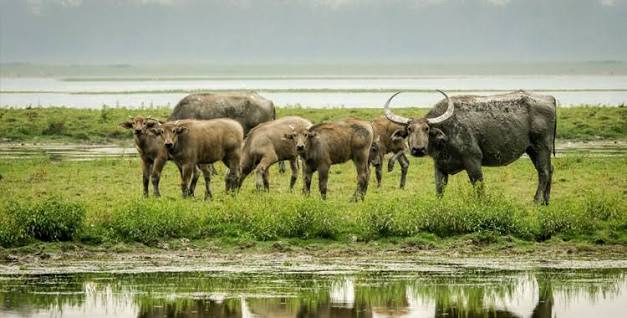
The wild water buffalo, called arna in Nepali, is a large, genuinely wild bovid that once ranged widely across the northern Indian plain and has been reduced to a handful of scattered populations. Nepal has exactly one, and it is here. The species needs extensive wet grassland and open water, which is the habitat that has been drained and converted faster than any other in South Asia.
When the reserve was created in the mid-1970s the surviving Nepali population was down to a few dozen animals. Protection, the removal of settlement from the core and decades of patrolling have brought it up into the several hundreds. That is a real conservation success and a fragile one, because a single population confined to one floodplain is exposed to any event that hits that floodplain.
There is also a subtler threat. Domestic buffalo grazed illegally inside the reserve can interbreed with wild animals, and genetic mixing degrades the very thing the population is protected for. Managing livestock incursion is therefore not a minor housekeeping issue here. It is core to whether Nepal still has wild arna in fifty years.
Why do birdwatchers rate Koshi Tappu so highly?
Because of where it sits. The Koshi drains a vast slice of the eastern Himalaya, and the wetland at its foot acts as a funnel for birds moving between the high country and the plains, and between Central Asia and the Indian subcontinent. Wintering waterfowl arrive in numbers, waders work the sandbars, and the reserve regularly turns up species recorded almost nowhere else in Nepal.
Specialities include the swamp francolin in the grassland, several stork species, Indian skimmer on the sandbars, and a long list of ducks and geese through the cold months. Raptors hunt the open ground, and the marshes hold bitterns, crakes and rails for those willing to stand still long enough. The nearby Koshi Barrage and its downstream pools are a separate and equally productive area; birders working the region routinely split their time between the reserve and the Koshi Barrage wetlands.
Beyond birds, the river holds smooth-coated otter and, occasionally, the Ganges river dolphin, which moves up from Indian waters when flows allow. Gharial have been released into the system. Neither is a reliable sighting, but both are possible.
What does the Ramsar listing actually mean?
The Ramsar Convention is an international treaty on the conservation and wise use of wetlands. Listing a site commits the country to maintaining its ecological character and reporting on its condition, and it puts the wetland into an international framework of monitoring and, where necessary, scrutiny.
Koshi Tappu was the first Nepali site on that list, added in December 1987. Nepal now has ten listed wetlands spanning everything from Terai marsh to high-altitude glacial lakes. The listing does not give a site extra legal protection under Nepali law by itself, but it raises the visibility of any threat to it and creates an obligation to explain any deterioration. For a wetland squeezed between embankments, agriculture and a growing population, that visibility matters.
When is the best time to visit Koshi Tappu?
October to March, without much argument. November through February is peak season for wintering waterfowl and the weather is dry and cool, with morning fog common in the coldest weeks. March brings passage migrants and the last of the winter birds, along with rising temperatures.
April and May are hot and humid, the wetland shrinks and birding quality drops considerably, though mammal viewing around remaining water can be good. From June to September the monsoon does what it always does on the Koshi: the river rises, islands are submerged, tracks disappear and access becomes impractical. Nobody sensible plans a Koshi Tappu trip for August.
How do you get to Koshi Tappu Wildlife Reserve?
The quickest route is a flight from Kathmandu to Biratnagar, around fifty minutes, followed by a drive of roughly an hour and a half northwest to the reserve headquarters at Kusaha. Overland, the East-West Highway crosses the Koshi at the barrage, and the reserve entrance is a short detour north from there, which makes it a natural stop on any journey between the eastern Terai and Kathmandu.
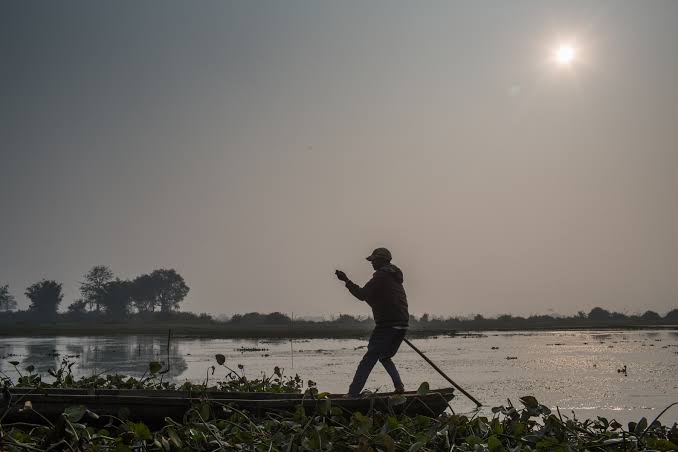
Entry permits are issued at the reserve office and a licensed guide is required. Boat trips on the Koshi, usually in rafts or local craft, are the classic way to see the reserve and the best method for approaching buffalo and waterbirds without disturbing them. Walking with a guide along the embankments and grassland edges covers the rest. A small cluster of camps and lodges operates near Kusaha in season.
What threatens Koshi Tappu?
Several things at once. Livestock grazing inside the core competes with wild ungulates and risks genetic mixing with the buffalo. Invasive plants, particularly water hyacinth and mikania, choke waterways and smother grassland. Fishing pressure, firewood collection and encroachment press in from a densely settled buffer zone where most households have few alternatives.
Then there is the river itself. In August 2008 the eastern embankment failed near Kusaha and the Koshi broke out across Nepali and Indian farmland in one of the most destructive floods the region has seen, displacing hundreds of thousands of people. That event is a reminder of the force this system carries and of how much the reserve depends on infrastructure it does not control. Any future barrage or embankment scheme on the Koshi is, by definition, also a decision about the reserve.
If you are planning a wider wildlife route through the lowlands, Koshi Tappu is the wetland counterpoint to the forest and grassland parks further west, and it pairs well with Chitwan National Park or, for a full traverse of the Terai, with Bardiya National Park at the other end of the highway.
FAQ
What is an arna?
Arna is the Nepali name for the wild water buffalo, a large wild bovid distinct from the domestic buffalo seen in villages across the Terai. Koshi Tappu holds the last wild population in Nepal, which is the main reason the reserve was created and the reason livestock incursion into the core is treated so seriously.
When is the best time for birdwatching at Koshi Tappu?
November to February for wintering waterfowl, with March adding passage migrants. The reserve is at its poorest from June to September, when monsoon flooding submerges the islands and makes most of it inaccessible. Serious birders generally plan for the December to February window.
Can you take a boat trip inside the reserve?
Yes. Rafts and local boats run on the Koshi during the drier months and are the standard way to see the reserve, giving quiet approaches to waterbirds, otters and buffalo grazing near the channels. Arrange it through the reserve office or a lodge, and expect the route to vary with water levels.
How do you get to Koshi Tappu from Kathmandu?
Fly to Biratnagar in around fifty minutes and drive roughly ninety minutes to the reserve headquarters at Kusaha. By road the East-West Highway crosses the Koshi at the barrage just south of the reserve, so it is an easy addition to any overland journey through the eastern Terai.
Why was Koshi Tappu made a Ramsar site?
It was listed in December 1987 as the first Ramsar site in Nepal because it supports large numbers of waterbirds and represents a wetland type that is disappearing across the region. The listing commits Nepal to maintaining the ecological character of the site and reporting on its condition internationally.