Koshi Tappu Wildlife Reserve protects 175 sq km of river island, sandbar, marsh and grassland on the Koshi floodplain in eastern Nepal, across Sunsari, Saptari and Udayapur districts. It was gazetted in 1976 to save the last wild water buffalo in the country, and in 1987 it became Nepal's first Ramsar wetland of international importance.
The arna, and why the reserve exists
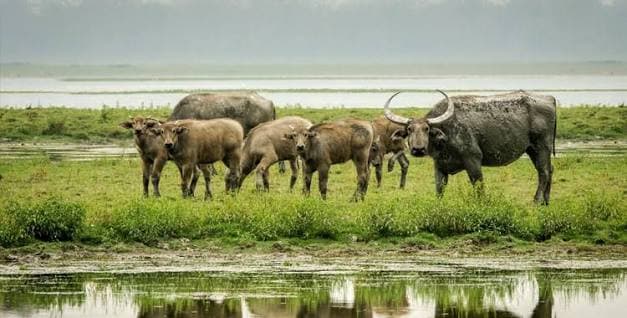
Koshi Tappu was created for one animal. The wild water buffalo, known locally as arna, had been reduced to a remnant herd on these river islands and nowhere else in Nepal. The reserve boundary was drawn around them. The population has grown substantially since, and the animals are now easy to see from the embankment road on almost any morning.
The conservation problem has changed shape rather than gone away. The main threat is no longer hunting but hybridisation: domestic buffalo graze the same floodplain, and genetic mixing steadily erodes what makes the wild population worth protecting. Managing that is far harder than fencing a boundary, and it is the reason survey work here focuses as much on genetics as on headcounts.
Other mammals are present but secondary. Hog deer, wild boar, spotted deer, jackal and smooth-coated otter are all recorded, and Gangetic river dolphins occasionally appear in the deeper channels. Nobody comes here for mammals apart from the arna. They come for the birds.
Birds: what the totals mean and when to come
More than 500 species have been recorded within the reserve and its immediate surroundings, one of the highest totals for any single site in Nepal. That number reflects position rather than habitat quality alone. The Koshi cuts a low, wide gap through the Himalayan front, and migrants moving between Central Asia and the Indian plains funnel down it. In late October and November the passage is heavy and continuous.
The specialities are wetland birds. Bengal florican breeds in the grasslands, swamp francolin skulks in the wet edges, and the reserve is one of the more reliable Nepali sites for both. Winter brings large concentrations of duck, waders, storks and terns to the shallow water and exposed sandbars. Raptors are conspicuous, and Pallas's fish eagle is a regular. Our complete guide to birdwatching in Nepal covers how Koshi Tappu fits into a national itinerary, and the note on Nepal's endemic and signature birds covers what you will not find here but will find in the hills.
Come between October and March. November to February is the core window. April onwards the water drops, the heat builds and the migrants have gone; the monsoon floods much of the reserve and closes it in practice.
How you actually watch birds here
Most of the reserve is water, sand and grass, and access is by boat, on foot along the embankments, or by jeep on the tracks that survive the flood season. A dugout or a motorised boat working the channels early in the morning is the productive option, because it puts you alongside sandbars where birds are resting rather than pushing them off from a bank.
Bring a scope if you own one. Distances across the braided channels are long, and much of the interest is in flocks on far bars rather than birds at your feet. A local guide is essential rather than optional: the channels shift every monsoon, the good bars move with them, and the guides at Kusaha know where the birds have settled this season in a way no map can tell you.
Accommodation is limited and clustered at Kusaha and Prakashpur on the western side. A small number of camps and lodges run birding packages with guides and boats included. Facilities are basic. There is no ATM inside the reserve area, so carry cash from Biratnagar or Itahari.
Floods, embankments and a river that moves
The Koshi is one of the most sediment-heavy rivers in the world and it does not stay put. Embankments hold it in a corridor it keeps trying to leave, and in August 2008 it left, breaching the eastern bank at Kusaha inside the reserve. The Koshi Barrage page covers that flood and what it did downstream.
For a visitor the consequence is the shape of the place. The wetland is squeezed between engineered banks rather than free to spread, the channels rearrange themselves every high-water season, and anything you read about where the good sandbars are will be out of date within a year or two. Our overview of Nepal's three great river systems sets the Koshi in its wider hydrological context, and the guide to Nepal's Ramsar wetlands explains what the designation does and does not protect.
| Detail | Koshi Tappu Wildlife Reserve |
|---|---|
| Established | 1976 |
| Area | 175 sq km |
| Ramsar designation | 1987, Nepal's first |
| Districts | Sunsari, Saptari, Udayapur |
| Province | Koshi |
| Elevation | Around 80 to 95 m, among the lowest ground in Nepal |
| Bird species recorded | More than 500 |
| Flagship species | Wild water buffalo, or arna |
| Main access points | Kusaha and Prakashpur on the Mahendra Highway |
| Nearest airport | Biratnagar, around 65 km |
| Best season | October to March |
Combining it with the barrage
Koshi Tappu and the Koshi Barrage downstream are two halves of the same wetland and are almost always birded together. The barrage road gives you a raised vantage over open water that the reserve itself cannot match, and the species lists differ enough to justify a morning at each. The Koshi Barrage page covers that side. For a longer eastern Nepal trip, the detailed reserve guide and Nepal's protected area system together explain how the reserve differs from a national park in what is permitted inside its boundary.
Frequently Asked Questions
What is the best month for birds at Koshi Tappu?
November and December. Migrants have arrived, water levels have dropped enough to expose sandbars, and the air is clear. Late October catches passage migrants still moving through, and February remains good before numbers thin out in March.
How is Koshi Tappu different from a national park?
It is a wildlife reserve, a category that allows some regulated local use of resources such as grass cutting and fishing alongside protection. In practice for a visitor the difference is small: entry permits, guides and boat hire work much the same way.
Can you see the wild water buffalo easily?
Yes. The arna is the one species here that is close to reliable, and herds are regularly visible from the embankment tracks and from boats in the morning. Distinguishing genuinely wild animals from hybrids is a job for a guide.
How do I get there from Kathmandu?
Fly to Biratnagar, about an hour, then drive roughly 65 km west along the Mahendra Highway to Kusaha or Prakashpur. Overland from Kathmandu is a long day on the highway, so most visitors fly.
Do I need a guide and a boat?
Effectively yes. The productive areas are channels and sandbars reached by boat, and the channels move each monsoon. Lodges at Kusaha arrange guides and boats as a package, which is far simpler than organising it yourself.
Is the reserve open during the monsoon?
It is not formally closed, but between June and September much of it is under water, tracks are impassable and few operators run. Plan for the dry season.