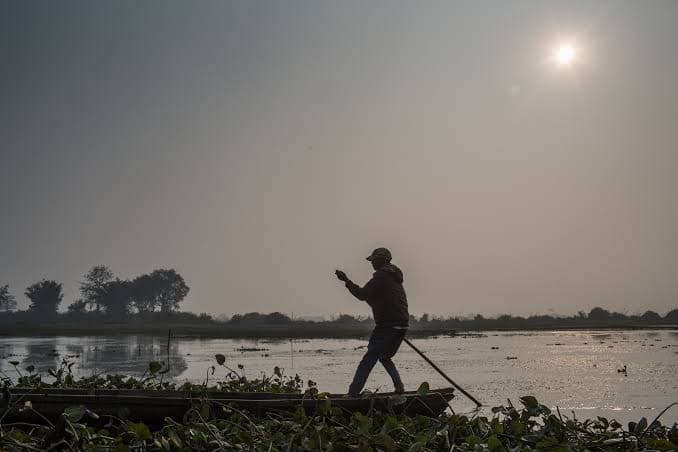
The Koshi Barrage sits on the Nepal-India border at Bhimnagar in Sunsari district, eastern Nepal, where the Koshi River leaves the hills and spreads onto the Gangetic plain. The barrage, the water it backs up and the marsh and sandbar downstream form one of the most productive birding areas in the subcontinent, immediately south of Koshi Tappu Wildlife Reserve.
An Indian structure on Nepali ground
The barrage is a piece of engineering with an unusual legal status, and understanding it explains a good deal about the landscape. Under the Koshi Agreement signed by Nepal and India in 1954, the structure and its long flanking embankments were built on Nepali territory in the early 1960s but are financed, operated and maintained by the Indian state of Bihar, whose flood problem the project was designed to address.
What that produced is a wide, shallow impoundment behind a gated barrage, with the river held between embankments for tens of kilometres upstream. The wetland birds are a byproduct of flood engineering rather than the point of it. The barrage road itself carries traffic between the two countries, and there is a functioning border crossing here.
The arrangement has been politically contentious in Nepal for decades, and the 2008 breach sharpened the argument considerably. Bear that in mind before you photograph the gates: this is infrastructure people have strong feelings about, and security personnel are present.
What you see from the barrage road
The reason birders come is the vantage. From the raised road you look down onto open water, exposed sandbars and shallow margins, and in winter those hold concentrations of waterfowl that are difficult to see this well anywhere else in Nepal. Duck species stack up in the hundreds, and the sandbars carry waders, terns, gulls, storks and cormorants.
The species mix differs enough from Koshi Tappu upstream to justify a separate morning. The barrage gives you open-water and deep-shallow habitat; the reserve gives you grassland, marsh edge and river channel. Serious birders work both and treat them as one site. Our complete birdwatching guide explains where the Koshi system sits in a national itinerary, and the Ramsar wetlands guide covers the designation that protects it.
Bring a telescope. This is scope country, with most of the interest at several hundred metres across water. A pair of binoculars alone will show you that there are a lot of birds without showing you what they are.
Gangetic dolphins, and the odds of seeing one
The Gangetic river dolphin is present in the Koshi below the barrage and is one of the reasons specialists come. It is also one of the most precarious populations of a highly endangered animal anywhere. Numbers in the Nepali stretch of the Koshi have been reported in single or low double figures in recent surveys, and the barrage itself is part of the problem: it blocks movement between the Nepali river and the much larger population downstream in India.
Sightings are a matter of patience and luck. The dolphins surface briefly, are usually solitary, and the water is turbid. Local boatmen below the barrage know the pools they favour. Anyone promising a guaranteed sighting is selling you something. Treat it as a bonus rather than the purpose of the trip.
Mugger crocodile are easier, basking on bars through the winter, and golden mahseer are present in the river, which draws a small amount of catch-and-release angling interest.
The 2008 breach and why the landscape looks like this
On 18 August 2008 the eastern embankment failed at Kusaha, about twelve kilometres upstream of the barrage. The Koshi abandoned its engineered channel and swung east across the plain, flooding a broad swathe of Sunsari district in Nepal and, on an enormous scale, districts of northern Bihar. Tens of thousands of people were displaced in Nepal, millions in India.
The river was eventually returned to its channel and the embankment rebuilt, but the visual evidence has not gone. Driving in you pass raised spurs, silt-buried fields, rebuilt villages and stretches where the vegetation is clearly younger than the surrounding forest. It is a useful corrective to any idea that this is a natural wetland left alone. Our overview of the Koshi, Gandaki and Karnali systems covers why this particular river carries so much sediment and moves so readily.
| Detail | Koshi Barrage and Sunsari wetlands |
|---|---|
| Location | Bhimnagar, Sunsari district, on the Nepal-India border |
| Province | Koshi |
| Governing agreement | Koshi Agreement, signed 1954 |
| Barrage built | Early 1960s |
| Operated by | The Indian state of Bihar, on Nepali territory |
| Adjoining protected area | Koshi Tappu Wildlife Reserve, immediately upstream |
| Key species | Wintering waterfowl, Gangetic river dolphin, mugger crocodile |
| Nearest airport | Biratnagar |
| Access | Mahendra Highway, then south towards the border |
| Best season | November to February |
Practicalities
Fly to Biratnagar from Kathmandu, then drive west and south. Almost all visitors stay at the Koshi Tappu lodges at Kusaha or Prakashpur and come down to the barrage for a morning, because there is nothing to stay in at Bhimnagar itself. The Koshi Tappu page covers that base.
November to February is the window. Water levels are low, migrants are in, and the winter light is clean. From March the birds thin out and the heat builds; the monsoon puts the whole floodplain under water and makes the roads unreliable.
Carry your passport. This is a border area with a functioning crossing and a security presence, and asking permission before photographing the structure itself is sensible. If your interest is wetlands generally rather than this site specifically, the far-western equivalent is covered in our guide to Ghodaghodi Lake, and the Koshi Tappu guide covers the reserve side in full.
Frequently Asked Questions
Is the Koshi Barrage in Nepal or India?
The structure stands on Nepali territory, but it was built and is maintained and operated by the Indian state of Bihar under the 1954 Koshi Agreement. There is a border crossing at the site.
When is the best time to see birds here?
November to February. Winter brings large concentrations of duck, waders and storks onto the exposed sandbars and shallow margins, and low water makes them visible from the barrage road.
Can you see Gangetic river dolphins?
Sometimes. A small and highly threatened population persists in the river below the barrage. Sightings are brief and unreliable, so treat any encounter as a bonus rather than a reason to make the trip.
Where do you stay to visit the barrage?
At the Koshi Tappu lodges around Kusaha and Prakashpur, roughly an hour north. There is no visitor accommodation at Bhimnagar itself, and the two sites are almost always birded on the same trip.
Do I need a permit?
Not for the barrage road itself, though the adjoining Koshi Tappu Wildlife Reserve charges an entry permit. Carry your passport, as this is a border area with security checks.
How do I get there from Kathmandu?
Fly to Biratnagar in about an hour, then drive roughly two hours west and south. Overland from Kathmandu is a full day on the Mahendra Highway and is rarely worth it.