Nepal has roughly 880 recorded bird species inside a country smaller than England and Scotland put together, and the two strongest birding windows are late February to mid April and October to early December. Winter, from December through February, is the peak period for waterfowl, raptors and grassland specialities on the Terai wetlands. May and June push the interest uphill, into the rhododendron and fir belt between 2,500 and 4,000 metres, where the breeding season is in full voice and the high passes are open.
Why does a country this small hold so many birds?
Nepal climbs from about 60 metres above sea level in the eastern Terai to 8,849 metres at the summit of Everest, and it does that across roughly 200 kilometres of horizontal distance. That gradient stacks tropical sal forest, subtropical riverine grassland, temperate oak and rhododendron, subalpine fir and open alpine scrub directly on top of one another. Each band carries its own bird community. A single well planned fortnight can take you from black-necked stork standing on a floodplain to snow pigeon crossing a moraine.
Position matters as much as relief. Nepal sits under the Central Asian Flyway, so birds that breed on the Tibetan plateau and further north in Mongolia and Siberia funnel south through Himalayan river valleys in autumn and reverse the journey in spring. The Kali Gandaki gorge is the best-known corridor, and demoiselle cranes are the sight to wait for there: long wavering skeins passing over Jomsom and Kagbeni from late September into October. Raptor watchers use the same valleys, plus the ridges above Pokhara, for steppe eagle and other broad-winged migrants.
Nepal also has one bird found nowhere else on earth, the spiny babbler, a skulking scrub species that went unrecorded for decades before being rediscovered in the late 1940s. It lives in terraced hill scrub and secondary growth between roughly 1,000 and 2,100 metres, and it is far easier to hear than to see. Add the Himalayan monal, the national bird, and the country’s appeal becomes obvious even to travellers who did not arrive as birders.
What is the best month for birdwatching in Nepal?
If you can only travel once, come in March or in early November. March gives you resident species in full song, the first wave of spring passage and weather clear enough for the mid hills. Late October and November give you arriving winter flocks plus the cleanest air of the year, which matters a great deal if you want mountain backdrops behind your photographs. The table below sets out what each season actually delivers rather than what a brochure promises.
| Season | Months | Best areas | Headline species | Field conditions |
|---|---|---|---|---|
| Winter | December to February | Koshi Tappu, Chitwan, Bardiya, Shuklaphanta, lowland lakes | Ducks, geese, waders, harriers, storks, ibisbill on gravel rivers | Dry and cool, thick dawn fog in the Terai, short days |
| Early spring | Late February to March | Terai parks, Kathmandu Valley rim, Pokhara Valley | Breeding herons and hornbills, early passage raptors, spiny babbler in song | Warm days, haze building, very comfortable walking |
| Late spring | April to May | Mid hills and temperate forest, 1,500 to 3,500 metres | Himalayan monal, satyr tragopan, cuckoos, rosefinches, laughingthrushes | Rhododendron in flower, hot lowlands, afternoon cloud build-up |
| Monsoon | June to September | Rain-shadow valleys such as Mustang and Dolpa, high alpine pasture | Alpine breeders, snow partridge, Tibetan snowcock, high-altitude finches | Leeches and mud below 2,000 metres, frequent flight delays |
| Autumn | October to November | Kali Gandaki gorge, Chitwan, Koshi, Pokhara lakes | Demoiselle crane passage, arriving wintering wildfowl, migrating raptors | Clearest skies of the year, stable weather, peak trekking crowds |
| Early winter | December | Eastern Terai wetlands and river barrages | Large duck concentrations, storks, gulls and terns on open water | Cold dawns, excellent visibility, few other birders |
Where should you bird in winter, from December to February?
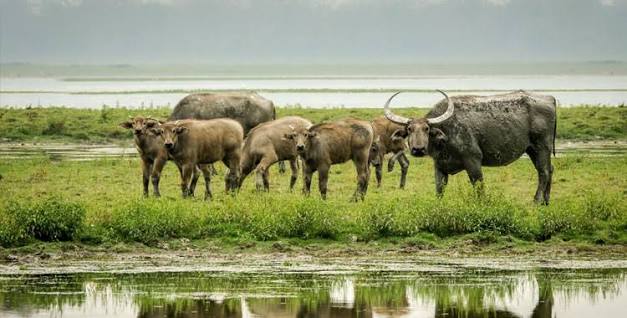
Winter belongs to the lowlands. The single most productive site in the country is Koshi Tappu Wildlife Reserve in the eastern Terai, a floodplain of shifting channels, sandbars and tall grass on the Sapta Koshi river. It became Nepal’s first Ramsar site in 1987 and its bird list is among the longest of any site in the country. Wildfowl gather in numbers on the open water above the barrage, waders work the sandbars, and the grasslands hold species that are difficult anywhere else in South Asia. Koshi Tappu is also the main home of Nepal’s wild water buffalo, the arna, which makes even a quiet bird day worthwhile.
West of there, Chitwan National Park gives you the same tropical species set inside far better infrastructure. Chitwan was gazetted in 1973 as Nepal’s first national park and inscribed as a UNESCO World Heritage Site in 1984. Its combination of sal forest, oxbow lakes and riverine grassland along the Rapti and Narayani produces hornbills, several kingfisher species, fish-eating raptors and, on the gravel bars in winter, the birds most visitors actually came for.
Further west again, Bardiya National Park and Shuklaphanta National Park reward anyone willing to add a day of travel. Shuklaphanta protects one of the largest surviving stretches of unbroken phanta grassland in the region, and grassland is where the rarest birds are. Bengal florican, swamp francolin and a suite of grass warblers all depend on it, and grassland birding is best done in the first two hours after sunrise before the heat kills activity.
What does the spring migration look like, from March to May?
Spring is a moving target. In March the Terai is still excellent but the wintering flocks begin to thin, while resident species reach peak song and become far easier to locate. By April the lowlands are hot and dusty and the interest has shifted up. Between 1,500 and 3,000 metres the rhododendron forests flower, sunbirds and minivets work the canopy, and the pheasants become active on the ridgelines at first light.
May is the month for anyone who wants Himalayan galliformes. Satyr tragopan, koklass pheasant, blood pheasant and Himalayan monal are all calling, which is by far the most reliable way to find them. This is also when the high trekking routes reopen properly after the winter snow, so a birding trip can be combined with a walking itinerary rather than run as a separate exercise. The trade-off is haze: the crystalline post-monsoon light is gone, and by late May the pre-monsoon storms have started.
Is the monsoon worth birding, from June to September?
For most visitors, no. Below about 2,000 metres the monsoon means leeches, mud, flooded feeder roads and cancelled domestic flights, and the middle hills spend much of the day inside cloud. The exception is the rain shadow. North of the main Himalayan chain, Mustang and Dolpa stay comparatively dry through the summer because the range strips the moisture out of the air before it arrives. Those valleys are at their greenest and most accessible in July and August, which is exactly when the alpine breeders are most active. If you are already going to the trans-Himalaya for cultural reasons, the birding comes as a bonus.
How should you plan a Nepal birding trip?
Work outward from a single anchor site rather than trying to cover the whole country. A realistic ten-day winter itinerary is Kathmandu, three nights in the eastern Terai, three nights in Chitwan and a day on the valley rim, with internal flights doing the long legs. A realistic spring itinerary swaps the eastern Terai for a mid-hill ridge walk. Two sites done properly beat five sites done in transit.
Hire a specialist bird guide, not a general nature guide. Nepal has an unusually strong community of professional bird guides, many of whom have contributed records to the national checklist, and their ear for call is worth more than any optic you can buy. Book them well ahead for the November and March peaks. Inside the national parks and reserves you will need a park entry permit and, in most cases, a licensed guide, and some grassland areas are only open on foot or by vehicle with a warden’s permission. Permit rules and fees are revised periodically, so confirm current requirements with the Department of National Parks and Wildlife Conservation or your operator before you travel.
What gear and field craft actually matter?
Eight or ten power binoculars with good low-light performance do most of the work, because the two productive hours of the day are the ones either side of sunrise. A scope earns its weight only on open water and open grassland, which in practice means the eastern wetlands and the western phantas. For clothing, assume a 15 degree Celsius swing between a foggy Terai dawn and midday, and assume dust. Neutral colours, not camouflage, and quiet fabric.
Field craft in Nepal is mostly about timing and patience. Be at the grassland edge before the light, not after breakfast. Work forest by ear and let mixed feeding flocks come to you rather than chasing them along a trail. On rivers, walk the gravel slowly and scan ahead, because ibisbill and the wintering waders will move long before you get close if you approach carelessly. Keep back from nests, do not use call playback in the breeding season, and treat grassland birds with particular restraint, since several of them are threatened.
Finally, submit your records. Nepal’s national checklist is maintained by an active community of ornithologists and amateur observers, and visitor records from less-watched districts have real scientific value. A trip list uploaded properly is a small contribution to the conservation case for the habitats you have just enjoyed.
FAQ
What is the single best month for birdwatching in Nepal?
November is the strongest all-round month. The wintering wildfowl have arrived, the post-monsoon air is at its clearest, the weather is stable and the lowland parks are comfortable. March is a close second and is better if your priority is song, breeding behaviour and hill species rather than sheer numbers on water.
How many bird species does Nepal have?
Roughly 880 to 900 species have been recorded, and the figure creeps upward as new records are confirmed. That is close to one tenth of the world total in a country of about 147,000 square kilometres, which is the statistic that draws serious birders in the first place.
Do I need a guide and a permit to go birdwatching?
Inside national parks and wildlife reserves you need an entry permit, and a licensed guide is required or strongly advised in most of them. Outside protected areas you can bird freely, though a local guide will still find you far more species. Restricted trekking areas such as Upper Mustang and Upper Dolpa carry additional permit conditions.
Can I combine birdwatching with trekking?
Yes, and spring is the natural season for it. A mid-hill trek between 1,500 and 3,500 metres in April or May passes through prime pheasant and rhododendron-forest habitat, and the walking pace suits birding far better than a vehicle itinerary does. Add a lowland park at either end for the tropical species.
Is birdwatching possible during the monsoon?
In the lowlands and middle hills it is difficult from June to September because of rain, leeches and flight disruption. In the trans-Himalayan rain shadow of Mustang and Dolpa the monsoon months are dry, green and good for alpine species, so the answer depends entirely on which side of the mountains you are standing.