
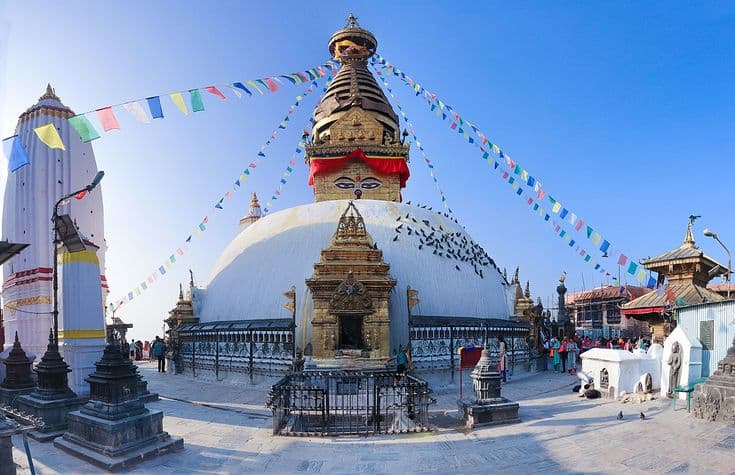
Swayambhunath is a Buddhist stupa on a wooded hill about three kilometres west of central Kathmandu, in Kathmandu district of Bagmati Province. A stone stairway of 365 steps climbs the eastern face to a platform crowded with shrines, votive chaityas, butter lamps and stalls. It has been part of the Kathmandu Valley World Heritage property since 1979.
Why the hill came before the city
The Newar chronicles say the Kathmandu Valley was once a lake, and that a lotus flowering at its centre gave off a light of its own. The bodhisattva Manjushri cut the valley wall open at Chobar with his sword, the water drained away, and the lotus came to rest on the hill the stupa now occupies. Swayambhu means self-arisen, and the word is doing real work. The claim is not that someone chose to build a holy place here; it is that the place was already holy and the building arrived afterwards.
The geology broadly agrees with the story. The valley floor is lake sediment, and the Bagmati does leave the basin through a gorge at Chobar. Whatever you make of the legend, it explains why this particular hill carries the oldest continuously used Buddhist site in the valley. The written record catches up later, through inscriptions and repairs running across the Licchavi centuries, and if you want that period in order our guide to the Licchavi golden age covers the dynasty whose stonework underpins most of what survives in the valley.
What you are looking at from the top step
The whitewashed dome is the oldest visible part of the structure and gets repainted often, sometimes with saffron water poured down it in wide petal shapes. Above the dome sits a gilded cube called the harmika, with a pair of eyes painted on each of its four sides and, between them, a curl that foreigners read as a nose and anyone who reads Devanagari recognises as the numeral one. Thirteen gilded tiers rise above that to a parasol at the top. Five niches around the dome hold the Dhyani Buddhas, and a line of prayer wheels runs the full circumference at hand height.
You walk clockwise. Everyone does, and if you set off the other way at seven in the morning somebody will gently turn you round. Two white shikhara towers, Pratapur and Anantapur, stand at the eastern corners of the platform. Harati Devi has her own temple on the north-western side, a Hindu shrine sitting inside a Buddhist complex and one of the busiest buildings on the hill: Harati is associated with smallpox and child health, and mothers still bring children to her. The large gilded vajra on its carved plinth at the head of the stairway is the photograph everyone takes, and it is worth walking round it to see the animals of the Tibetan calendar cut into the mandala beneath.
The 365 steps, and the road that avoids them
The eastern stairway is the pilgrim approach and it is steep. The final third is hard work in the heat, the stone treads are worn smooth and slightly dished, and there is no handrail for most of the climb. A road runs up the western side of the hill to a car park that leaves you a short level walk from the platform, which is where most taxi drivers will take you if you simply say Swayambhu. Older Nepali visitors and anyone with a bad knee use the west gate without a second thought.
The tidy compromise is to walk up the steps and come down by the road, or the reverse if you are arriving in the dark for sunrise. Either gate sells the same ticket.
Swayambhunath at a glance
| Detail | Swayambhunath |
|---|---|
| District | Kathmandu |
| Province | Bagmati |
| Distance from Thamel | About 3 km west |
| Eastern stairway | 365 stone steps |
| Vehicle access | Road to a car park on the western side |
| World Heritage listing | 1979, within the Kathmandu Valley property |
| Typical visit | One to two hours |
| Best light | Sunrise, and the hour before dusk |
| Entry | Ticketed for foreign visitors, collected at both gates |
| Trekking permit | Not required |
The monkeys are a genuine logistical problem
Rhesus macaques live on the hill in large numbers and they are habituated, fast and completely unafraid of people. This is not a charming detail to photograph from two metres away. Do not carry food in an open hand, do not swing a plastic bag, and do not hold a bottle of juice loosely. A troop will lift sunglasses off a head and take a phone that is being held out for a picture. Keep small bags zipped and worn on the front of your body, and if a monkey does take something, let it go rather than pulling back.
They are not aggressive without a reason, but an unattended offering plate or a bag of prasad counts as a reason. Mornings are calmer than mid-afternoon, when the animals congregate around the food stalls.
When to arrive
First light, if you can manage it. Between roughly six and half past seven the platform belongs to people doing their morning circuit rather than to tour groups: bells, a smell of juniper smoke from the incense burners, and the low continuous noise of prayer wheels being spun. The Himalayan skyline, when it shows at all, shows in that first hour and is usually gone into haze by nine from March onward. Late afternoon is the second-best slot, because the sun sets behind the hill and the valley below it turns gold.
Winter mornings from November to February give the cleanest air and the best chance of a mountain horizon; the monsoon buries the view in cloud but makes the hill green and the crowds thin. The site is open daily and needs no booking.
What the 2015 earthquake did
The main stupa came through the April 2015 earthquake structurally sound. Several smaller structures on and around the platform did not: parts of the monastery buildings, a number of votive chaityas and one of the shikhara towers were damaged, and repair work has run in stages ever since. You will still see propped walls, replacement brickwork and stacked salvaged timber at the edges of the site.
Fitting it into a valley itinerary
Swayambhunath sits naturally in a morning with Boudhanath at the other end of the city, which is the same tradition at a very different scale and rhythm, or with Patan Durbar Square if you would rather spend the afternoon on Newar architecture than on stupas. The wider picture of how the seven monument zones fit together is in our guide to the World Heritage sites of Nepal, and the valley itself is covered district by district in the Kathmandu Valley districts guide. If temples are the reason you came, the temples of Nepal overview and the Pashupatinath guide are the next two things to read.
Frequently Asked Questions
How many steps lead up to Swayambhunath?
The eastern pilgrim stairway has 365 stone steps. It is steep and the treads are worn, so allow fifteen to twenty-five minutes and carry water in warm weather.
Can I reach the stupa without climbing the stairs?
Yes. A road climbs the western side of the hill to a car park a short, almost level walk from the platform. Taxi drivers use it by default, and the same entry ticket is sold at that gate.
Why is it called the Monkey Temple?
Because a large population of rhesus macaques lives on the hill and around the platform. The nickname is a visitor coinage rather than a Nepali name; locally the site is simply Swayambhu.
Is Swayambhunath Buddhist or Hindu?
The stupa is Buddhist and is maintained by Buddhist institutions, but Hindu shrines sit on the same platform and Hindu visitors worship at them. The Harati Devi temple is the clearest example of that shared use.
What is the best time of day to visit?
Sunrise. The platform is at its quietest and most locally active between about six and half past seven, and any Himalayan view will have faded into haze by mid-morning for much of the year.
How long should I allow?
One hour covers the platform and a full circumambulation. Two hours is comfortable if you want to look properly at the Harati temple and the vajra plinth, or to walk the quieter wooded paths around the back of the hill.