
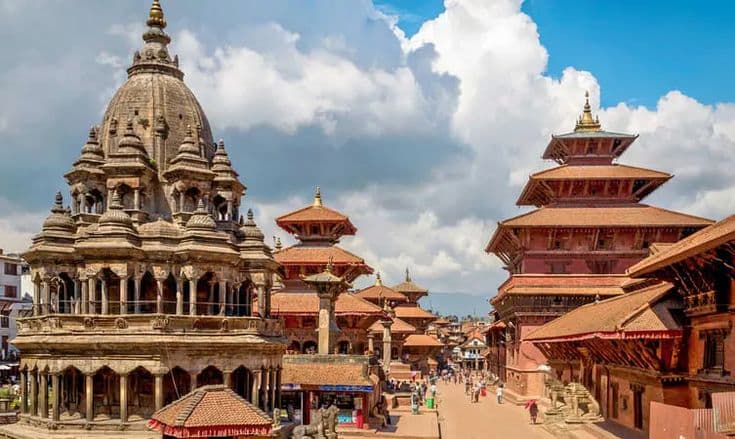
Patan Durbar Square is the palace square of Lalitpur, one of the three medieval Newar capitals of the Kathmandu Valley, about five kilometres south of central Kathmandu across the Bagmati. It holds a royal palace of three linked courtyards, a stone shikhara temple to Krishna, and the museum most visitors rate the best in Nepal.
One square, three courtyards, one museum
The layout is simple once you see it. The palace runs down the eastern side of the square in a single long brick facade broken by three gilded doorways, each opening into its own courtyard: Mul Chowk, Sundari Chowk and Keshav Narayan Chowk. The temples all stand opposite, on the western side, so the square is effectively a wide brick street with royalty on one side and gods on the other. Everything is built of brick, carved timber and dressed stone, and almost nothing is painted, which is why photographs of Patan look warmer than photographs of Bhaktapur.
The kings who built it were the Malla rulers of Lalitpur, competing directly with their cousins in Kathmandu and Bhaktapur. That rivalry is the reason the valley has three extraordinary squares within thirteen kilometres of each other rather than one; our guide to the Malla dynasty and the three kingdoms explains how a single kingdom split and what each capital tried to outdo the others at.
The Krishna Mandir is the building to look at first
The Krishna Mandir was built in 1637 under Siddhi Narsingh Malla and it does not look like anything else on the square. It is stone rather than brick and timber, and it is a north Indian shikhara design rather than a Newar pagoda: three storeys of open colonnaded verandas rising to a curved tower with a cluster of small finials around it. The stone beams of the first and second floors carry continuous carved friezes narrating the Mahabharata and the Ramayana, with short Newari captions cut beneath the scenes. If you look at nothing else closely, look at those.
The temple is in daily use. On Krishna Janmashtami, which falls in August or September, the queue to enter runs the length of the square and around the corner, and the building is lit and garlanded overnight. On an ordinary morning you will find a handful of people on the plinth and pigeons on the finials.
Tusa Hiti, and the courtyard most people walk past
Sundari Chowk is the smallest of the three palace courtyards and holds Tusa Hiti, a sunken royal bath lined with stone deities. The king bathed here, ritually, with the whole pantheon carved into the walls around him at eye level and a gilded spout in the shape of a conch delivering the water. It is a small space and it is easy to miss because the door is unremarkable. Do not miss it.
Mul Chowk next door is the largest courtyard and remains the ritual centre of the palace, with the Taleju shrines that opened only to the royal household. Keshav Narayan Chowk, at the northern end, is where the museum lives.
Patan Durbar Square at a glance
| Detail | Patan Durbar Square |
|---|---|
| City | Lalitpur, also called Patan |
| District | Lalitpur |
| Province | Bagmati |
| Distance from central Kathmandu | About 5 km south |
| Krishna Mandir built | 1637, under Siddhi Narsingh Malla |
| Palace courtyards | Three: Mul Chowk, Sundari Chowk, Keshav Narayan Chowk |
| World Heritage listing | 1979, within the Kathmandu Valley property |
| Museum | Patan Museum, inside Keshav Narayan Chowk |
| Typical visit | Half a day, longer with the museum |
| Entry | Ticketed for foreign visitors; the museum is a separate charge |
The Patan Museum earns its own morning
The museum occupies the restored northern courtyard of the palace and displays Hindu and Buddhist bronze and stone sculpture from the valley. What makes it unusual is that the labels explain iconography rather than provenance: they teach you to read a figure, so that by the time you walk back out onto the square you can identify the deities on the temple struts you walked past on the way in. Allow ninety minutes and start here rather than finishing here.
The Golden Temple is five minutes away and half of visitors miss it
Hiranya Varna Mahavihar, usually called the Golden Temple, sits in a lane a few minutes north of the square. It is a working Buddhist monastery courtyard with a gilded facade, a small central shrine and a rota of young boy caretakers who serve short terms. It is quieter and darker than the square, shoes come off at the entrance, and it gives a better sense of how Newar Buddhism actually operates than any monument does. Kumbheshwar, a five-storey temple a little further north, is the other neighbourhood site worth the walk, and its sacred tank is said to be fed by water from the high lake at Gosaikunda.
Rato Machhindranath: the valley's longest festival
Once a year a tall wheeled chariot is built in Pulchowk, loaded with the red image of Rato Machhindranath, and hauled through the streets of Lalitpur in stages over several weeks, finishing with the Bhoto Jatra at Jawalakhel before the image is carried on to Bungamati. The tower sways alarmingly, the ropes are pulled by hundreds of people, and the route is closed to traffic for as long as it takes. It is the longest chariot festival in the valley and the least stage-managed. The season is spring, though the exact dates move with the lunar calendar; our festival calendar guide sets out how those dates are fixed and which months carry the largest events.
What the 2015 earthquake took
Patan came through the April 2015 earthquake better than Bhaktapur but not untouched. The Char Narayan temple, a sixteenth-century structure that was among the oldest buildings on the square, collapsed completely; it has since been rebuilt using salvaged original timbers alongside new work. Several other temples lost upper roofs and have been reassembled. If you look at older photographs of the square before comparing them with what stands today, the differences are instructive rather than depressing.
How to plan the visit
Half a day is the minimum: museum first, then the square, then the lanes north towards the Golden Temple. Mornings are cooler and the light falls on the palace facade; late afternoon lights the temples instead. There are cafes with upper terraces on the western side of the square, which is the standard place to sit and look at the whole thing at once. Patan combines well in a single day with Swayambhunath, and it is the natural comparison piece to Bhaktapur Durbar Square. For the wider geography, our Kathmandu Valley districts guide covers Lalitpur alongside its neighbours, and the World Heritage sites guide places the square among the seven monument zones.
Frequently Asked Questions
Is Patan the same place as Lalitpur?
Yes. Lalitpur is the official name of the city and the district; Patan is the older and more commonly used name. Signs, tickets and maps use both interchangeably.
How far is Patan Durbar Square from Kathmandu?
About five kilometres south of central Kathmandu, across the Bagmati river. Traffic decides the journey time far more than the distance does, so allow thirty to forty-five minutes each way.
Is the Patan Museum included in the square ticket?
No. The monument zone entry ticket and the museum admission are charged separately at their own counters. Both are collected on site and neither needs booking ahead.
Which of the three durbar squares should I choose?
Patan for sculpture, bronzes and the museum; Bhaktapur for a whole walled town rather than a single square; Kathmandu Durbar Square for the living goddess and the city centre. If you have one day, Patan and Bhaktapur are the stronger pair.
How much time does the square need?
Half a day is realistic, with about ninety minutes of that inside the museum. A full day lets you add the Golden Temple, Kumbheshwar and the surrounding lanes at walking pace.
Was the square rebuilt after the 2015 earthquake?
Partly. Patan suffered less structural loss than Bhaktapur, but the Char Narayan temple collapsed and has been rebuilt, and several other roofs were dismantled and reassembled. Restoration work is still visible in places.