
Nepal holds four UNESCO World Heritage Sites. That number is misleading, because one of the four is a bundle. The Kathmandu Valley listing covers seven separate monument zones spread across three cities, which means a traveller ticking off Nepal’s World Heritage list is really visiting ten distinct places, not four.
Two of the four are cultural sites and two are natural. They are also spread from the lowland Terai to the highest ground on earth, which makes any attempt to see all of them in one trip a logistics problem rather than a sightseeing problem. This guide sets out what each site actually is, how much time it deserves, and how to combine them without wasting a week in transit.
What are the four UNESCO World Heritage Sites in Nepal?
The four inscriptions are the Kathmandu Valley, Sagarmatha National Park, Chitwan National Park and Lumbini, the birthplace of the Lord Buddha. The Kathmandu Valley and Sagarmatha were both inscribed in 1979, Chitwan followed in 1984, and Lumbini was added in 1997. Two of them are protected primarily for architecture and religious history, two for ecology and landscape.
| Site | Type | Inscribed | Where | Realistic time needed |
|---|---|---|---|---|
| Kathmandu Valley | Cultural, seven monument zones | 1979 | Bagmati Province | Three to four days |
| Sagarmatha National Park | Natural | 1979 | Solukhumbu, Koshi Province | Twelve to sixteen days on foot |
| Chitwan National Park | Natural | 1984 | Central Terai | Two to three days |
| Lumbini | Cultural | 1997 | Rupandehi, Lumbini Province | One full day, two with the outlying sites |
The Kathmandu Valley: one listing, seven monument zones
The valley listing is the densest concentration of protected architecture in the Himalaya. It covers three royal squares, two Buddhist stupas and two Hindu temple complexes, all within about twenty kilometres of one another. The seven zones are treated as a single site by UNESCO but they are managed by different authorities, charge separate entry fees, and are in noticeably different states of repair after the 2015 earthquake and the reconstruction that followed.
| Monument zone | City or district | Tradition | What it is known for |
|---|---|---|---|
| Hanuman Dhoka Durbar Square | Kathmandu | Hindu and Buddhist | Old royal palace, Kumari Ghar, Taleju temple |
| Patan Durbar Square | Lalitpur | Hindu and Buddhist | Krishna Mandir, Newar stone and metalwork |
| Bhaktapur Durbar Square | Bhaktapur | Hindu | Fifty-five window palace, Nyatapola tower |
| Swayambhu | Kathmandu | Buddhist | Hilltop stupa above the valley floor |
| Bauddhanath | Kathmandu | Buddhist | One of the largest stupas in the region |
| Pashupati | Kathmandu | Hindu | Bagmati riverside temple and cremation ghats |
| Changu Narayan | Bhaktapur district | Hindu | Ancient Vishnu temple with early stone inscriptions |
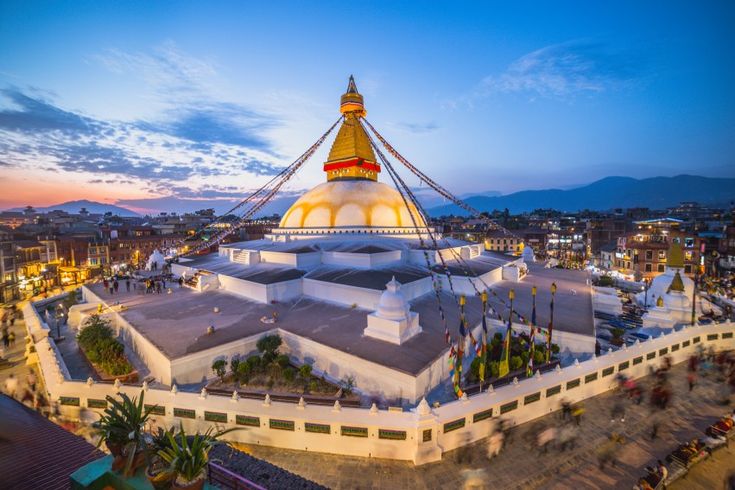
If time is short, the honest ranking is Bhaktapur first, Patan second, and Kathmandu Durbar Square third. Bhaktapur has the most intact urban fabric, meaning you get streets and courtyards rather than a square surrounded by traffic. Among the religious zones, Bauddhanath rewards an early morning or an evening visit when the circumambulation route fills with Tibetan and Sherpa pilgrims. Pashupati is a working cremation ground and should be approached as such rather than as an attraction.
Lumbini and the archaeology of the Buddha
Lumbini is the birthplace of Siddhartha Gautama, and unlike most sites attached to a founder figure it has physical evidence behind the claim. The Maya Devi Temple encloses excavated brick foundations and a marker stone, and beside it stands a sandstone pillar erected by the Mauryan emperor Ashoka in the third century BCE, whose inscription records his visit and identifies the site. Around the sacred garden, a large modern monastic zone holds temples built by Buddhist countries from Thailand to Germany, each in its own national style.
Lumbini rewards slowness. It is flat, hot for most of the year, and best covered by bicycle in the early morning. It also has a hinterland that most visitors skip entirely. Tilaurakot, a short drive away, is widely identified as the ruins of Kapilavastu, the town where the Buddha spent his early life, and it sits on Nepal’s tentative list for future inscription. Walking the excavated gateways there with nobody else present is a different experience from the monastic zone.
Chitwan and Sagarmatha: the two natural sites
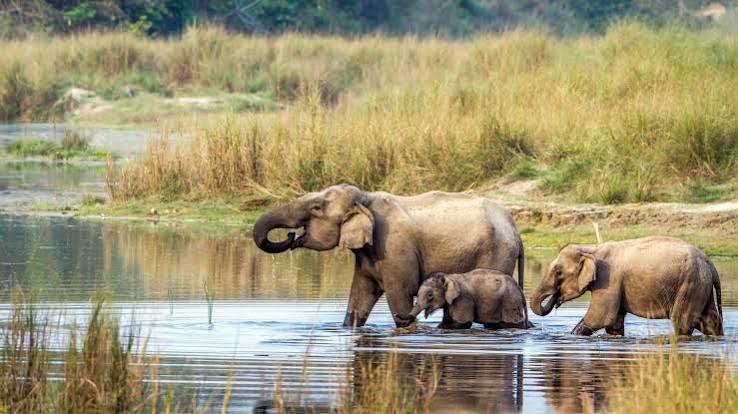
Chitwan National Park was Nepal’s first national park and remains its most visited. It protects sal forest, riverine grassland and oxbow lakes on the floodplain of the Rapti and Narayani rivers, and it is the stronghold of the greater one-horned rhinoceros. Tiger, sloth bear, gaur, gharial and more than five hundred recorded bird species share the same ground. A visit to Chitwan National Park works as a two or three night stop, and it sits conveniently on the road between Kathmandu, Pokhara and Lumbini.
Sagarmatha National Park is the outlier. It protects the Nepali side of Everest, which stands at 8,849 metres, along with Lhotse, Nuptse, Ama Dablam and the Khumbu glacier system, and it also protects the Sherpa cultural landscape of monasteries and high summer settlements woven through it. There is no road. Reaching the park means either a flight to Lukla and a walk of several days, or a longer approach on foot from lower down. Nobody visits Sagarmatha casually, and nobody should try to fit it into a fortnight that also includes the other three sites.
Which UNESCO sites can you realistically combine?
Three of the four form a natural circuit. Kathmandu, Chitwan and Lumbini all sit on the road network, and a loop taking in all three is comfortable in ten days with time to spare in each. Adding Pokhara costs nothing extra in effort and breaks up the longest drive. Sagarmatha is a separate trip and should be planned as one, ideally with two spare days built in for flight delays out of Lukla.
The commonest planning mistake is treating the Kathmandu Valley listing as a single afternoon. Seven monument zones in three cities, each with its own ticket and its own opening rhythm, cannot be compressed into a day tour without reducing all of them to a photograph. Three days is the minimum that leaves the valley feeling like a place rather than a checklist.
What else is on Nepal’s tentative list?
Nepal maintains a tentative list, the queue of sites it has formally proposed for possible future inscription. That list has been revised repeatedly and entries move on and off it, so treat any summary as provisional. It has included the archaeological remains at Tilaurakot and Ramagrama, the medieval walled settlement of Lo Manthang and the cave architecture of Upper Mustang, the Newar town of Khokana, and several protected areas in the west of the country.
The western entries are the interesting ones for anyone who wants heritage without crowds. The Sinja Valley in Jumla was the seat of the Khas Malla kings and is where the ancestor of modern Nepali developed, and its stone inscriptions and ruined settlements sit in open farmland with no ticket office and almost no visitors. Khaptad and Rara have both been raised as candidate natural sites. None of this carries a UNESCO plaque today, which is precisely why it is still quiet.
FAQ
How many UNESCO World Heritage Sites does Nepal have?
Nepal has four: the Kathmandu Valley, Sagarmatha National Park, Chitwan National Park and Lumbini. The Kathmandu Valley inscription covers seven separate monument zones, so the practical count of places to visit is ten.
Can you see all four UNESCO sites in Nepal in one trip?
Only with three weeks or more. Kathmandu, Chitwan and Lumbini connect easily by road and fit in about ten days. Sagarmatha National Park requires a flight to Lukla and a trek of roughly two weeks, so most travellers treat it as a separate journey.
Which UNESCO site in Nepal is best for a short visit?
Bhaktapur inside the Kathmandu Valley listing. The whole old town is walkable in a day, the streets and courtyards survive largely intact, and it needs no internal flight or long drive to reach.
Do you need a separate ticket for each Kathmandu Valley monument zone?
Yes. The seven zones are administered separately and each collects its own entry fee from foreign visitors, so carry cash and expect to pay at every site rather than once for the whole listing.
Is Lumbini worth visiting if you are not Buddhist?
Yes, mainly for the archaeology. The Ashokan pillar and the excavated foundations under the Maya Devi Temple are among the oldest datable structures in Nepal, and the international monastic zone is an unusual open-air survey of Buddhist architecture from across Asia.