
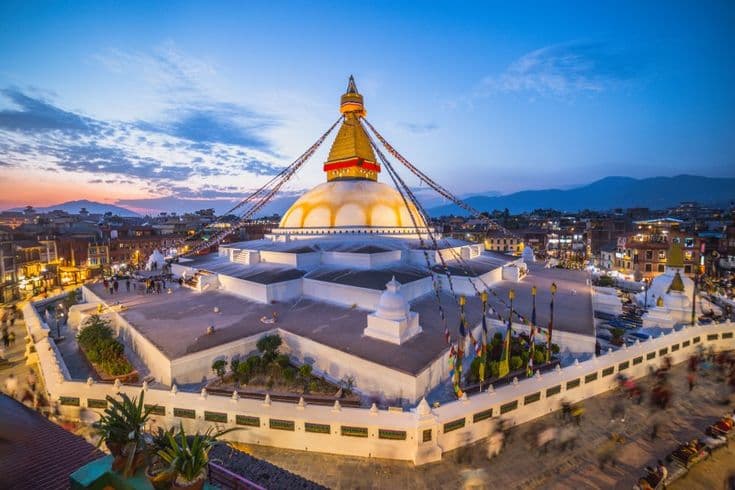
Boudhanath is a white dome about 36 m high standing in its own square at Boudha, in north-eastern Kathmandu, roughly six kilometres from Thamel and a short drive from the airport. It is among the largest stupas in Nepal, the centre of Tibetan Buddhist life in the country, and part of the Kathmandu Valley World Heritage inscription of 1979.
What you are looking at
The stupa is built as a mandala, which is easier to see from a rooftop than from the ground. A three-tiered plinth forms the base, stepped so that pilgrims can walk the upper levels; the white dome sits on it; above that the square harmika carries the painted eyes on all four sides, and the gilded spire above them rises in thirteen steps, read as the stages towards enlightenment. Rows of prayer wheels ring the outer wall, turned by hand by everyone who passes.
The spire was badly damaged in the 2015 earthquake, dismantled to the harmika and rebuilt, then reconsecrated the following year. The work was paid for largely by the Buddhist community and by donations rather than by the state, which is a point of quiet pride locally and worth knowing when you look at how clean the gilding is.
Visiting details
| Location | Boudha, north-eastern Kathmandu |
| Distance | About 6 km from Thamel, close to the airport |
| Status | Part of the Kathmandu Valley World Heritage inscription, 1979 |
| Height | About 36 m |
| Form | Three-tiered plinth, dome, harmika with eyes, thirteen-step spire |
| Rebuilt | Spire dismantled after the 2015 earthquake, reconsecrated in 2016 |
| Entry | Ticketed for foreign visitors at the lanes into the square |
| Kora | Walked clockwise, busiest at dawn and dusk |
| Main festival | Losar, in February or March |
| Time needed | One to two hours, longer if you visit the monasteries |
The kora, and when to walk it
The circuit around the stupa is the point of the place. It is walked clockwise, and the two times worth setting an alarm for are early morning, roughly between six and eight, and the hour after sunset. In the morning the crowd is almost entirely local and devotional: elderly Tibetans with hand-held prayer wheels, monks from the surrounding monasteries, whole families making circuits before work. At dusk butter lamps are lit in the lamp houses on the north side and the square fills again.
In the middle of the day the square belongs to tour groups and pigeons and is much less interesting. If you can only come once, come at one end of the day rather than the middle. Full-moon days are busier and better.
The monasteries around it
Boudha is not one monument but a quarter. A Tibetan community settled here in numbers after 1959, joining Tamang and Sherpa populations already long established, and the streets radiating from the square hold dozens of monasteries, some very large. Several open their courtyards and prayer halls to visitors outside teaching hours, and morning or evening puja, when it is audible from the street, is worth stopping for.
Ask before entering a hall, take your shoes off, and do not photograph during a ceremony without permission. The shops around the circuit sell thangka, statues and singing bowls at a wide range of quality and price; the good thangka studios will let you watch painters at work, and the difference between those and the printed versions is obvious once someone shows you.
Where it fits in a Kathmandu itinerary
An hour covers the stupa itself. Two or three is better, because Boudha rewards sitting still: rooftop cafés ring the square at first-floor height and give the best view of the mandala plan, and the kora looks entirely different from above. It pairs naturally with Pashupatinath, which is a few kilometres away on the same side of the city, and the standard order is the temple in the early morning and the stupa in the late afternoon. The third of the valley great Buddhist sites, Swayambhunath, is on the opposite side of Kathmandu and belongs to a different day.
Losar, the Tibetan new year in February or March, is the biggest day here, with masked dances at the monasteries and fresh saffron arcs painted down the dome. Dates move with the Tibetan calendar; our festival calendar tracks them. For the site's place among the seven monument zones, see the UNESCO sites guide and the longer account of how the Kathmandu Valley inscription came about. The Kathmandu Valley districts guide covers what else is within a short drive.
Frequently Asked Questions
Is there an entry fee for Boudhanath?
Yes, foreign visitors pay a ticket at the lanes leading into the stupa square, with a lower rate for SAARC nationals. It is collected at the entrance and there is no advance booking.
What is the best time of day to visit?
Early morning, roughly six to eight, or the hour after sunset when the butter lamps are lit. The middle of the day is the least interesting, with tour groups and little devotional activity.
Which way do you walk around the stupa?
Clockwise, keeping the stupa on your right, as everyone else will be doing. The upper plinth levels are open for walking too, and the prayer wheels on the outer wall are turned with the right hand.
Was Boudhanath damaged in the 2015 earthquake?
Yes. The spire was cracked, dismantled down to the harmika and rebuilt, then reconsecrated in 2016. The dome and plinth survived, and the work was funded largely by community and Buddhist donations.
Can you go inside the monasteries around the stupa?
Many welcome visitors into their courtyards and prayer halls outside teaching hours. Ask first, remove your shoes, keep quiet during puja and do not photograph a ceremony without asking permission.
How long should you spend at Boudhanath?
One hour for the stupa alone, two or three to do it properly with a rooftop café and a monastery or two. It is close to the airport, which makes it a good first or last stop in Nepal.