
Nepal has four UNESCO World Heritage Sites. Travellers routinely say seven or ten, and they are not entirely wrong to be confused. One of the four, the Kathmandu Valley, bundles seven separate monument zones into a single inscription, so counting temples instead of listings gives you a different number every time.
The four are the Kathmandu Valley and Sagarmatha National Park, both inscribed in 1979, Chitwan National Park in 1984, and Lumbini in 1997. Two cultural, two natural. Between them they cover the highest point on the planet, a floodplain full of rhinos, the birthplace of the Buddha and roughly a thousand years of Newar architecture. This is the history behind each listing and what the past two decades have done to them.
| Site | Year inscribed | Type | Where | Core reason for listing |
|---|---|---|---|---|
| Kathmandu Valley | 1979 | Cultural | Bagmati Province | Seven monument zones of Newar palace, temple and stupa architecture |
| Sagarmatha National Park | 1979 | Natural | Solukhumbu, Koshi Province | Extreme high mountain ecosystem including Everest and Sherpa cultural landscape |
| Chitwan National Park | 1984 | Natural | Chitwan and neighbouring districts | Last major stretch of Tarai lowland forest and grassland habitat |
| Lumbini | 1997 | Cultural | Rupandehi, Lumbini Province | Birthplace of the Buddha, documented by the Ashoka pillar inscription |
Why the Kathmandu Valley Counts as One Site
The 1979 Kathmandu Valley inscription is a single entry covering seven monument zones spread across three cities and several hilltops. The logic behind it is historical rather than geographical. All seven are products of the same civilisation, the Newar urban culture that built and rebuilt the Valley through the Licchavi and Malla centuries. Splitting them into separate listings would have implied they were separate traditions. They are not.
The three durbar squares exist for one blunt reason: dynastic rivalry. When the Malla realm split among heirs in the fifteenth century, Kathmandu, Patan and Bhaktapur became competing kingdoms within a few hours of each other. Each court then spent three hundred years trying to out-build the other two. That is why three palace squares within a short drive each hold a dense stack of pagoda temples, stone shikhara shrines, royal baths and courtyards, and why the styles rhyme without repeating.
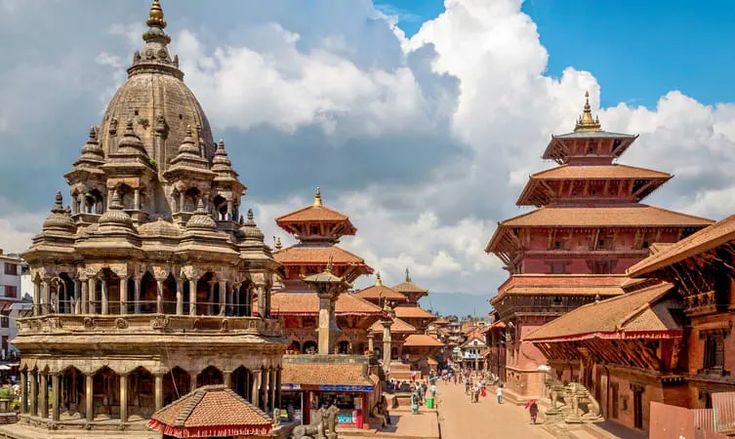
The Seven Monument Zones
Three are durbar squares, two are Buddhist stupas and two are Hindu temple complexes. Each documents a different piece of the same story.
| Monument zone | City or location | Type | Historical anchor |
|---|---|---|---|
| Hanuman Dhoka Durbar Square | Kathmandu | Royal palace complex | Malla capital, later seat of the Shah kings after 1769 |
| Patan Durbar Square | Lalitpur | Royal palace complex | Malla court patronage, including the 17th century Krishna Mandir |
| Bhaktapur Durbar Square | Bhaktapur | Royal palace complex | 55-window palace and the five-storey Nyatapola, early 18th century |
| Swayambhunath | Kathmandu | Buddhist stupa | Hilltop stupa tied to the Valley lake tradition, Licchavi era onward |
| Bauddhanath | Kathmandu | Buddhist stupa | Trade-road stupa, now the centre of Tibetan Buddhist Kathmandu |
| Pashupatinath | Kathmandu | Hindu temple complex | Bagmati riverside shrine of national importance to Shaivism |
| Changu Narayan | Bhaktapur district | Hindu temple complex | Holds the pillar inscription of King Manadeva dated to 464 CE |
Changu Narayan deserves more attention than it gets. Its Manadeva pillar inscription is the earliest firmly dated document in Nepal, which makes a quiet ridge-top temple above Bhaktapur the effective starting line of written Nepali history. Bhaktapur is the most complete of the three old towns because it was never absorbed into a modern capital and kept its brick lanes largely intact.
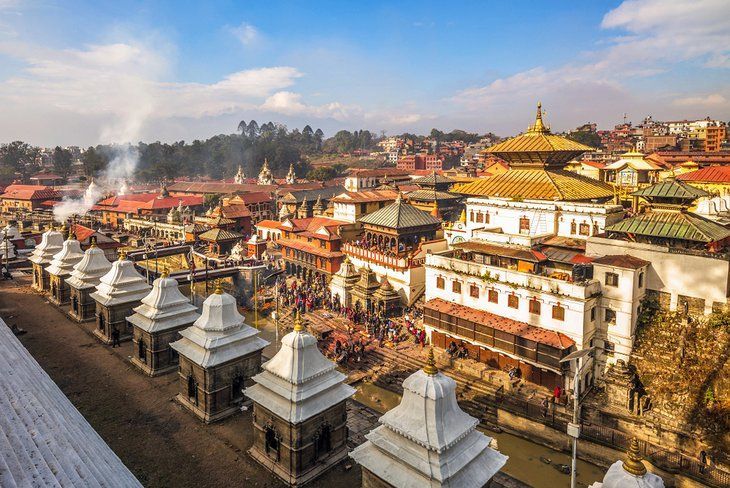
The Danger List Years
The Kathmandu Valley was placed on the List of World Heritage in Danger in 2003. The reasons were not dramatic collapse but slow attrition: uncontrolled construction inside and around the monument zones, loss of traditional buildings, unregulated development pressure and weak management coordination between the different authorities responsible. Nepal spent the following years tightening zone boundaries, restoring traditional buildings and improving management arrangements, and the Valley was removed from the danger list in 2007.
That episode is worth knowing because it explains what conservation in the Valley actually fights. The threat has rarely been a single event. It is the steady replacement of brick and carved timber with concrete, one plot at a time.
What the 2015 Earthquake Did
The Gorkha earthquake of 25 April 2015 hit the monument zones hard. Kasthamandap, the timber pavilion in Kathmandu Durbar Square that arguably gave the city its name, collapsed completely. Temples fell in Bhaktapur and Patan. Parts of the Hanuman Dhoka palace complex were badly damaged. The upper structure of Bauddhanath cracked and had to be dismantled and rebuilt, which was completed and reconsecrated the following year.
The reconstruction has been long, uneven and frequently argued about, and it is genuinely unfinished in places. Some structures were rebuilt using traditional timber joinery and reclaimed carved elements; others attracted criticism for shortcuts. Travellers today will still see scaffolding, propped walls and rebuilding in progress in all three durbar squares. That is not a reason to skip them. Watching a wood carver recut a strut for a temple that fell eleven years ago is one of the more memorable things you can do in the Valley.
The Two Natural Sites
Sagarmatha National Park was gazetted in 1976 and inscribed in 1979. The listing recognises an extreme high altitude ecosystem rather than a viewpoint. It runs from roughly 2,800 metres to the summit of Everest at 8,849 metres, and it protects glaciers, the Gokyo lake system, snow leopard and Himalayan tahr habitat, and the Sherpa settlements that are inseparable from the landscape. Almost everyone who walks the Everest Base Camp trail is inside a World Heritage Site the entire time and never thinks about it.
Chitwan National Park was established in 1973 as the first national park in Nepal and inscribed in 1984. It protects one of the last substantial blocks of Tarai lowland forest, grassland and riverine habitat, and it is the reason the greater one-horned rhino recovered from the edge of local extinction. Chitwan also holds a significant Bengal tiger population, gharial crocodiles and several hundred bird species. Its history is not only ecological. The forests were once royal hunting reserves, and the protection that followed had painful consequences for Tharu communities who had lived there for generations.
Which Nepali Sites Might Be Listed Next
Countries keep a tentative list, a queue of candidate sites they intend to nominate. Nepal has kept a long one for years, and it is heavily weighted toward places that see very few foreign visitors. It has included the Shakya city mound at Tilaurakot, the Ramagrama stupa in the eastern Tarai, the traditional Newar settlements of Khokana and Panauti, the cave architecture of Mustang, the medieval walled town of Lo Manthang, and the Sinja Valley in Karnali, the cradle of the Khas Malla kingdom and of the Nepali language itself. Several protected areas in the far west have appeared on it too. Tentative lists change, so treat any specific entry as something to verify rather than assume.
Practical Information for Travellers
All four sites are open year round, but the useful season is October to April for the Valley, Chitwan and Lumbini, and roughly March to May or October to November for the high Khumbu. Each Kathmandu Valley monument zone charges its own entry fee for foreign visitors, and the fees change, so budget rather than memorise. Bhaktapur charges the most and gives the most in return.
A workable plan for a first visit spends three days in the Valley, two nights in Chitwan and one full day at Lumbini. Sagarmatha needs a minimum of twelve days on foot and is a separate trip. If your interest is the architecture rather than the checklist, spend a full morning in one town instead of half an hour in three.
FAQ
How many UNESCO World Heritage Sites does Nepal have?
Four: the Kathmandu Valley and Sagarmatha National Park, both inscribed in 1979, Chitwan National Park in 1984, and Lumbini in 1997. Two are cultural and two are natural.
Why do people say Nepal has seven or ten World Heritage Sites?
Because the Kathmandu Valley listing contains seven monument zones. Counting those zones individually and adding the other three sites gives ten, but UNESCO records four inscriptions.
Was Nepal ever on the List of World Heritage in Danger?
Yes. The Kathmandu Valley was placed on the danger list in 2003 because of uncontrolled development and loss of traditional buildings, and it was removed in 2007 after boundary and management reforms.
Did the 2015 earthquake destroy the World Heritage sites?
It damaged them badly but did not destroy them. Kasthamandap collapsed, several temples fell and the top of Bauddhanath had to be rebuilt. All the monument zones are open, with restoration work still visible in places.
Can you visit all four Nepali World Heritage Sites in one trip?
Three of them easily, in about a week, since the Kathmandu Valley, Chitwan and Lumbini are linked by road and short flights. Sagarmatha National Park requires a trek of roughly two weeks and is normally a separate journey.