
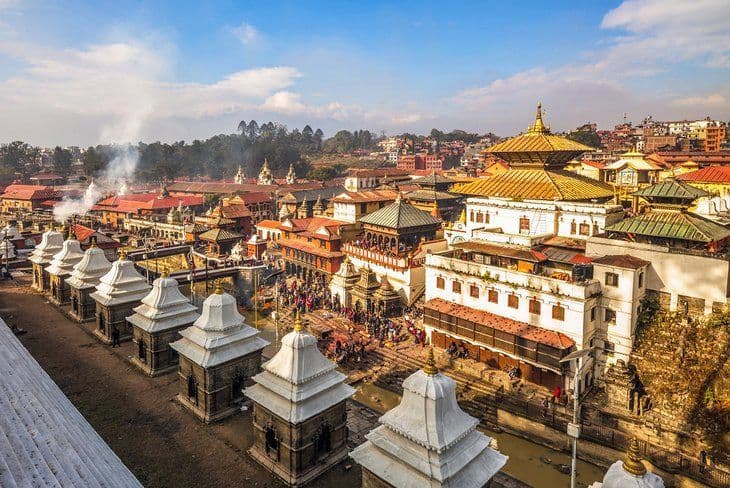
Pashupatinath is the principal Shiva temple of Nepal, standing on both banks of the Bagmati at Deopatan in eastern Kathmandu, about five kilometres from Thamel and a short drive from the airport. It is a working temple and a working cremation ground rather than a monument, and it forms part of the Kathmandu Valley World Heritage inscription made in 1979.
What you can and cannot enter
This is the thing to understand before you arrive. Non-Hindus are not admitted to the main temple courtyard, and no ticket changes that. What foreign visitors buy at the gate is access to the wider precinct, which is extensive: the eastern bank terraces, the ghats, the Gorakhnath complex, the wooded slope of Mrigasthali and the walk down to Guhyeshwari.
The usual route is to enter from the west, follow the river, cross a footbridge and climb the terraces on the east bank. From there you look straight across at the gilded roofs of the main temple and down onto the cremation platforms. It is the best vantage point in the precinct, and it is available to everybody.
Practical details
| Location | Deopatan, eastern Kathmandu, on the Bagmati |
| Distance | About 5 km from Thamel, close to the airport |
| Status | Part of the Kathmandu Valley World Heritage inscription, 1979 |
| Main temple | Present pagoda dates from the late seventeenth century |
| Access for non-Hindus | Precinct and east bank terraces only, not the main courtyard |
| Entry | Ticketed for foreign visitors at the gates, free for Nepalis |
| Opening | Before dawn to evening, with the inner shrine closed for part of the middle of the day |
| Best times | Early morning, and the evening river aarati |
| Main festivals | Maha Shivaratri, Teej, Bala Chaturdashi |
| Time needed | Two to three hours |
The cremation ghats, and how to behave there
Cremations happen on the platforms below the terraces every day of the year, in full view, and they are not a performance for visitors. Arya Ghat, immediately upstream of the footbridge, is reserved for particular families and is off limits; the platforms downstream are in general use, and that is where most of what you see takes place.
There is no rule against watching, and Nepali families do not generally object to a respectful foreign presence. There are practical rules worth keeping anyway. Do not photograph faces of the bereaved, and think hard before photographing a body at all. Do not stand at the edge of a platform in use. Do not treat the terrace above a pyre as a viewpoint for a group photograph, which happens more often than it should. If you would not do it at a funeral at home, do not do it here.
What else is in the precinct
Most people give the site an hour and miss most of it. Behind the east bank terraces the Gorakhnath complex opens into a courtyard of small stone Shiva shrines, quiet even in the middle of the day. The path continues through Mrigasthali, a wooded slope where deer are kept and macaques are numerous and confident, and drops to Guhyeshwari temple on the river downstream, an important shrine in its own right and again closed to non-Hindus at the sanctum.
The stretch of riverbank between the two is where sadhus, some resident and some seasonal, sit for photographs and expect payment for them. That transaction is entirely up to you; agree the price first if you want the picture. On full-moon evenings, classical music is sometimes played at the small Kirateshwar shrine near the bridge.
When to come
Early morning is the best hour of the day. The temple opens before dawn, the crowd is local rather than touristic, and the light on the west bank is good. The evening aarati on the river, when lamps are offered on the ghats, is the other set piece and draws a large audience; arrive well before dusk if you want a place on the steps.
Maha Shivaratri in February or March is the biggest day in the calendar here, when the precinct fills overnight and sadhus arrive from across India. It is extraordinary and it is not a good day for a first visit, because the queues run for hours and the crowd is dense. Teej brings thousands of women in red saris in August or September, and Bala Chaturdashi in late autumn brings a night vigil and a dawn procession. Our festival calendar gives the dates for the year.
Fitting it into a Kathmandu day
Two to three hours is right for a proper visit, more if you walk down to Guhyeshwari. Pashupatinath and Boudhanath are close to each other on the eastern side of the city and pair naturally: temple in the early morning, stupa at dusk when the butter lamps are lit. Both are near the airport, which makes them a sensible pair for a first or last day.
Dress modestly, cover shoulders and knees, and remove leather where signs ask you to. For the deeper history of the shrine, its priesthood and its place in Shaivism, read our complete guide to Pashupatinath; for how it sits among the country's other major shrines see the top temples of Nepal, and for the wider inscription the UNESCO sites guide. The Kathmandu Valley districts guide covers what else is within reach.
Frequently Asked Questions
Can non-Hindus enter Pashupatinath?
Not the main temple courtyard, which is restricted to Hindus. Foreign visitors buy a ticket for the wider precinct, which includes the east bank terraces overlooking the temple and the ghats, Gorakhnath and Mrigasthali.
Is there an entry fee?
Yes, foreign visitors pay a ticket at the precinct gates, with a lower rate for SAARC nationals and free entry for Nepalis. It is collected on the spot; there is no advance booking.
Can you watch a cremation?
Yes, from the terraces on the east bank, and it is not considered intrusive to observe quietly. Photographing the bereaved or a body at close range is another matter, and is best simply not done.
What time should you visit?
Early morning for the ritual life of the temple and the best light, or late afternoon for the evening river aarati. The middle of the day is the quietest for the shrine and the hottest on the terraces.
How long do you need at Pashupatinath?
Two to three hours covers the main temple viewpoints, the ghats and the Gorakhnath courtyard. Add another hour if you walk downstream through Mrigasthali to Guhyeshwari.
Can you combine Pashupatinath with Boudhanath?
Easily. They are a few kilometres apart on the eastern side of Kathmandu. The usual pairing is the temple in the early morning and the stupa at dusk, when the lamps are lit and the kora is busiest.