
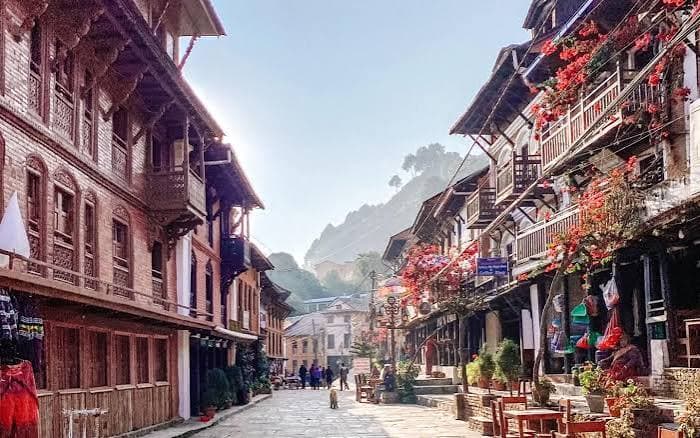
Bandipur is a hilltop town at about 1,030 metres in Tanahun district, Gandaki Province, on a ridge above the Prithvi Highway roughly halfway between Kathmandu and Pokhara. Its main street is a nineteenth-century Newar bazaar closed to vehicles, and it survives intact for the unglamorous reason that the highway was built in the valley below and left the town behind.
How a trading town gets preserved by being abandoned
Bandipur was settled by Newar merchant families from Bhaktapur in the nineteenth century, when trade between India and Tibet moved along the hill routes rather than the valleys. They built what they knew: tall brick and timber houses with carved windows, shuttered shopfronts at street level, a paved bazaar and temples at either end. For a century it was a prosperous customs and trading post.
Then the Prithvi Highway went in along the Marsyangdi valley in the 1970s, and commerce moved down to Dumre. Bandipur emptied. No money meant no rebuilding, so nobody replaced the timber facades with concrete, which is what happened to almost every comparable town in Nepal. When travellers rediscovered it in the 2000s the streetscape was still there. The town's good fortune was thirty years of economic irrelevance.
The building tradition itself comes from the Kathmandu Valley, and our guide to the Malla dynasty and the three kingdoms covers where that architecture was developed before it travelled west with the merchants.
Walking the bazaar
The main street is a few hundred metres of continuous nineteenth-century frontage, with no cars, a stone-paved surface and the Tundikhel parade ground at one end. Come to the Tundikhel at dawn: a flat grassy shelf on the edge of the ridge with an open northern view to the Himalaya. Bindabasini temple sits above the town, and the Thani Mai shrine on the ridge west of the bazaar is the standard sunrise walk, about thirty to forty minutes up.
Most of the merchant houses are now guesthouses and cafes, which is the compromise that pays for their upkeep. Some restorations are careful and some are not, but the street reads as a whole in a way that Kathmandu's equivalents no longer do.
Beyond the main street
Siddha Gufa, one of the largest caves in Nepal, is reached by a walk of an hour and a half to two hours down the hillside towards Bimalnagar, through forest and then a steep descent. Take a torch and someone who knows the path. The cave is a genuine chamber rather than a tourist installation, with stalactites and a bat colony, and the walk back up is the price.
Ramkot, a Magar village about ninety minutes west along the ridge, gives an easy half-day walk with round stone houses and no facilities. Both walks are more interesting than the town's formal attractions and neither needs a guide, although one helps at Siddha Gufa.
Fitting Bandipur into the route
The town's practical function is to break the Kathmandu to Pokhara drive, which is otherwise a long day in a bus. Get off at Dumre, take a jeep or taxi up the eight kilometres of switchbacks, and arrive in the afternoon. Kathmandu is roughly four to five hours below; Pokhara is two to two and a half.
It also pairs with Trishuli rafting, which happens on the same highway corridor, and with Nuwakot if you are building a route around Nepal's trading and military history. For the Kathmandu Valley towns whose architecture Bandipur inherited, see our Kathmandu Valley districts guide and the UNESCO sites guide.
| Detail | Bandipur |
|---|---|
| Elevation | About 1,030 m |
| District | Tanahun, Gandaki Province |
| Road head | Dumre on the Prithvi Highway, about 8 km below |
| From Kathmandu | 4 to 5 hours by road |
| From Pokhara | 2 to 2.5 hours by road |
| Main street | Pedestrian only, nineteenth-century Newar bazaar |
| Best season | Year round; October to February for the clearest Himalayan views |
| Typical stay | One or two nights |
Rooms range from simple guesthouses to restored heritage houses at prices closer to Pokhara's upper end, and the cafes are good, which is not something you can say of most Nepali hill towns. Mornings and evenings are the reason to stay overnight: day trippers arrive at eleven and leave at four, and the bazaar between six and eight is a different place entirely. The wider argument for stopping here rather than driving through is in our slow travel guide.
Frequently Asked Questions
How do I get to Bandipur from the highway?
Get off any Kathmandu to Pokhara bus at Dumre and take a local jeep or taxi for the eight-kilometre climb, which takes twenty to thirty minutes. Tourist buses will stop at Dumre on request if you tell the conductor in advance.
Is one night enough?
One night covers the bazaar, a sunrise walk and dinner. Two nights lets you add Siddha Gufa or the Ramkot ridge walk without rushing, which is what makes the stop worth the detour rather than just a break in the drive.
Can you see the Himalaya from Bandipur?
Yes, from the Tundikhel and the Thani Mai ridge on a clear morning, most reliably between October and February. Haze from late spring onwards closes the view for weeks at a time.
Why is the architecture Newari when the region is not?
The town was settled by Newar merchant families from Bhaktapur in the nineteenth century, who built in the style of the Kathmandu Valley. The surrounding hills are largely Magar and Gurung, which is why the villages half an hour away look nothing like the bazaar.
Is Siddha Gufa suitable for anyone?
It needs a steep descent of an hour and a half or so and a hard climb back, plus a torch and reasonable footwear. It is not a casual stroll, and it is unwise in the rain.