
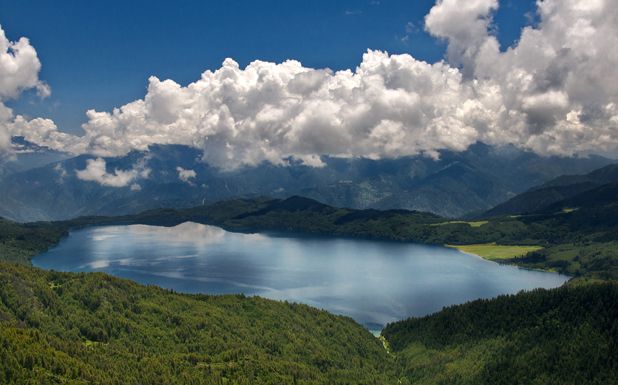
Rara National Park is the smallest national park in Nepal, covering about 106 square kilometres of Mugu and Jumla districts, and it was gazetted in 1976 around a single body of water. Rara Lake covers roughly 10.8 square kilometres at an altitude of 2,990 metres and reaches about 167 metres deep, making it both the largest and the deepest lake in the country; it was listed as a Ramsar wetland of international importance in 2007. Three species of snow trout that occur nowhere else on earth live in its water, and the blue pine forest around the shore holds red panda, Himalayan musk deer and Himalayan black bear.
What kind of lake is Rara?
An oligotrophic high-altitude freshwater lake in a basin generally described as tectonic in origin, sitting in a bowl of forested ridges with almost no farmland in its catchment. Oligotrophic means nutrient-poor, and that is the key to everything else about it. Low nutrient input means very little algal growth, which means exceptional water clarity and the deep blue-green colour that changes hour by hour with the light. It also means low biological productivity: the food web here is short, slow and easily disturbed.
The lake is roughly five kilometres long and three kilometres wide, and it drains at its western end through the Nijar Khola, which runs down into the Mugu Karnali and eventually into the Karnali river system. The catchment is small and almost entirely inside the park boundary, which is unusual and is the main reason the water quality has held up. Ice forms along the margins in the coldest weeks of winter, and snow lies on the surrounding ridges from roughly December to March.
| Feature | Figure | Note |
|---|---|---|
| Park area | About 106 sq km | The smallest national park in Nepal, gazetted 1976 |
| Lake surface area | About 10.8 sq km | The largest lake in the country by surface area |
| Maximum depth | About 167 m | Also the deepest lake in Nepal |
| Surface elevation | 2,990 m | Ridges around the basin rise to roughly 4,000 m |
| Outflow | Nijar Khola | Drains west into the Mugu Karnali and the Karnali system |
| Ramsar listing | 2007 | Designated a wetland of international importance |
Which fish live only in Rara Lake?
Three snow trout of the genus Schizothorax have been described from Rara and are considered endemic to it: Schizothorax raraensis, Schizothorax nepalensis and Schizothorax macrophthalmus. Endemic to a single lake is an extremely narrow distribution for a vertebrate, and it is the strongest single ecological argument for the park existing at all. The three species appear to partition the lake between them by depth and by feeding habit, which is a textbook pattern of isolation and divergence in a closed water body.
Their narrowness is also their vulnerability. A species that exists in one lake and nowhere else has no refuge if that lake changes. Introduction of a non-native fish, a shift in water chemistry from sewage or detergent runoff at the shore, or a change in the outflow regime would each be capable of doing permanent damage, and none of them would be reversible. This is why fishing inside the park is controlled and why the shoreline campsites are placed where they are.
What forest surrounds Rara Lake?
Blue pine dominates the immediate shoreline and the lower slopes, growing right down to the water on the northern and eastern sides and producing the reflection that most photographs of the lake are really about. Behind and above it the mix changes with aspect and altitude: west Himalayan spruce and black juniper on the drier ridges, Himalayan cypress in places, oak and rhododendron on the wetter southern flanks, and fir and birch approaching the high ground toward Chuchemara, the ridge on the south side that rises to around 4,000 metres. Juniper here is the slow-growing black juniper, and a stand cut for fuel at this altitude does not come back in a human lifetime.
The forest is the reason the mammal list is as good as it is. It is continuous, it is old, and it connects north and east toward the larger forest blocks of Mugu and the Karnali headwaters rather than ending at a farmed valley floor. That continuity is what allows a small park to hold species that normally need a large one.
Where do red panda and musk deer fit in the Rara ecosystem?
Rara sits near the western edge of the red panda range in Nepal, which makes the population here biogeographically important out of proportion to its size. Red panda need bamboo understorey beneath a closed canopy of fir, oak or rhododendron, and they use the wetter southern and eastern slopes rather than the dry pine shoreline. They are crepuscular, they move slowly and they are very hard to see; the practical evidence is droppings and claw marks on trunks rather than the animal.
Himalayan musk deer occupy the birch and fir zone above the lake and are solitary, small and nocturnal. The male carries the musk pod that has driven poaching pressure across the whole Himalaya for centuries, and snare removal is a routine part of patrol work in every park that holds the species. Alongside them the park supports Himalayan black bear, common leopard, Himalayan tahr, goral, yellow-throated marten, red fox, jackal and otter, with occasional records of Himalayan serow and wild dog. Otters using the lake margins and the Nijar Khola outflow are one of the more overlooked pleasures of an early morning on the shore.
Which birds use Rara Lake?
More than two hundred species have been recorded in the park, and the lake works as two quite different habitats through the year. In winter it becomes a staging and wintering site for migratory waterfowl moving along the Central Asian Flyway, and open water at 2,990 metres in a region where most standing water freezes is a genuinely scarce resource. Coot, mallard, common teal, gadwall, pochard and great crested grebe all use it, and the numbers rise through the coldest months. That flyway function is the main reason the Ramsar designation was made.
The forest and ridge birds are a separate list and a better spring proposition. Himalayan monal, the national bird, feeds on open slopes near the treeline and is often visible from the Chuchemara path in the early morning. Blood pheasant, kalij, snow partridge and Himalayan snowcock all occur. Lammergeier and Himalayan griffon patrol the ridgelines, and the forest holds nutcracker, treecreeper, laughingthrush and a good range of rosefinches. Late April through May, with rhododendron in flower and residents breeding, is the strongest window for birds; December through February is the strongest for waterfowl.
How has the ecosystem changed since 1976?
The most significant single change happened at the moment of gazetting. Two villages inside the boundary, Rara and Chhapra, were resettled to the lowlands when the park was created, which removed cultivation, grazing and firewood cutting from the immediate catchment in one step and is the clearest reason the water quality and the shoreline forest are in the condition they are. It also displaced people, and that history is part of how the park is regarded locally.
A buffer zone was declared around the park in 2006, bringing the surrounding communities into a revenue-sharing and community-forestry arrangement of the kind now standard across the system. The pressures today are grazing by livestock from outside the boundary, firewood collection, and the arrival of road access into Mugu, which has cut journey times dramatically and raised visitor numbers in the short summer season. Waste management on the shoreline and around the campsites is the practical front line. Compared with the deeper trans-Himalayan basin at Phoksundo in Dolpa or the crowded lakeshore at Phewa in Pokhara, Rara is still in unusually good ecological condition, and keeping it that way is a straightforward matter of keeping the catchment intact.
FAQ
How deep is Rara Lake?
About 167 metres at its deepest point, which makes it the deepest lake in Nepal as well as the largest by surface area at roughly 10.8 square kilometres. It sits at 2,990 metres.
Which fish are endemic to Rara Lake?
Three snow trout of the genus Schizothorax are described as endemic to the lake: Schizothorax raraensis, Schizothorax nepalensis and Schizothorax macrophthalmus. They are found in no other water body on earth.
Can you see red pandas at Rara?
Red panda are present near the western edge of their Nepali range, in the bamboo understorey on the wetter southern and eastern slopes rather than in the pine along the shore. Sightings are rare and normally require a guide, an early start and considerable patience.
Why is Rara Lake a Ramsar site?
It was designated in 2007 because it is a large, deep, high-altitude freshwater lake supporting endemic fish and functioning as a wintering and staging site for migratory waterfowl on the Central Asian Flyway. Open water at nearly 3,000 metres is a scarce resource in that region in midwinter.
When is the best time for wildlife at Rara?
Late April to May for breeding forest birds, rhododendron flowering and active mammals, and December to February for migratory waterfowl on the lake, with cold nights and possible snow on the approach. The monsoon months from late June to September bring cloud, leeches on the walk in and poor visibility.