Bardiya is a Tarai district in Lumbini Province, western Nepal, on the Indian border. Its headquarters is Gulariya, and it holds Bardiya National Park, the largest protected area in the Nepali lowlands and the country's strongest tiger population. The Karnali river enters the plain here and splits into braided channels along the park's western edge.
Bardiya is the one district in this province that people travel to for its own sake. It is also the one where the gap between reputation and reality runs the right way: visitors expecting a quieter Chitwan usually find the wildlife better and the crowds a fraction of the size. What it does not have is Chitwan's infrastructure, which is precisely why it works.
Where is Bardiya?
Bardiya lies between Banke to the east and Kailali to the west, with Surkhet climbing away to the north and the Indian state of Uttar Pradesh along the southern boundary. The district covers roughly 2,025 square kilometres, running from flat farmland in the south up into the Churia hills in the north, where the national park sits.
The organising feature is the Karnali. Nepal's longest river comes out of the hills at Chisapani, on the boundary with Kailali, passes under a long cable-stayed bridge that the east-west highway crosses, and immediately fans out into a braided delta of shifting channels. The largest eastern branch, the Geruwa, forms the western edge of the national park, and it is the reason the park has the habitat mix it does. Our overview of the country's drainage is at the river systems of Nepal.
Bardiya National Park
The park covers 968 square kilometres, which makes it the largest in the Tarai. It began as the Royal Karnali Wildlife Reserve in 1976, was renamed and enlarged over the following decade, and was gazetted as a national park in 1988. Roughly seventy per cent of it is sal forest, with the rest grassland, riverine forest and the channels of the Karnali system.
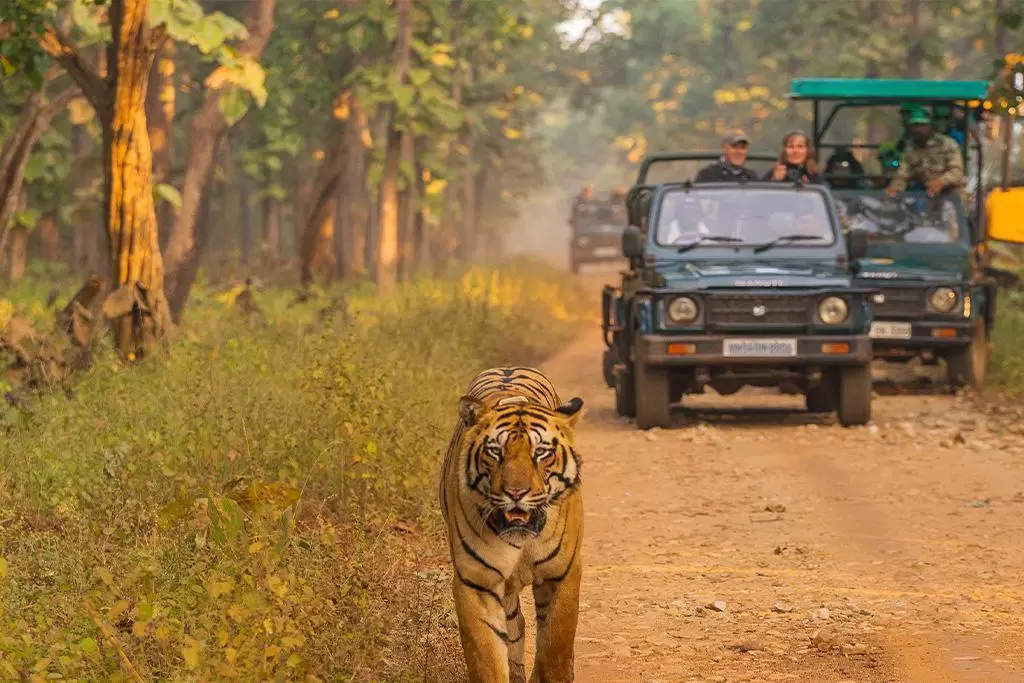
The tigers are the reason most people come. Nepal's 2022 national survey counted 355 tigers across the country, and Bardiya held the largest share of them at around 125, a figure that has climbed steeply from the low double digits two decades ago. Sightings are never guaranteed, and anyone promising one is selling something, but the odds here are as good as anywhere in Nepal, and better in the dry months when the grass is down.
The rest of the list is substantial. Greater one-horned rhino were reintroduced from Chitwan and hold a small population. Wild elephant move through, including some notably large bulls. Swamp deer, hog deer, sambar and chital are all common, and the Karnali channels hold gharial, mugger crocodile and Gangetic river dolphin, which is the single most surprising animal on the list for most visitors. Birding is strong year round, with over four hundred species recorded.
Watching is done on foot with a licensed guide, from machan towers overlooking grassland and waterholes, or from a jeep on the park tracks. Walking is the most rewarding and the most disciplined: you go slowly, you sit still for long stretches, and you follow instructions. The full breakdown of how to plan it sits in our guide to Bardiya National Park and its tigers.
Bardiya district at a glance
| Fact | Detail |
|---|---|
| Province | Lumbini Province |
| District headquarters | Gulariya |
| Area | About 2,025 square kilometres |
| Elevation range | Roughly 140 m on the plain to about 1,290 m in the Churia hills |
| National park | Bardiya National Park, 968 square kilometres, gazetted 1988 |
| Main visitor base | Thakurdwara, at the park headquarters |
| Journey time from Nepalgunj | Around three hours to Thakurdwara by road |
| Journey time from Kathmandu | An hour by air to Nepalgunj plus the road leg, or thirteen to sixteen hours by bus |
Thakurdwara and Gulariya
Two settlements matter and they do different jobs. Thakurdwara sits at the park headquarters in the north-west of the district and is where every lodge, guide and jeep is. It is a village strung along a dirt road with the park boundary on one side and Tharu farmland on the other, and it has grown just enough to hold twenty or so places to sleep without turning into a strip. There is a small museum, a crocodile breeding centre nearby, and not a great deal else, which is the point.
Gulariya is the district headquarters, twenty-odd kilometres south near the border, and it is a market town with offices, a hospital and no tourism. Most visitors never see it. If you need a bank, a chemist or a bus onward, it is where those things are, and it is a straightforward place to spend an hour between connections.
Tharu villages and the Dangaura communities
Bardiya's population is heavily Tharu, mostly Dangaura Tharu whose ancestors moved west from the Dang valley, alongside hill families who settled after malaria eradication opened the Tarai in the middle of the twentieth century. Around Thakurdwara the villages are close enough to walk to, and a guided walk through one is the standard afternoon activity when the park is closed in the heat.
The architecture is the immediate thing: long houses of mud and thatch, some with painted or relief-worked walls, grain stores raised off the ground, and a village layout that assumes shared work. Maghi in mid-January is the Tharu new year and by far the biggest festival. As in Dang, the kamaiya bonded labour system was strong here until its abolition in 2000, and the land rights of freed families remain unfinished business. Visiting respectfully means going with a local guide rather than wandering, and asking before photographing anyone. Our fuller treatment is at Tharu culture around Bardiya National Park.
The Karnali at Chisapani
The Karnali is the longest river in Nepal and the district's other headline feature. It leaves the hills at Chisapani on the Kailali boundary, passes under a long cable-stayed bridge carrying the east-west highway, and immediately breaks into braided channels across the plain. The stretch above Chisapani is the takeout for multi-day rafting expeditions that start days upstream in the Karnali hills, and it is one of the classic whitewater trips in the country.
Below the bridge the river behaves differently. The channels shift year to year, islands form and disappear, and the resulting mosaic of water, sand and riverine forest is the habitat that makes Bardiya's wildlife list what it is. Gharial and mugger crocodile use the sandbanks, the dolphins work the deeper pools, and the grassland between the channels is where swamp deer and rhino feed. Boat trips on the Geruwa branch run from the park in the dry season and are the calmest way to see any of it.
The buffer zone and the community forests
Around the park sits a buffer zone of community-managed forest and farmland, and understanding it explains a lot about how conservation works here. Buffer-zone user committees receive a share of park revenue, manage forest blocks and run the community homestays that some visitors stay in. In return, they carry the cost of living beside a national park: crop raiding by elephant and deer, occasional livestock losses to leopard and tiger, and the risk that comes with collecting fodder in forest where large animals live.
That arrangement is why tiger numbers have climbed rather than fallen, and it is also why the relationship is not uncomplicated. Visitors staying in the buffer zone rather than the lodges put money directly into that system. It is a reasonable thing to do and it is also, in practice, a more interesting way to spend a few nights.
Best time to visit Bardiya
October to early April, with two distinct windows inside that. October and November give clear air, comfortable temperatures and green country after the monsoon, and the birding is at its best. February to early April is the wildlife window: the tall elephant grass has been cut and burned by local communities under permit, sightlines open up dramatically, and the animals concentrate on the shrinking water. If tigers are your reason for coming, go in March.
May and June are punishing on the plain and regularly pass forty degrees. The monsoon from late June to September floods park tracks, closes river crossings and shuts most lodges. Our regional calendar is at the best time to visit western Nepal.
How to get to Bardiya and where to stay
The standard route is a flight from Kathmandu to Nepalgunj, about an hour, then roughly three hours by road west and north to Thakurdwara. Lodges will arrange the transfer and it is worth letting them, because the last stretch off the highway is not obvious. By bus from Kathmandu it is thirteen to sixteen hours to Ambassa on the highway, then a local jeep in. From Dhangadhi in the far west it is around three hours east.
Accommodation at Thakurdwara runs from simple community-run guesthouses to a handful of comfortable lodges with gardens and generators, and prices are modest by Nepali safari standards. Almost all of them include guided walks and jeep drives, and most work with local Tharu guides who grew up next to the park. Book ahead for March and for the October to November stretch, when the small number of good rooms fills. Bring long neutral clothing, insect repellent and binoculars, which nobody rents. For the neighbouring park an hour east, see the Banke National Park guide, and for the administrative context, the 77 districts of Nepal.
Frequently Asked Questions
Where is Bardiya district in Nepal?
Bardiya is in Lumbini Province in the western Tarai, between Banke to the east and Kailali to the west, with the Indian border to the south. Its headquarters is Gulariya and its main visitor base is Thakurdwara.
How many tigers are in Bardiya National Park?
Nepal's 2022 national tiger survey counted 355 tigers nationwide, with Bardiya holding the largest share at around 125. Numbers have risen sharply over the past two decades from a much smaller base.
Is Bardiya better than Chitwan?
For wildlife and quiet, most visitors say yes. Bardiya has fewer people, a larger park and a stronger tiger population. Chitwan has more lodges, easier access from Kathmandu and a wider range of facilities, so it suits a shorter or first trip.
When is the best time to see tigers in Bardiya?
February to early April, after the tall grassland has been cut and burned. Sightlines open up and animals concentrate near shrinking water. October and November are more comfortable and better for birds.
How do you get to Bardiya from Kathmandu?
Fly to Nepalgunj in about an hour, then drive roughly three hours to Thakurdwara. By bus it is thirteen to sixteen hours to Ambassa on the east-west highway, followed by a local jeep to the park.
Can you see river dolphins in Bardiya?
Gangetic river dolphins are present in the Karnali channels along the park boundary, though sightings depend on water levels and luck. They are most often reported in the cooler months when the river runs lower and clearer.
Do you need a guide inside Bardiya National Park?
Yes. Entry is with a licensed guide, whether on foot, from a machan tower or by jeep, and walking safaris in particular are run under strict instructions from the guide.
