
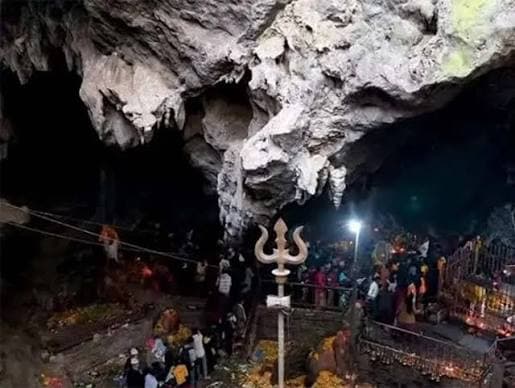
Halesi Mahadev is a limestone cave complex in Khotang district, Koshi Province, in the middle hills of eastern Nepal. Hindus revere the main cavern as a shrine of Shiva and call it the Pashupatinath of the east; Tibetan Buddhists know the same cave as Maratika and associate it with Padmasambhava. Both traditions use it at once.
Three caves, and how pilgrims move through them
The complex is usually described as three caves. The main one, the Mahadev cave, is entered down a steep stone stairway through a narrow mouth into a large chamber where limestone formations are worshipped as lingams and smeared with vermilion. It is dim, wet underfoot and warm compared with the air outside, and it smells of incense and lamp oil. A second cave is associated with Nandi, the bull, and a third with the serpent Basuki.
Two narrow openings out of the main chamber carry a well-known local test. Squeezing through one is said to release you from accumulated sin; the other is for merit. They are genuinely tight, and people of every build attempt them while a crowd offers commentary. Whatever you make of the theology, it is a good illustration of how completely this is a participatory site rather than a viewing one.
Take a torch. Lamps and electric lighting exist but are unreliable, the floor is uneven and the steps are slick where water runs.
Maratika: the same cave, a different lineage
In Tibetan Buddhist tradition the cave is Maratika, where Padmasambhava and his consort Mandarava are said to have accomplished the practice of long life and attained the realisation of the deathless. It is one of the significant pilgrimage caves of the Nyingma tradition, and monasteries and retreat quarters have been built on the ridge above. During Buddhist pilgrimage seasons you will see groups from Tibetan-speaking communities and from abroad, circumambulating and making offerings alongside Hindu families doing something entirely different in the same chamber.
The surrounding hills are Rai and Limbu country, and the Kirat relationship with the site predates both of the traditions above in local understanding. Our guide to the Kirat dynasty and ancient Nepal covers the communities whose territory this is.
Halesi Mahadev at a glance
| Detail | Halesi Mahadev |
|---|---|
| District | Khotang |
| Province | Koshi |
| Terrain | Middle hills, limestone |
| Caves in the complex | Three: Mahadev, Nandi and Basuki |
| Buddhist name | Maratika |
| Largest festival | Maha Shivaratri, February or March |
| Highway approach | Ghurmi, on the BP Highway, then north into the hills |
| Drive from Kathmandu | Roughly 10 to 12 hours, road conditions permitting |
| Permit | Not required |
| Best months | October to April |
The festivals are the reason to plan around a date
Maha Shivaratri in February or March is the largest gathering of the year and the cave runs day and night, with queues down the stairway and the whole hillside turned into a temporary market of food stalls, bangle sellers and sleeping mats. Ram Nawami in spring, Teej in late summer and Bala Chaturdashi are the other days that fill the site.
On an ordinary week there will still be a steady stream of domestic pilgrims, minibuses parked below the steps and priests working the chamber, but you will be able to move. Which version you want is a real choice: the festival is the site at full intensity and also the version where you will see very little of the cave itself. The lunar dating of all of these is explained in our festival calendar guide.
Getting there is the hard part
This is the reason Halesi receives enormous domestic traffic and almost no foreign visitors. There is no easy way in. The usual road route from Kathmandu runs east on the BP Highway to Ghurmi on the Sun Koshi, then climbs north into Khotang, and the whole journey takes most of a long day when conditions are good. The hill section is unsealed in places and deteriorates during and after the monsoon; landslides close it periodically.
Night buses and day buses run from Kathmandu, and shared jeeps cover the last stretch. Flying to one of the eastern hill airstrips and continuing by road is possible but schedules are thin and unreliable, so most visitors simply take the bus. Come with time in hand rather than a fixed onward booking.
What there is to stay in and eat
Accommodation at Halesi is pilgrim accommodation: simple lodges and dharamshalas near the top of the steps, shared bathrooms, hot water by the bucket. Food is dal bhat, tea, and fried snacks from the stalls. There are shops for basics and mobile coverage is generally usable, but do not expect an ATM you can rely on. Bring cash from Kathmandu or from a larger town on the way.
Nobody speaks much English, which is part of the character of the place rather than a problem, and pilgrims will go out of their way to explain what is happening if you show interest.
How it compares, and what to read next
The comparison with Pashupatinath is worth taking seriously and also worth qualifying. Both are major Shiva sites with continuous ritual use; the difference is that Pashupatinath sits in the capital with a state apparatus around it and an international visitor flow, and Halesi is a cave on a hill reached by a day on a bus. Our Pashupatinath guide covers the other end of that comparison, the Halesi Mahadev cave temple guide goes further into the site's own traditions, and the temples of Nepal overview places both within the country's wider pilgrimage geography.
Frequently Asked Questions
Where is Halesi Mahadev?
In Khotang district, Koshi Province, in the middle hills of eastern Nepal. The usual road approach leaves the BP Highway at Ghurmi on the Sun Koshi and climbs north into the district.
What is the road in like?
Sealed on the BP Highway as far as Ghurmi, then unsealed in places as it climbs north into Khotang, and closed by landslides during and after the monsoon. Come with time in hand rather than a fixed onward booking.
Do I need a torch inside the caves?
Take one. Lamps and electric lighting exist but are unreliable, the floor is uneven and wet underfoot, and the stone steps are slick where water runs down them.
Is Halesi a Hindu or a Buddhist site?
Both, simultaneously. Hindus worship the cave formations as Shiva lingams, while Tibetan Buddhists know the cave as Maratika and associate it with Padmasambhava and long-life practice. Kirat communities of the surrounding hills have their own relationship with it.
What is it like outside the festival dates?
A steady stream of domestic pilgrims, minibuses parked below the steps and priests working the chamber, but room to move. Maha Shivaratri in February or March is the other extreme: the cave runs day and night, and you will see very little of it.
What should I take?
Cash drawn in a larger town, shoes with grip for wet stone steps, and patience with the language. Accommodation is simple pilgrim lodging with bucket hot water, and English is little spoken.