For roughly six weeks from the middle of May, whole villages in Dolpa, Humla and Mugu move up to the high pastures to collect yarsagumba. Families camp above the tree line, schools empty out, and many households earn more in that window than in the rest of the year put together. It is the largest cash event in the Karnali calendar.
What yarsagumba actually is
A fungus that infects the larva of a ghost moth underground, kills it, and grows a thin brown fruiting body up through the soil. What gets collected is the whole thing: the mummified caterpillar with the stalk still attached, which is why the Tibetan name translates as summer grass, winter worm. It is sold by weight into the Chinese medicinal market, where it has been used for centuries. Our guide to the yarsagumba economy covers the trade chain and the money in detail; this piece is about the season on the ground.
Finding it is the hard part
The stalk comes up a few centimetres out of short alpine turf and is about the thickness of a matchstick. Collectors crawl. That is not a figure of speech — the posture is on hands and knees, face close to the ground, working across a slope in a line for hours at a stretch. Children are often the best at it, which is a large part of why schools in the collecting districts effectively close for the season.
It grows in a narrow band above the tree line and below the permanent snow, on grazing land that spends most of the year buried. Snowmelt timing sets the start of the season, so it shifts by a week or two from year to year and from one pasture to the next.
What the season looks like
| When | What happens |
|---|---|
| Late April to early May | Permits and collection fees arranged with the local committees and the district. Households sort out who goes up and who stays with the animals |
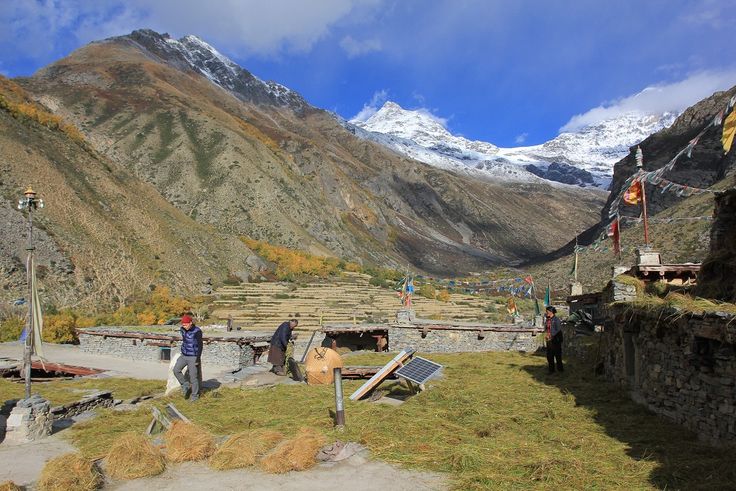
| Mid-May to mid-June | The peak. Tarpaulin camps on the pastures, whole families living up there, collecting from first light |
| Late June into July | The season closes as the grass grows up and hides the stalks. Higher and later pastures run longest |
| Through the summer | Drying, cleaning and grading, then selling on to traders. Most of the crop leaves Nepal |
Permits, fees and who is allowed up there
Collecting is neither free nor open to everyone. Local committees and district authorities charge collection fees, at a much higher rate for people from outside the district, and the government takes a royalty on the trade. Underneath the paperwork sits an older arrangement about whose grass it is: access to a particular pasture is controlled by the community that has always grazed it.
For a visitor the point is simpler. The pastures are not somewhere to wander in during the season. Upper Dolpo, most of Humla and parts of Mugu are restricted areas needing a permit and a registered guide in any case — the restricted-area permit guide sets out what that involves. May and June are also when porters and pack animals are hardest to hire in Dolpa, Humla and Mugu, because everybody who would carry your bag is up on the grass earning more.
The disputes
Access to a good pasture is worth a great deal of money for a short time, which is exactly the shape of problem that turns violent. Arguments between villages over boundaries, between locals and outside collectors, and over who is entitled to charge whom are routine, and the worst of them have gone badly wrong. The case everybody in the collecting districts knows is the killing of a group of collectors from outside the area at Nar, in Manang, in 2009, which ran through the courts for years afterwards. Most seasons pass without anything of the kind, but the tension is real, and it is why the committees police the pastures as closely as they do.
The sustainability question
Yields have been falling across the Himalaya for years, and collectors say the same thing everywhere: you climb higher and search longer than you used to for less. The species was assessed as Vulnerable on the IUCN Red List in 2020, with sustained overharvesting given as the reason. Warming is pushing the band it grows in further up the mountain, and above some of these pastures there is not much mountain left.
The pressure is structural rather than careless. A household that sits out a season loses the money that pays school fees, clears a debt, or covers the trip to hospital in Nepalgunj, so nobody sits out a season. Rotation schemes and closed periods exist in some districts, and enforcing them against that arithmetic is the whole difficulty.
If you are travelling in Karnali in May or June
Expect villages to be half empty, guesthouses unstaffed and shops shut, and expect to be told that no porter is available at any price. It is also a remarkable thing to come across: a temporary town of tarpaulins on a hillside, tea shops that appear for six weeks and then vanish. Ask before photographing, and do not buy from a collector — whether an onward sale to a foreigner is legal is not something to test at the airport.
Frequently Asked Questions
What is yarsagumba?
A parasitic fungus that infects ghost moth larvae underground and grows a fruiting body up through the soil. The harvested product is the caterpillar and stalk together, collected from Himalayan pastures and sold mainly into the Chinese medicinal market.
When is yarsagumba collected in Nepal?
Roughly mid-May to late June, depending on when the snow clears from each pasture. Higher grounds run later. The season ends when the grass grows tall enough to hide the stalks.
Where does yarsagumba grow in Nepal?
In alpine pasture above the tree line, mainly in Dolpa, Humla, Mugu, Jumla, Bajhang and Rukum, and in the northern districts further east. Dolpa is the best known of the Karnali collecting districts.
Can tourists collect or buy yarsagumba?
Collecting requires permission from the local committee and is in practice reserved for residents, with much higher fees for outsiders. Buying from a collector and carrying it out of the country is a customs and trade question rather than a souvenir one, so do not assume it is allowed.
Why is yarsagumba getting scarcer?
Decades of heavy collection, combined with a warming climate pushing its altitude band upwards. It was assessed as Vulnerable on the IUCN Red List in 2020, and collectors across the range report having to go higher and search longer for smaller returns.