
Shoes come off before you enter a temple. Walk clockwise around a shrine, keeping it on your right. Do not touch images, offerings or the priest. Ask before photographing people or the inside of a sanctum. If a temple is closed to you, a sign or a person will say so, and that is the end of it rather than a negotiation. Most of the rest is common sense applied a little more carefully than usual.
Shoes and leather
Footwear comes off at the entrance to the temple building, and at many sites at the entrance to the whole courtyard. Look for the pile of shoes and add yours to it. Socks are usually acceptable where shoes are not, but bare feet are the safe assumption, so travel with feet you do not mind putting on warm stone.
Leather is a separate rule and it catches people out. At Pashupatinath, leather items are not permitted inside: belts, bags, camera straps, watch straps. This is signed and enforced at the gates. Other temples are less strict, but if you are visiting a major Hindu shrine it is worth leaving the leather at your accommodation rather than arguing about a belt in a queue.
Which way to walk
Circumambulation is clockwise at Hindu temples and at Buddhist stupas and monasteries: you keep the shrine, the stupa or the mani wall on your right shoulder as you go round. Prayer wheels are spun clockwise, with the right hand, as you walk past them.
There is one important exception in West Nepal. Bon practitioners circumambulate anticlockwise, and Bon sites exist in Dolpa alongside Buddhist ones, including inside Shey Phoksundo National Park. If you see local people going the other way round a wall or a shrine, follow them rather than the rule you learned in Kathmandu.
Where non-Hindus may not go
Most Nepali temples are open to everyone. A small number of important Hindu shrines restrict the inner sanctum or the main courtyard to Hindus, and the most prominent is the main temple at Pashupatinath in Kathmandu, where non-Hindus can walk the wider complex and view the temple from the far bank of the Bagmati but may not enter the central courtyard.
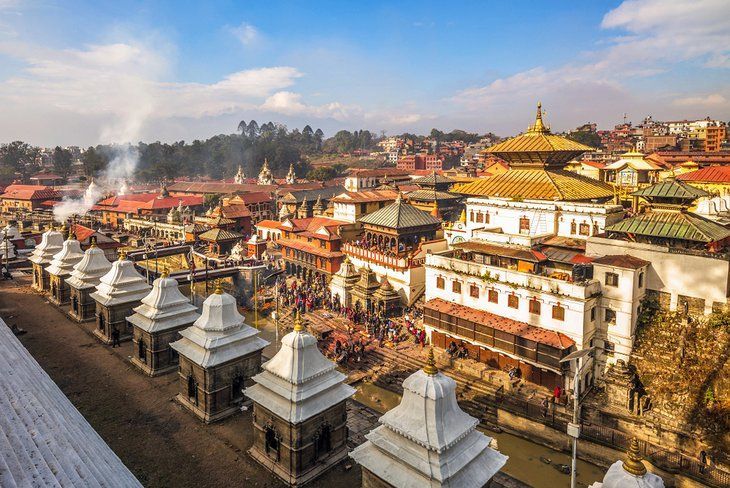
This is not personal and it is not a puzzle to be solved. Nobody is being tested, and there is no fee or dress code that unlocks it. Village shrines occasionally have their own restrictions, sometimes by caste, sometimes on entry by women who are menstruating, and these are rarely signposted in English. Ask, or watch what other visitors do, and accept the answer you get.
Photography
| Situation | Usual position |
|---|---|
| Courtyards, exteriors, architecture | Generally fine |
| Inside a sanctum, or of a deity image | Often prohibited. Look for a sign, then ask |
| People at prayer | Ask first, every time |
| Cremations at Pashupatinath | Do not. It is signed, and it is a funeral |
| Monks, priests, sadhus | Ask. Some sadhus will pose and then expect payment |
A camera changes how you are read in a religious space more than anything else you carry. Putting it away for the first ten minutes and looking at where you are will tell you what is acceptable faster than any guide can.
Prasad, tika and offerings
Prasad is food that has been offered to a deity and then distributed, and being handed some is a small kindness rather than a religious demand. Take it with your right hand, and eat at least a little. Refusing outright is the one thing that reads as a rejection.
Red powder pressed onto your forehead is tika, and accepting it is a blessing, not a conversion. It comes off with water. If you would rather not have it on your face, holding out your hand instead is understood and causes no offence.
Do not step over offerings laid on the ground, over a person sitting down, or over their outstretched feet. Do not point the soles of your feet at a shrine or an image, which mostly means being careful about how you sit. Do not touch the head of a child or an adult; the head is treated as the most sacred part of the body.
Donation boxes are common and a small note is a normal gesture. There is no expected amount and nobody is watching.
Dress, and the practical version of modesty
Shoulders and knees covered is the working standard for both men and women at temples anywhere in Nepal, and it matters more in the far west and the rural hills than it does in tourist Kathmandu. Long trousers or a long skirt, and a shirt with sleeves, will get you into everything. Carrying a light scarf solves most problems, including cold stone floors.
Beef is worth mentioning here because the connection is not obvious to everyone. The cow is sacred to Hindus and cow slaughter is illegal in Nepal. Do not bring beef products into a temple, and be aware that the subject is not a neutral one in conversation.
When you are not sure
Watch, wait and copy. If people are taking their shoes off at a particular line, take yours off at the same line. If nobody is going past a doorway, do not. Ask someone: temple staff, a priest, or simply the person next to you, and the answer will be given without irritation because being asked is easier for everyone than being surprised.
Almost everything in West Nepal is less formal than the major Kathmandu shrines, and simultaneously less used to visitors. The temple clusters around Dailekh are working local sites rather than monuments, and the same is true of the monasteries in the Limi valley. Turning up during a festival changes everything about what you will see and how crowded it will be, so it is worth checking the festival calendar before you plan a temple day, and the Dashain guide if you are travelling in the autumn.
Frequently Asked Questions
Can non-Hindus enter temples in Nepal?
Almost all of them, yes. The best known exception is the main courtyard of Pashupatinath in Kathmandu, which is open to Hindus only. A handful of other shrines have their own restrictions. Where a rule exists it will be stated, and it is not negotiable.
Do I have to take my shoes off?
Yes, before entering the temple building and often before entering the courtyard. Look for where other people are leaving theirs. Socks are usually tolerated where shoes are not.
Which direction do you walk around a temple?
Clockwise, keeping the shrine on your right, at both Hindu and Buddhist sites. The exception is Bon practice, which goes anticlockwise, and you will meet it in Dolpa. Follow what local people are doing.
Is it rude to refuse prasad?
Slightly, yes. Take it with your right hand and eat a little. If you genuinely cannot eat it, accept it anyway and keep it rather than handing it back.
Can I take photographs inside temples in Nepal?
Courtyards and exteriors are usually fine. Inner sanctums are often not, and photographing people at prayer or the cremations at Pashupatinath is not acceptable. When there is no sign, ask before you lift the camera.