The far west has three sunrises worth setting an alarm for: the open plateau at Khaptad, the ridges above Jumla and Rara, and Api seen from high ground in Darchula. All three need a genuinely clear morning, which in practice means October to early December, and all three require you to be cold and in position well before anything happens.
What you actually see
The good part comes before the sun does. For twenty minutes or so the snow peaks are lit while everything below them is still dark, first a flat pink, then orange, then plain white as the light becomes ordinary. Meanwhile the valleys underneath are usually full of cloud sitting below you like a floor. Once the sun is properly up the contrast collapses, the mist starts rising through the trees, and it is over.
Which means arriving at sunrise is arriving late. Be in place at least three quarters of an hour before. It is also worth knowing that Nepal runs a single time zone across the entire country and the far west is its western edge, so the sun comes up noticeably later here than it does in Kathmandu.
Khaptad
Khaptad is the unusual one, because it is flat. The plateau is open rolling grassland at around 3,000 metres, broken by patches of forest, and there is very little country like it anywhere else in Nepal. You are not looking up at a viewpoint from a valley; you are standing on a wide open top with sky in every direction, the eastern hills going gold, and on a clear morning the snow of the Saipal range away to the north.
The cost is the approach. Khaptad is a walk of a day or more from the road head, there is no lodge in the ordinary sense, and it is snowed in through the winter. The practical seasons are spring and autumn. Our Khaptad National Park guide covers the park and the access; the ashram guide covers the pilgrimage side and where people actually stay.
The ridges above Jumla and Rara
Khalanga sits low in the Tila valley with ridges on both sides, so the town itself gets the sun late and sees very little of the sunrise. Climb the trail north towards Rara for an hour or two and that changes: you get above the valley cloud, with the Kanjiroba peaks off to the north-east catching light first.
Rara itself is the better-known target. The lake sits at 2,990 metres, and the ridge above it — Murma Top — rises several hundred metres over the water. The reason to be up there at dawn is not only the peaks but the lake: it is dead flat at that hour, holds the whole colour change on its surface, and then wrinkles as soon as the morning wind arrives. The Rara National Park guide has the practicalities of getting there and staying.
Api from Darchula
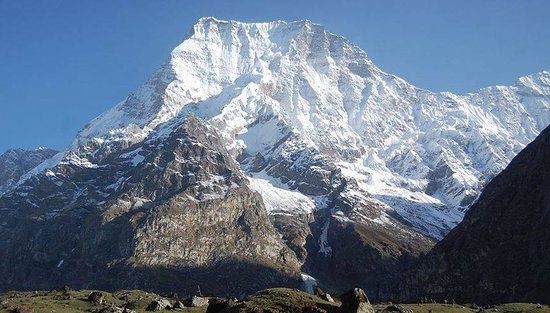
Api is 7,132 metres and the highest mountain in far western Nepal, with Saipal, just over 7,000 metres, its neighbour in Bajhang. The thing to understand before you plan around it is that Darchula bazaar is jammed into a deep valley on the Mahakali and you cannot see the mountain from it at all. Every view of Api involves climbing, either on the trail towards base camp or up to the villages on the ridges above the river. That is a day of effort minimum, not a hotel balcony.
| Where | District | What you see | Effort |
|---|---|---|---|
| Khaptad plateau | Doti, Bajhang, Achham, Bajura | Open grassland, sunrise over the eastern hills, Saipal to the north | A day or more on foot from the road head |
| Murma Top, above Rara | Mugu | The lake flat and lit, snow peaks north, cloud filling the valleys | A few hours uphill from the lakeside |
| Ridges north of Khalanga | Jumla | Above the valley cloud, Kanjiroba to the north-east | One to two hours from town |
| Ridges above the Mahakali | Darchula | Api and the far-western snow line | A hard day of climbing, or several on the base camp trail |
The odds of a clear morning
October and November are the best weeks of the year: the monsoon has washed the air, the dust of spring has not started, and long runs of clear mornings are normal. December and January are also clear at altitude, and brutally cold before dawn — Khaptad is out of the question and the high ridges need real winter kit. From March the haze builds, partly dust and partly field burning, and the mountains often stay a pale suggestion until a storm clears the air for a day. June to September is monsoon, and you will see cloud.
Valley cloud is a different thing from bad weather, and it works in your favour. On cold clear mornings the valleys fill with an inversion layer and the ridges stand out of it. From above, that is the best morning you can get; from the valley floor it looks like fog and feels like a wasted alarm. Plan around it by sleeping high. Our seasons guide sets out the wider trade-offs month by month.
Frequently Asked Questions
Where is the best sunrise in far west Nepal?
Khaptad for the open plateau and the sense of space, Murma Top above Rara for the lake, and the ridges above the Mahakali in Darchula for Api. Khaptad and Rara both need multi-day travel; none of the three is a roadside viewpoint.
When is the sky clearest in west Nepal?
October and November, with December and January nearly as reliable but far colder. Spring is hazy from dust and field burning, and the monsoon from June to September usually keeps the peaks out of sight entirely.
Can you see Api from Darchula bazaar?
No. The bazaar sits in a deep valley on the Mahakali with no line of sight to the mountain. You have to climb to the ridge villages above the river, or walk in towards Api base camp.
What time should I be in position?
At least forty-five minutes before sunrise. The peaks are lit well before the sun clears the horizon, and that pre-dawn window is the part worth being there for. Note that the far west sees sunrise later than Kathmandu, since Nepal uses one time zone throughout.