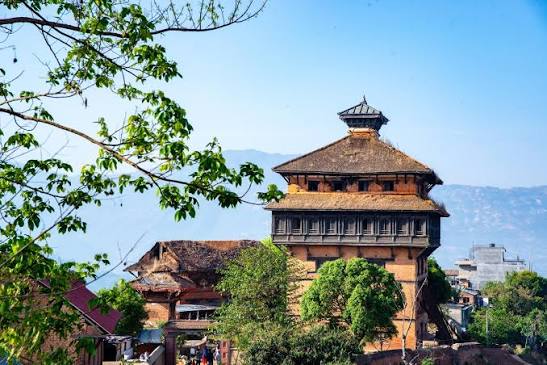
Nuwakot Durbar is a fortified palace complex around seventy kilometres north-west of Kathmandu, in Nuwakot district. Its centrepiece is the Saat Talle Durbar, the seven-storey tower Prithvi Narayan Shah used as his forward base after taking the town in 1744. From here he ran the campaign that ended with the capture of Kathmandu in 1768 and the founding of the modern Nepali state. It is one of the most consequential buildings in the country, and one of the least visited.
Why Nuwakot mattered so much
Look at a map of the old Kathmandu Valley trade routes and Nuwakot's importance becomes obvious. The valley was rich, walled by hills, and dependent on trade with Tibet. The route north ran through Nuwakot. Whoever held Nuwakot held the valley's northern trade, and could throttle it.
Prithvi Narayan Shah understood this. He inherited Gorkha, a small hill state to the west, in 1743. His first serious target was not Kathmandu but Nuwakot, which he took in 1744 after an earlier attempt failed. He then spent more than twenty years tightening the ring: seizing the hills around the valley, blockading its trade, and taking the fortified town of Kirtipur after repeated assaults. Kathmandu fell in 1768, Patan shortly afterwards, Bhaktapur the following year.
Nuwakot was the staging post for all of it. Shah kept a palace here for the rest of his life, and he died at Devighat, at the confluence below the town, in 1775. Our guide to Prithvi Narayan Shah and the unification of Nepal covers the campaign in full, and the military history of Gorkha explains where the army that fought it came from.
What is actually at the site
The complex sits on a ridge above the Trishuli valley and is walled, with the tower dominating everything. The Saat Talle Durbar is brick, tall and narrow, with carved timber windows and struts and a stepped profile that narrows as it rises. Seven storeys is unusual for Nepali palace architecture, where three or four is more typical, and the height was as much about surveillance as status. From the upper floors you can see a long way down the approaches.
Around it are smaller buildings from different periods, courtyards, and a Bhairavi temple that is the ritual focus of the site for local people rather than for visitors. The Bhairavi shrine has its own festival cycle and is in active worship, which gives the complex a working religious life alongside its museum function. Treat it as a temple rather than a monument when you are inside it.
| Detail | Nuwakot Durbar |
|---|---|
| District | Nuwakot, Bagmati Province |
| Distance from Kathmandu | Roughly 70 km by road |
| Typical drive | Three to four hours each way |
| Nearest town | Bidur, also known as Trishuli Bazaar |
| Built | Eighteenth century, under the Shah dynasty |
| Taken by Prithvi Narayan Shah | 1744 |
| Main structure | Saat Talle Durbar, the seven-storey tower |
| Also on site | Bhairavi temple, subsidiary palace buildings, walled courtyards |
The 2015 earthquake and the restoration
The April 2015 Gorkha earthquake hit Nuwakot hard. The district lay close to the rupture and lost a large share of its housing stock. The Durbar complex was damaged: masonry cracked, upper storeys were destabilised, and parts of the site were closed off. Restoration work has been under way since, supervised through Nepal's heritage authorities and at points supported from abroad.
What this means for a visitor is that the site is a live restoration project rather than a finished museum. Scaffolding, closed sections and work in progress are normal. Whether the tower interior can be entered, and how far up, has varied across the years of the works. Do not travel three hours on the assumption that you will climb to the seventh floor. Ask before you set out, or accept that you may be looking at the exterior.
It is genuinely worth seeing even in that state. Nepali timber-and-brick restoration is craft work, done by hand with traditional joinery, and watching it happen is part of the interest.
Getting to Nuwakot from Kathmandu
The standard route leaves Kathmandu on the road north through Balaju and Kakani, crosses the ridge, and drops into the Trishuli valley to Bidur, the district headquarters, also known as Trishuli Bazaar. The Durbar sits above the town. It is roughly seventy kilometres, but the number is misleading. The road is mountainous and in variable condition, and three to four hours each way is a realistic expectation rather than a pessimistic one.
There are three ways to do it. A hired car or taxi for the day is simplest, and lets you stop at Kakani for the mountain view on a clear morning. Public buses run from Kathmandu's Machhapokhari and Balaju areas to Trishuli Bazaar, cheaply and slowly, with a local jeep or a walk up at the far end. A motorbike is popular with Kathmandu residents and is the fastest option if you are confident on hill roads.
As a day trip it works, but it is a long day. Leaving Kathmandu by seven in the morning gives you a comfortable few hours at the site and gets you back before dark, which matters, because this road at night is not enjoyable. If you would rather not rush, Bidur and the surrounding area have simple guesthouses, and an overnight lets you add the Devighat confluence and the hot springs at Tatopani in the same district.
Combining Nuwakot with the Trishuli valley
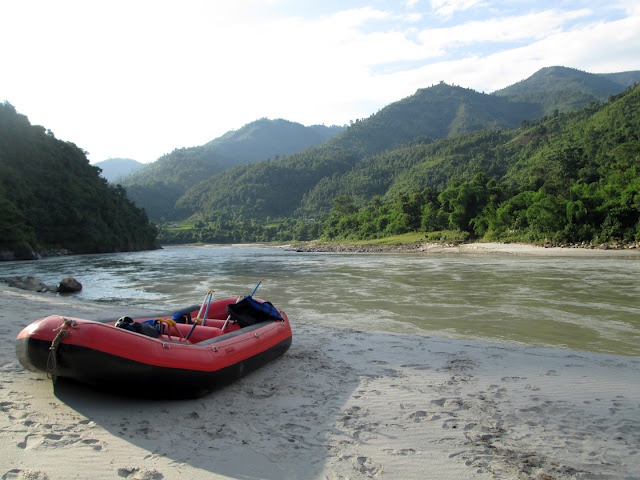
The Trishuli is one of Nepal's major rivers, and the valley below Nuwakot is the start of the rafting stretch that runs down toward Mugling and eventually joins the Kali Gandaki at Devghat. If you have a second day, the river is the obvious addition. Our guide to Nepal's river systems explains how the Trishuli fits into the wider drainage of the country.
Devighat, at the confluence just below Bidur, is where Prithvi Narayan Shah died in 1775, and it is a cremation and pilgrimage site in its own right. It is a short trip from the Durbar and closes the historical loop neatly: the king who took the fort is commemorated at the water below it.
Practical notes
There is an entry charge at the Durbar, with the usual Nepali structure of different rates for Nepali citizens, visitors from SAARC countries and other foreign nationals. It is modest. Bring cash in small notes, because change is a perennial problem and there is no card facility.
Food in Bidur is dal bhat and Newar and Tamang snacks in small local places, none of them aimed at tourists. There is no restaurant at the Durbar itself. Carry water. The site is exposed and the walking between buildings is on uneven stone, so proper shoes are worth more than they sound.
If Nuwakot leaves you wanting more of the same, the temples and palaces of the Kathmandu Valley are the natural next step, and our guide to the top temples of Nepal maps out which ones repay a full day.
The Bhairavi temple and the living side of the site
It is easy to treat Nuwakot as a history lesson with a building attached, and to miss that a substantial part of the complex is in daily worship. The Bhairavi temple within the walls is the ritual centre for the town, and it has its own annual jatra, a festival procession with music, offerings and a level of local participation that has nothing to do with the palace's national significance.
Bhairavi is a fierce form of the goddess, and shrines to her are typically the guardian deity of a fortified place. That pairing is the whole logic of the site: a garrison town needs a protective deity, and the deity gets a temple inside the walls. The military and the religious functions were never separate things here.
If your visit coincides with the jatra you will find the site crowded, noisy and much harder to photograph, and considerably more interesting. Ask in Bidur about the current date. Like all Nepali festival dates it moves against the Gregorian calendar, and the local municipality is a better source than any website.
The rest of Nuwakot district
Kakani, on the ridge you cross on the way from Kathmandu, is a viewpoint in its own right, with a long panorama toward Ganesh Himal and Langtang on a clear morning. It is best at dawn, which is an argument for the early start you should be making anyway, and it has a small number of resorts if you want to break the trip.
Tatopani in the same district has hot springs, of the plain concrete-pool variety rather than anything landscaped, and they are popular with Nepali visitors in winter. Devighat at the confluence below Bidur is the site associated with Prithvi Narayan Shah's death in 1775. Together with the Durbar these make a comfortable two-day trip rather than a rushed one, and the second day is where the district stops feeling like a single monument and starts feeling like a place.
Frequently Asked Questions
How far is Nuwakot Durbar from Kathmandu?
Roughly seventy kilometres by road, but allow three to four hours each way. The route climbs over the ridge at Kakani and drops into the Trishuli valley, and it is the road condition rather than the distance that sets the journey time.
Can you visit Nuwakot Durbar as a day trip?
Yes, and most people do. Leave Kathmandu by around seven in the morning to get several unhurried hours at the site and be back before dark. An overnight in Bidur lets you add Devighat and the Trishuli valley without rushing.
Why is it called the Saat Talle Durbar?
Saat talle means seven-storey in Nepali. Most Nepali palace towers are three or four storeys, so the height was exceptional and served a practical purpose: from the upper floors the garrison could watch the approaches to the town and the trade route north to Tibet.
Was Nuwakot Durbar damaged in the 2015 earthquake?
Yes. Nuwakot district lay close to the rupture of the April 2015 Gorkha earthquake and the palace complex suffered structural damage. Restoration has been under way since, so expect scaffolding and closed sections, and check before travelling whether the tower interior is open.
Why did Prithvi Narayan Shah capture Nuwakot first?
Nuwakot controlled the trade route between the Kathmandu Valley and Tibet. Taking it in 1744 let him strangle the valley's northern trade and gave him a fortified base within striking distance. Kathmandu itself did not fall until 1768, twenty-four years later.
Is there an entry fee at Nuwakot Durbar?
Yes, a modest one, charged at different rates for Nepali citizens, SAARC nationals and other foreign visitors. Bring small notes in cash; there is no card payment on site.
What else is there to see in Nuwakot district?
Devighat, the confluence below Bidur where Prithvi Narayan Shah died in 1775, the hot springs at Tatopani, and the Trishuli river valley itself, which is the top of Nepal's best-known rafting stretch.