A sandstone pillar stands inside a walled garden in Rupandehi district, on Nepal’s southern plain. The emperor Ashoka had it raised in the third century BCE, and the Brahmi inscription cut into it states that the Buddha was born on that spot. It is the oldest surviving physical evidence for the beginning of Buddhism anywhere in the world, and it stands in Nepal.
What grew out of that spot is not a museum sequence. Buddhism in Nepal never became purely historical. Newar priests still read Sanskrit manuscripts in courtyard monasteries in Patan that have functioned for something close to a thousand years. Monasteries above 4,000 metres in Dolpo and Mustang preserve Tibetan lineages that were broken elsewhere. The history of Buddhism in Nepal is best read as three overlapping streams rather than one straight line.
Where Buddhism Began: Lumbini and the Shakya Homeland
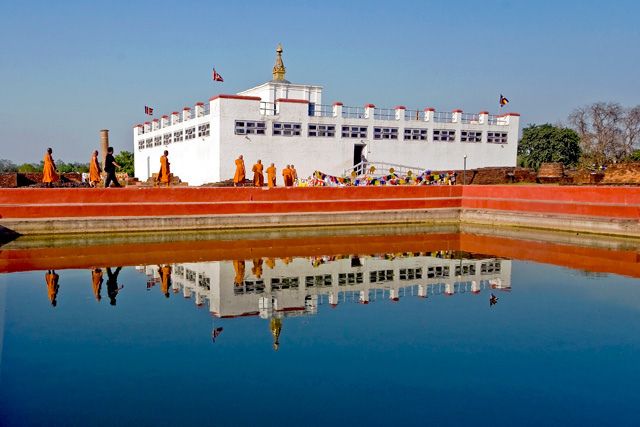
Siddhartha Gautama was born into the Shakya clan in the sixth or fifth century BCE. Historians argue about the exact decades. Nobody serious argues about the place. Lumbini lay inside Shakya territory in the Tarai, the flat farming belt that runs the length of Nepal’s southern border.
Ashoka came here roughly two centuries after the Buddha’s death and left the pillar as a kind of imperial receipt. The site then dropped out of memory for a very long stretch. It was identified again in 1896, when the buried pillar and its inscription were examined and the garden was matched against the descriptions left by Chinese pilgrims who had walked to it in the fifth and seventh centuries CE. Lumbini was inscribed as a UNESCO World Heritage Site in 1997.
A short drive west, Tilaurakot is widely identified with Kapilavastu, the Shakya capital where the future Buddha grew up. Its mounds, moat and eastern gateway see a fraction of the visitors that Lumbini does, and they give a far better sense of the small republic he walked away from.
How Buddhism Reached the Kathmandu Valley
Tradition holds that Ashoka travelled north into the Kathmandu Valley himself, and that his daughter Charumati founded a monastery in the settlement now called Chabahil. The four earthen mounds that ring the old town of Patan are still called the Ashoka stupas. Archaeology has not confirmed the visit. The persistence of the story is itself significant: the Valley has claimed a direct line to the Mauryan period for a very long time.
What is documented is the Licchavi period, roughly the fourth to the ninth century CE, which left stone inscriptions, sculpture, votive chaityas and the earliest recognisable forms of the great stupas. By then the Valley was a junction on the trade road between the Gangetic plain and Tibet. Buddhism moved along the same routes as salt, wool, grain and paper.
Swayambhu and the Story of the Valley Lake
Newar Buddhist tradition says the Kathmandu Valley was once a lake, and that the bodhisattva Manjushri cut open the gorge at Chobhar to drain it. A self-arisen flame rose from the water where Swayambhunath now stands, and the stupa was built over it. Geology broadly agrees about the lake, which makes the legend one of the more satisfying pieces of oral memory anywhere in the Himalaya. The hilltop complex has been repaired and rebuilt many times over; its present form reflects layer on layer of patronage rather than one founding date.
Newar Vajrayana: The Tradition That Stayed Put
When organised Buddhist monasticism collapsed in northern India, the Kathmandu Valley kept going. Newar Buddhism is a Vajrayana tradition practised by a settled urban community, and it has features you will not find anywhere else. Its priests, drawn from the Vajracharya and Shakya lineages, marry and pass the role down through the family rather than taking celibate vows. Its monasteries are courtyard buildings, called bahal and bahi, embedded inside dense city blocks instead of standing apart on ridges. Its Sanskrit manuscripts, including the group of texts known as the Nine Dharmas, survived here after being lost in India, and nineteenth century European scholarship on Indian Buddhism leaned heavily on copies collected in Kathmandu.
The clearest single place to see the tradition working is Kwa Bahal, the gilt-fronted courtyard monastery usually called the Golden Temple, a few minutes north of Patan Durbar Square. During Gunla, the holy lunar month that falls in the monsoon, music groups walk the old processional routes at dawn and the bahals open displays of their treasures.
Tibetan Buddhism in the High Himalaya
The third stream came over the passes. From roughly the eleventh century onward, Tibetan Buddhist schools took root along Nepal’s northern rim: Mustang, Dolpo, Manang, Nubri, Tsum, Solu-Khumbu, Limi and the upper Karnali valleys. These communities are culturally Tibetan, speak Tibetan-family languages, and have kept monastic architecture, mural painting and manuscript traditions intact partly because they were so difficult to reach.
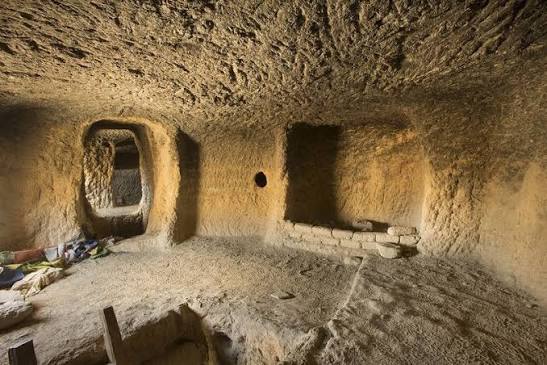
The walled town of Lo Manthang in Upper Mustang holds fifteenth century assembly halls whose wall paintings rank with anything on the Tibetan plateau. The cliffs above the same valleys are riddled with man-made caves used as meditation cells, granaries and burial chambers. In Dolpo, the Bon tradition, which runs parallel to Buddhism and in places predates it, survives alongside Buddhist gompas in the country around Shey Phoksundo. In the Limi Valley in Humla, village monasteries preserve early western Tibetan styles that have largely disappeared north of the border.
Boudhanath, 1959 and the Shape of Nepali Buddhism Today
The largest single change of the last century came in 1959, when very large numbers of Tibetans crossed into Nepal and India. Boudhanath, already a stop on the old Kathmandu to Lhasa trade road and long a Tamang devotional centre, became the anchor of that community. Monasteries representing the Nyingma, Kagyu, Sakya and Gelug schools were built through the surrounding lanes over the decades that followed. Walking the kora at dusk today means walking through a twentieth century displacement as much as an ancient monument.
A quieter revival ran in parallel. Theravada Buddhism, effectively absent from Nepal for centuries, was reintroduced in the early twentieth century by Newar monks who had taken ordination in Burma, Sri Lanka and India. The Rana government expelled a group of them in the 1940s. They regrouped across the border, returned after the Rana regime fell in 1951, and Theravada vihars and vipassana meditation centres are now an ordinary part of Nepali religious life, in Kathmandu and in the western hills alike.
The Main Buddhist Sites and What Each One Represents
Nepal packs an unusual amount of Buddhist history into a small country. This table sorts the essential sites by what they actually document, which is more useful than sorting them by fame.
| Site | District | Tradition | Period | What to look for |
|---|---|---|---|---|
| Lumbini | Rupandehi | Shared by all schools | Pillar from the 3rd century BCE | Ashoka pillar, Maya Devi temple, marker stone, monastic zone |
| Tilaurakot | Kapilvastu | Early historic | Mid first millennium BCE | Ramparts, moat, eastern gateway, excavated mounds |
| Swayambhunath | Kathmandu | Newar Vajrayana | Licchavi onward, rebuilt repeatedly | Stupa dome, painted eyes, Manjushri hill, Harati shrine |
| Boudhanath | Kathmandu | Tibetan schools | Medieval, restored after 2015 | Mandala terraces, kora circuit, surrounding monasteries |
| Kwa Bahal | Lalitpur | Newar Vajrayana | Medieval courtyard monastery | Gilt facade, hereditary priesthood, daily ritual |
| Lo Manthang | Mustang | Tibetan, mainly Sakya | 15th century | Thubchen and Jampa assembly halls, walled town, murals |
| Shey Gompa | Dolpa | Tibetan and Bon | Medieval | Crystal Mountain circuit, remote yarsa settlements |
Practical Information for Travellers
The Kathmandu Valley sites are open year round and reachable in a day each. Lumbini is best from October to March; the Tarai is punishing in May and June and waterlogged in the monsoon. The high Himalayan monasteries have a much narrower window, roughly May to early October, because the passes carry snow the rest of the year.
Upper Mustang, Dolpo and Humla sit inside restricted areas. Entry requires a restricted area permit arranged through a registered agency, a licensed guide and, in practice, a minimum group size. Permit rules and costs change, so confirm current conditions with a registered agency rather than with an old forum post.
Etiquette is straightforward and worth getting right. Walk clockwise around stupas, mani walls and chortens. Remove shoes and hats before entering an assembly hall. Ask before photographing people at prayer, and never photograph inside a shrine room if a sign or a monk says no. Buddha Jayanti, the full moon of Baisakh in April or May, marks the birth, enlightenment and death of the Buddha and fills Lumbini, Swayambhu and Boudhanath at once. Losar, the Tibetan new year, falls in February or March and is the best time to see high valley communities at home.
FAQ
Was the Buddha born in Nepal or India?
In Nepal. Lumbini, in Rupandehi district, is the birthplace, confirmed by the Ashoka pillar inscription and inscribed as a UNESCO World Heritage Site in 1997. He later taught and died in what is now India, which is where the confusion comes from.
What is the difference between Newar Buddhism and Tibetan Buddhism in Nepal?
Both are Vajrayana, but Newar Buddhism is an urban Kathmandu Valley tradition with married hereditary priests, Sanskrit texts and courtyard monasteries, while the Tibetan schools of the high valleys use Tibetan texts, celibate monastic ordination and the familiar gompa architecture.
Which Buddhist sites in Nepal are UNESCO World Heritage?
Lumbini is listed in its own right. Swayambhunath and Boudhanath are two of the seven monument zones inside the Kathmandu Valley listing. Tilaurakot sits on the tentative list rather than the inscribed list.
When is the best time to visit Buddhist sites in Nepal?
October to April for Lumbini and the Kathmandu Valley, with clear skies and mild days. May to early October for the Himalayan monasteries of Mustang, Dolpo and Humla, which are cut off by snow in winter.
Do I need a permit to visit Himalayan monasteries in Nepal?
Not for the Kathmandu Valley or Lumbini. Upper Mustang, Dolpo and Humla are restricted areas that require a permit arranged through a registered trekking agency, plus a licensed guide, so plan those trips several weeks ahead.