
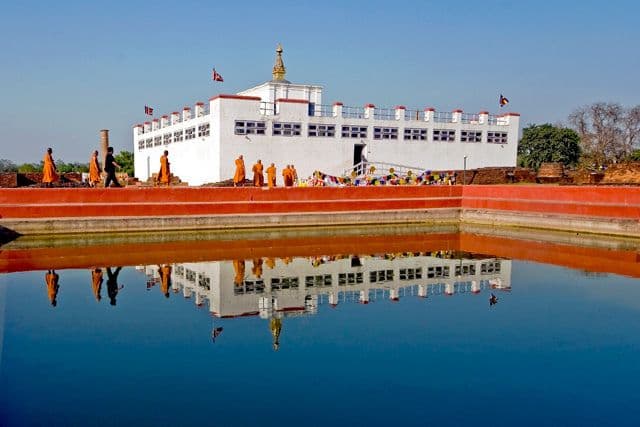
Lumbini is the birthplace of Siddhartha Gautama, in Rupandehi district of Lumbini Province on the Nepal Terai near the Indian border. The sacred garden at its centre holds the Maya Devi Temple, a pillar erected by the emperor Ashoka in 249 BCE and the Puskarini bathing pond. It was inscribed on the UNESCO World Heritage list in 1997.
The garden, and the three things in it that matter
Everything that makes Lumbini Lumbini is inside a small walled enclosure at the southern end of the site. Shoes come off at the boundary and stay off on the brick paths, which get very hot by mid-morning.
Inside the Maya Devi Temple building, a walkway runs above excavated brick foundations. Set within them is a marker stone, identified as the point of the birth, and on the wall nearby a worn sandstone relief of the nativity showing Maya Devi holding a branch. Outside, the Ashoka pillar carries an inscription in Brahmi recording the emperor's visit twenty years after his consecration and the tax relief he granted the village. That inscription is the archaeological evidence for the identification of the site. South of the temple lies the Puskarini, a stepped rectangular pond, and beside it a large pipal tree hung with so many prayer flags that the branches are barely visible.
Monks sit and chant in groups on the lawns. It is quieter than any other major pilgrimage site in Nepal, and the quiet is enforced.
Lumbini at a glance
| Detail | Lumbini |
|---|---|
| District | Rupandehi |
| Province | Lumbini |
| Terrain | Terai lowland plain |
| Ashoka pillar erected | 249 BCE |
| World Heritage listing | 1997 |
| Master plan | Kenzo Tange, adopted in 1978 |
| Nearest airport | Gautam Buddha International, Bhairahawa |
| Distance from Bhairahawa | About 22 km |
| Most comfortable months | October to March |
| Entry | Ticketed for foreign visitors; shoes off inside the sacred garden |
The monastic zone is a planned city
What surprises most first-time visitors is the scale. Lumbini is not a temple; it is a rectangular planned zone several kilometres long, laid out to a master plan drawn by the Japanese architect Kenzo Tange and adopted in 1978. A central canal runs the length of it. The sacred garden sits at the southern end, the monastic zones occupy the middle, and a World Peace Pagoda and crane sanctuary lie at the northern end.
The monastic zones are divided by tradition: Theravada foundations on one side of the canal, Mahayana and Vajrayana on the other. More than thirty countries have built monasteries on allocated plots, each in its own national idiom, so a twenty-minute walk takes you past a Thai vihara in white and gold, a Myanmar shrine modelled on Shwedagon, a German-funded stupa with a painted interior, and Korean, Chinese, Vietnamese, Cambodian and Sri Lankan compounds. Some are finished and staffed; others are half-built with cement dust on the steps. It is an odd and genuinely interesting piece of twentieth-century architecture as much as a religious site.
If you only have half a day
Start in the sacred garden early, before the heat and before the coach parties. Then take a cycle rickshaw or an electric rickshaw north along the canal and stop at three or four monasteries rather than trying to see all of them, which is a mistake people make and regret by the fourth. The Myanmar and Thai compounds are the most striking from outside; the German-funded Lotus Stupa is the one to enter, for the painted walls. Finish at the World Peace Pagoda if you have the time and the daylight.
Bicycles can be hired in the village and are the pleasant way to cover the distances, which are longer than they look on the site map. Walking the full length in the middle of the day is a mistake in any month except December and January.
Getting there
Gautam Buddha International Airport at Bhairahawa, about twenty-two kilometres away, is the nearest airport and takes domestic flights from Kathmandu as well as some international services. By road, Lumbini sits just off the east-west highway; buses from Kathmandu and Pokhara take most of a day, and the Sunauli border crossing to India is close enough that many pilgrims arrive overland from Uttar Pradesh. Visitors flying in from further afield will find the entry process covered in our visa on arrival guide.
The heat decides your dates
This is the Terai, not the hills. From April to early June the plains are extremely hot, and walking a site of this size in the middle of the day is genuinely unpleasant. The monsoon from June to September is humid and wet but green and empty of visitors. October to March is the comfortable window, and December and January mornings can be cold and foggy, which is atmospheric in the garden and occasionally disruptive for flights into Bhairahawa. Buddha Jayanti in April or May is the site's largest day of the year, and the festival calendar guide explains how that date moves.
The wider Kapilavastu circuit
Lumbini is where the Buddha was born, but he grew up elsewhere. Tilaurakot, west of Lumbini, is the leading candidate for ancient Kapilavastu, the Shakya capital where Siddhartha lived until he left at twenty-nine, and its excavated gateways and ramparts are quiet and largely unvisited. Several smaller sites nearby are associated with earlier Buddhas and with the return of relics. Pilgrims doing the full circuit take two or three days over it. If you are placing Lumbini in the wider picture of the country's listed heritage, see our history of Nepal's World Heritage listings and the World Heritage sites guide; for religious architecture more broadly, the temples of Nepal overview is the place to start.
Frequently Asked Questions
What proves that the Buddha was born at Lumbini?
The Ashoka pillar of 249 BCE carries an inscription recording the emperor's visit and identifying the site as the birthplace, and excavation beneath the Maya Devi Temple has exposed successive brick structures around a marker stone. The pillar inscription is the primary evidence.
How long do I need at Lumbini?
A full day is comfortable: a morning in the sacred garden and an afternoon among the monasteries. Two days lets you add Tilaurakot and the smaller sites of the Kapilavastu circuit.
What is the nearest airport?
Gautam Buddha International Airport at Bhairahawa, about twenty-two kilometres away. Lumbini is also close to the Sunauli land border with India and sits just off the east-west highway.
Is there an entry fee?
Foreign visitors pay an entry charge, collected on site. Individual monasteries are generally free to enter, though several ask for shoes to be removed and some restrict photography inside shrine rooms.
When is the best time to visit?
October to March. The Terai is very hot from April to early June and humid through the monsoon, which makes a site of this size hard work on foot.
How do I get around inside the site?
Cycle rickshaws and electric rickshaws wait at the gates and at the sacred garden, and bicycles can be hired in the village. The zone is several kilometres long, so walking the whole of it is only realistic in winter.