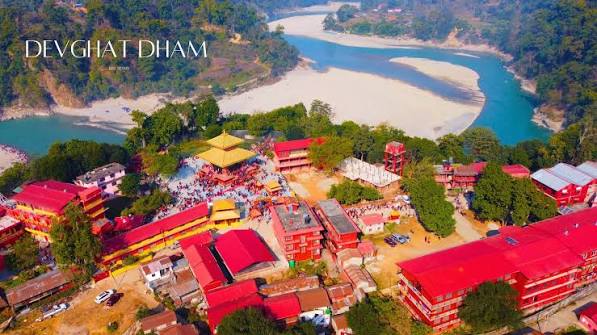
Devghat is a pilgrimage town at the confluence of the Kali Gandaki and Trishuli rivers, on the boundary between Tanahun, Chitwan and Nawalpur districts in central Nepal. The two rivers join here to form the Narayani. It is about seven kilometres from Bharatpur, the nearest city, and it is best known for two things: a large mid-January bathing festival, and a resident community of elderly Hindus who move there to spend their last years by the water.
Why a confluence is a pilgrimage site
In Hindu practice a place where rivers meet is a tirtha, a crossing point, and bathing at one is held to carry particular merit. The most famous is Prayag in India, where three rivers are said to meet. Nepal has its own set, and Devghat is the largest and most active of them.
The two rivers involved are significant in their own right. The Kali Gandaki runs from the Tibetan border through the deep gorge between Dhaulagiri and Annapurna, and it is the river that carries shaligram, the fossil ammonites treated as aniconic forms of Vishnu and collected from its bed. The Trishuli comes down from the Langtang side, past Nuwakot. Their meeting is therefore not just a geographic event but a joining of two rivers with separate religious weight. Our guide to Nepal's river systems sets out how the Gandaki basin fits into the country's three great drainage systems.
| Detail | Devghat |
|---|---|
| Rivers | Kali Gandaki and Trishuli, joining to form the Narayani |
| Districts | On the Tanahun, Chitwan and Nawalpur boundary |
| Nearest city | Bharatpur, around 7 km away |
| Nearest airport | Bharatpur, with daily flights from Kathmandu |
| Biggest gathering | Maghe Sankranti, mid-January |
| Resident community | Ashrams housing elderly retirees and sadhus |
| Entry fee | None |
The ashram community
What makes Devghat different from other Nepali tirthas is that people live there on purpose, at the end of their lives. A number of ashrams and small dharamsalas house elderly residents, mostly widows and widowers, who have left family homes to spend their remaining years in a religious setting near the water. Some are supported by their families, some by charitable trusts, some by donations from pilgrims.
This gives the town a particular atmosphere. It is quiet, slow and mostly old. Mornings are the busy part of the day, with bathing, ritual, and the sound of bells from several directions at once. By early afternoon it is still. It is not a place that performs for visitors, and it repays being treated with more restraint than a monument would need.
Practically, that means asking before photographing anyone, not entering ashram buildings uninvited, and dressing conservatively. If someone offers to show you around, a donation to the ashram rather than to the individual is the appropriate response. Cremations take place at the ghats; if one is under way, keep your distance and put the camera away.
Maghe Sankranti at Devghat
The town's biggest day is Maghe Sankranti, the mid-January festival marking the sun's northward turn. Tens of thousands of people come to bathe at the confluence over the festival period, and Devghat is one of the two or three largest gatherings for it anywhere in Nepal. Temporary stalls, transport chaos and a genuinely enormous crowd are all part of it.
It falls in mid-January, but the precise date shifts by a day between years because it is set by a solar reckoning rather than the Gregorian calendar. Our guide to Maghe Sankranti in Nepal covers the festival itself, what is eaten and why, and how it is marked elsewhere in the country.
Going for the festival and going for the place are different trips. The festival is a spectacle and a logistical challenge: accommodation in Bharatpur books out, roads into Devghat close to private vehicles, and the walk in from wherever your transport stops can be long. Going in October, November or February gives you the same site, the same rivers, and an atmosphere you can actually hear yourself think in.
Getting to Devghat from Bharatpur
Bharatpur in Chitwan is the gateway. It has an airport with frequent short flights from Kathmandu, and it sits on the main road network with connections east to Kathmandu, west to Butwal and Nepalgunj, and north to Pokhara via Mugling. It is also the base for Chitwan National Park, which is why most foreign visitors are in the area at all.
From Bharatpur the trip to Devghat is short, around seven kilometres, and taxis do it readily. Local buses run as well. On the far bank there is a footbridge crossing, and part of the site is reached on foot rather than by vehicle, which is part of the character of the place: the last stretch of a tirtha is meant to be walked.
Bharatpur is where you should sleep, eat and draw cash. Devghat has religious accommodation rather than tourist hotels, and turning up expecting a room is not a plan. A morning trip out and back, leaving Bharatpur early, is how most visitors do it and it works well.
Combining Devghat with the rest of central Nepal
Devghat pairs naturally with Chitwan, since both are reached from Bharatpur and a wildlife day and a pilgrimage morning make a reasonable two-day stop. It also sits on the Kathmandu to Pokhara road corridor, which means it can be a stop on a journey rather than a detour from one.
Upstream on the Trishuli, Nuwakot Durbar and the Devighat confluence below it are the other end of the same river, covered in our Nuwakot Durbar guide. The Manakamana temple, reached by cable car from the Prithvi Highway between here and Pokhara, is close enough to add to the same trip, and our Manakamana cable car visiting guide covers the practicalities. For a broader survey of where Devghat sits among Nepal's major shrines, see our guide to the top temples of Nepal.
What there is to see on the ground
Devghat is a scatter rather than a single building. Small temples, shrines, ashram compounds and caves are spread along the banks on both sides of the water, connected by paths and steps, and several of them are tied in local tradition to figures from the Ramayana and the wider Hindu epic literature. There is no single monument to photograph and no route marked out for visitors.
The practical consequence is that Devghat rewards wandering more than it rewards ticking things off. Walk the paths, look at the ghats, and let the place be smaller and more domestic than a guidebook entry suggests. An hour spent sitting at the confluence watching the two rivers meet, one visibly a different colour from the other after rain, is a better use of a morning than hunting for a specific shrine.
If you want the story attached to what you are looking at, a local guide is worth arranging in Bharatpur. There is no formal guiding service and no ticket desk to ask at, so it is a hotel-desk arrangement rather than a booking.
The shaligram and the Kali Gandaki
One detail is worth knowing before you look at the riverbed. The Kali Gandaki carries shaligram, dark fossil ammonites eroded out of marine sedimentary rock high in the gorge between Dhaulagiri and Annapurna. In Hindu practice they are treated as aniconic forms of Vishnu, requiring no consecration, and they are found and venerated across the Gandaki basin.
Their presence is a straightforwardly geological fact with a large religious consequence. The rock in the upper Kali Gandaki was sea floor before the Indian plate collided with Asia and lifted it, which is why a river running out of an arid Himalayan valley delivers marine fossils to the plains. Our guide to Nepal's river systems covers how the Gandaki cuts through the range.
Do not collect them casually. Shaligram taken from the riverbed are religious objects to a great many of the people around you, and export of them, like other cultural material, is restricted. Looking is free and unproblematic; pocketing is neither.
Practicalities: Bharatpur as a base
Bharatpur is a working Nepali city rather than a tourist town, and it is the better base for that reason: real hotels across the price range, functioning banks and ATMs, hospitals, and food that is not aimed at anybody in particular. Sauraha, the tourist village on the edge of Chitwan National Park, is the alternative and is more comfortable but further from Devghat.
| Practicality | Devghat | Bharatpur |
|---|---|---|
| Hotels | Religious accommodation only | Full range |
| ATMs | None to rely on | Plentiful |
| Restaurants | Basic stalls | Wide choice |
| Transport | Taxi or local bus from Bharatpur | Airport, buses in all directions |
| Best visited | Early morning | Somewhere to sleep, not to sightsee |
Go out early. Devghat is at its most active in the first hours of the day, when the bathing and the morning ritual happen, and it is quiet by lunchtime. The Tarai is hot from March through to the monsoon, and a morning trip avoids both the heat and the emptiest part of the day. Carry water and small notes; there is nowhere useful to change money and nothing takes a card.
Frequently Asked Questions
Where is Devghat?
At the confluence of the Kali Gandaki and Trishuli rivers in central Nepal, on the boundary of Tanahun, Chitwan and Nawalpur districts. It is around seven kilometres from Bharatpur, which has the nearest airport and hotels.
Which rivers meet at Devghat?
The Kali Gandaki, coming down from the Tibetan border through the gorge between Dhaulagiri and Annapurna, and the Trishuli, coming from the Langtang side past Nuwakot. Below the confluence they become the Narayani.
What is the Devghat ashram community?
A number of ashrams and dharamsalas at Devghat house elderly Hindus, mostly widows and widowers, who have chosen to spend their final years living beside the confluence. Some are supported by families, some by charitable trusts and pilgrim donations.
When is the main festival at Devghat?
Maghe Sankranti, in mid-January, when tens of thousands of people come to bathe at the confluence. The exact date shifts by a day between years because it follows a solar reckoning rather than the Gregorian calendar.
Can I stay overnight at Devghat?
Accommodation at Devghat is religious rather than commercial, and turning up without an arrangement is not a plan. Stay in Bharatpur, which has a full range of hotels, and make Devghat a morning trip.
Is photography allowed at Devghat?
Of the rivers and the buildings, generally yes. Of people bathing, of ashram residents and of cremations, no, unless you have asked and been told otherwise. This is a place people live and die in, not a monument.
Is Devghat worth visiting outside the festival?
Yes, and arguably it is better. October, November and February give you the same confluence and the same ashram community without the crowds, the road closures and the fully booked hotels in Bharatpur.