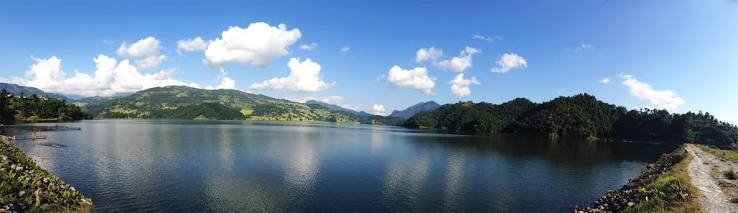
Begnas and Rupa are two lakes about 15 km east of Pokhara, separated by a single forested ridge. Begnas is the larger at roughly 3 square kilometres and about 650 m elevation; Rupa is smaller at around 1.35 square kilometres and lies just over the ridge to the east. Both are part of the Lake Cluster of Pokhara Valley, a Ramsar site of nine lakes designated in 2016. They are 30 to 40 minutes from Pokhara by local bus.
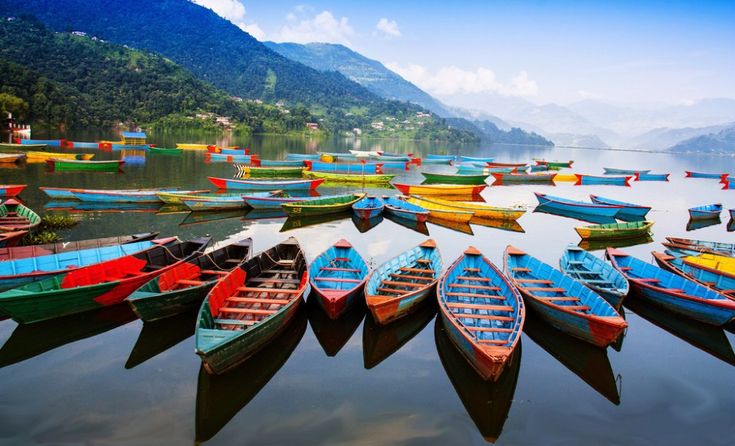
The reason to come is straightforward. Phewa has the boats, the restaurants, the paragliders landing on the shore and a great many people. Begnas has fishing nets, a few guesthouses and buffalo in the shallows. It is the same valley, the same mountains behind it, and roughly a tenth of the traffic.
Begnas and Rupa compared with Phewa
| Phewa | Begnas | Rupa | |
|---|---|---|---|
| Area | roughly 4.5 to 5.7 sq km | about 3 sq km | about 1.35 sq km |
| Elevation | about 742 m | about 650 m | about 600 m |
| Maximum depth | about 24 m | about 10 m | about 6 m |
| From Pokhara centre | Walking distance | 30 to 40 min by bus | Ridge walk from Begnas |
| Boats for hire | Many | A few | Occasional, ask locally |
| Accommodation | Hundreds of hotels | A handful of guesthouses and resorts | Homestays only |
| Main activity | Boating, lakeside dining | Fishing, walking, swimming | Birding, farm homestays |
The depth figures matter more than they look. At about 24 m Phewa is deep enough to stay cool and clear; at about 10 m and 6 m Begnas and Rupa are warm, productive and full of fish, which is why aquaculture happened here and not there.
The ridge walk between the two lakes
This is the single best thing to do in the area and almost nobody does it. The ridge separating Begnas from Rupa, Panchabhaiya Danda, carries a footpath along its spine with Begnas on one side and Rupa on the other, and on a clear morning Annapurna II, Lamjung Himal and Machhapuchhre stand up along the northern horizon.
The walk takes roughly two to three hours at an easy pace from Begnas Bazaar to the top end of Rupa, with an obvious high point at Sundari Danda where most people stop. There is climbing at the start and then it is level. Paths lead down to villages on both sides, so it is easy to shorten and easy to turn into a loop.
Go early. The mountain view closes in by mid-morning for most of the year, and the ridge is exposed with almost no shade. Carry water; there are no shops along it. Sunrise from the ridge in October and November, when the air is at its clearest after the monsoon, is the reason people who know Pokhara stay out here rather than in Lakeside.
Fishing, fish farming and the cooperative at Rupa
Begnas is the centre of freshwater aquaculture in Nepal. Cage fish farming is practised on the lake, there is a government fisheries research station on its shore, and the carp on the menu at the lakeside restaurants was very likely raised a hundred metres away. Fried fish with the local beer, sitting on a terrace with the water below you, is what most Nepali visitors come out here to do.
Rupa runs a different and more interesting model. The lake is managed by a community fisheries cooperative, and its arrangement with the villages in the catchment upstream is one of the better-documented payment-for-ecosystem-services schemes in South Asia: a share of the fishery income goes back to the upland communities whose land management determines how much silt reaches the lake. It works because the incentive lines up with the hydrology rather than against it.
Both lakes lie inside the Lake Cluster of Pokhara Valley, a Ramsar site since 2016 covering nine water bodies. Designation has not solved the problems: encroachment on the shoreline, nutrient runoff from surrounding farmland, and invasive water hyacinth choking the shallow margins are all live issues. See our guide to Nepal's Ramsar wetland sites for what listing does and does not oblige.
The other seven lakes of the cluster
The Ramsar listing covers nine water bodies, and Phewa, Begnas and Rupa are only the three anybody names. The rest are small, shallow and largely unvisited: Dipang, Maidi, Khaste, Neureni, Gunde and Kamalpokhari, scattered across the eastern side of the valley between Begnas and the Seti river.
Khaste in particular is worth an hour if you are already at Begnas. It is a small lake surrounded by community forest a short way off the road, it holds a good deal of birdlife for its size, and a local user group manages it. None of these smaller lakes have visitor facilities beyond a path and occasionally a bench, which is precisely their appeal.
On the water and in the water
Rowing boats are for hire at Begnas Bazaar and at one or two points along the northern shore. There is no fixed tariff, prices are negotiated, and the going rate is a fraction of Phewa. An hour is enough to get out to the middle and back; a half day lets you reach the quiet eastern arm where the lake narrows and the forest comes down to the water.
Swimming is normal here in a way it is not at Phewa. Local people swim, the water is warm through most of the year, and the shallow gradient means you can wade a long way out. Two practical cautions: stay clear of the fish cages and the boat channels, and be aware that shoreline water quality after heavy rain is noticeably worse than mid-lake, because the runoff comes off farmland.
Birds and wildlife
Rupa is the better of the two for birds, being shallower and with more marginal marsh. Winter is the season, when migrants arrive on the water: various ducks, grebes, cormorants and herons, with kingfishers along the reedy edges year-round. Early morning from the ridge path or a hired boat is the way to see them.
The surrounding hillsides carry mixed broadleaf forest with the usual mid-hill birds, and there is a serious jungle-edge quality to the lanes behind Rupa. It is nothing like the density of a Terai wetland such as Ghodaghodi, but for somebody staying in Pokhara it is by far the best birding within an hour of the city.
Getting there and where to stay
Local buses to Begnas leave from Prithvi Chowk and the Chipledhunga area in Pokhara through the day. The fare is small, the bus is slow and full, and the journey takes 30 to 40 minutes to Begnas Bazaar at the western end of the lake. A taxi does it in about 25 minutes for a great deal more money. Renting a scooter in Pokhara is the option most independent travellers end up taking, and the road is sealed the whole way. If you are cycling, the ride out is gently uphill and takes a little over an hour, with one steady climb near the end and a fast run back in the afternoon.
Accommodation ranges from simple guesthouses in Begnas Bazaar to a few genuinely comfortable places set above the water on the northern shore, most of them small. Rupa has homestays in the villages around it rather than hotels, and staying in one is the closest thing to a farm stay available near Pokhara. Book ahead in October and November; the good places are few and Nepali domestic tourism fills them at weekends.
Eating is simple and good. The lakeside places at Begnas do fried or curried carp, dal bhat and not much else, and they do it well; the fish is the thing to order and it is cheaper than the equivalent in Lakeside by a wide margin. Kitchens close early by Pokhara standards, so plan on eating before nine. There is no ATM at the lake worth relying on, so draw cash in Pokhara before you come out, and note that the smaller guesthouses take cash only.
Two or three nights is enough: a day for the ridge, a morning on the water, and an afternoon doing nothing. If you want to make it part of something larger, the lakes sit at the foot of the country covered in our Annapurna Conservation Area guide, and the wider valley is in our Kaski district and Pokhara guide. The rivers feeding all of this come off the Annapurnas as part of the Gandaki system, described in our overview of Nepal's three great river systems.
Frequently Asked Questions
How far is Begnas Lake from Pokhara?
About 15 km east of the city centre. Local buses from Prithvi Chowk take 30 to 40 minutes to Begnas Bazaar, a taxi takes around 25 minutes, and the road is sealed the whole way.
How big is Begnas Lake?
Roughly 3 square kilometres, at about 650 m elevation, with a maximum depth of around 10 m. It is the second largest lake in the Pokhara valley after Phewa.
Is Begnas better than Phewa Lake?
It is quieter, cheaper and has the same mountain backdrop, with a fraction of the visitors and a handful of guesthouses instead of hundreds of hotels. Phewa has more boats, more restaurants and more to do after dark. If you want the walk and the water, come to Begnas.
How long is the walk between Begnas and Rupa?
Two to three hours at an easy pace along the Panchabhaiya Danda ridge, with a climb at the start and level walking after that. Go early for the Annapurna and Machhapuchhre views, and carry water, as there are no shops on the ridge.
Can you swim in Begnas Lake?
Yes, and local people do. The water is warm and shallow compared with the high lakes. Stay clear of the fish cages and the boat channels, and be aware that shoreline water quality varies with the season and the runoff.
Are Begnas and Rupa Ramsar sites?
Both are part of the Lake Cluster of Pokhara Valley, a Ramsar site designated in 2016 covering nine lakes including Phewa, Begnas and Rupa. The listing does not restrict visitors.
Is there fishing at Begnas?
Begnas is the centre of freshwater aquaculture in Nepal, with cage farming on the lake and a fisheries research station on the shore. The fried carp in the lakeside restaurants comes from there. Rupa is managed by a community fisheries cooperative that shares income with upstream villages.
When is the best time to visit Begnas and Rupa?
October and November, when the post-monsoon air is clearest and the mountains are visible from the ridge most mornings. February and March are also good. The monsoon closes the views entirely, though the lakes themselves are at their fullest.