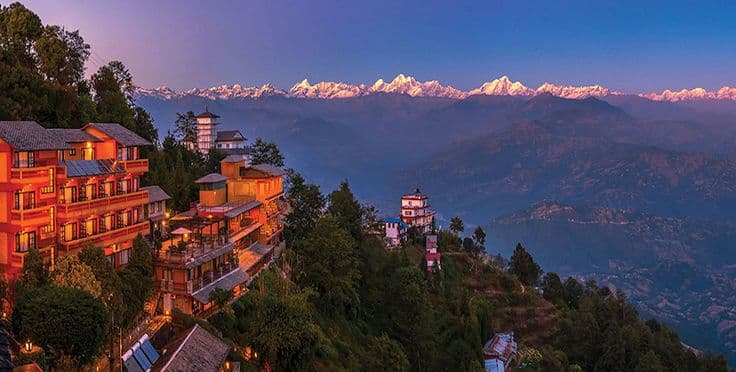
Nagarkot is a ridge settlement at 2,195 m on the eastern rim of the Kathmandu Valley, in Bhaktapur district about thirty-two kilometres from Kathmandu. People come for one thing: a clear early-morning view north along the Himalaya from the hotel terraces and the view tower above the bazaar. It is the closest reliable mountain horizon to the capital.
What you can actually see, and what you probably cannot
Brochures for Nagarkot list eight Himalayan ranges and finish the sentence with the word Everest. That is worth unpacking, because the difference between the claim and the experience is where disappointment comes from.
What you will see on a clear winter morning, reliably and at a satisfying scale, is the Langtang and Jugal group directly north, Ganesh Himal to the north-west, and Manaslu beyond it. These are large, close and unmistakable. Rolwaling appears to the north-east. Everest is a different matter: it lies far to the east and, on the clearest mornings only, shows as a small distant triangle that most people need pointing out to them and that will not fill a photograph. Treat it as a bonus rather than the reason for the trip. Claims about ranges far to the west should be read the same way.
The mountains show in the first ninety minutes after dawn and then dissolve into haze on most days. By ten in the morning there is often nothing left to see, and by lunchtime the ridge is simply a pleasant green hilltop with pine trees.
Nagarkot at a glance
| Detail | Nagarkot |
|---|---|
| District | Bhaktapur |
| Province | Bagmati |
| Elevation | 2,195 m |
| Distance from Kathmandu | About 32 km east |
| Drive time from Kathmandu | Roughly 1.5 to 2 hours |
| Distance from Bhaktapur | About 15 km, uphill throughout |
| Clearest months | October to February |
| Reliable peaks | Langtang, Jugal, Ganesh Himal, Manaslu |
| Permit | Not required |
| Difficulty | Easy, a road destination rather than a trek |
October to February, and why the rest of the year is a gamble
October and November are the best months: the monsoon has washed the air, the skies clear overnight and the mornings are cold and sharp. December through February keeps the clarity and adds frost, and you will want a proper jacket on the terrace at six in the morning. March and April bring haze from dust and agricultural burning across the plains, and the mountains vanish for weeks. The monsoon from June to September closes the view almost entirely, though the ridge is green, the air is soft and the room rates fall.
Even in the best month, a given morning can be cloudy. Two nights doubles your chances and costs very little. Our seasons guide sets out how the same pattern plays out across the rest of the country.
Getting up there
A taxi from Kathmandu takes roughly an hour and a half to two hours, most of it climbing switchbacks after Bhaktapur, and drivers usually quote a return fare including the wait. From Bhaktapur, local buses and minibuses leave from the Kamalbinayak stand and take about an hour to the Nagarkot bazaar; they are cheap, slow and crowded, and they stop running in the evening. Cycling up from Bhaktapur is a serious climb and a popular one, with a fast descent afterwards.
There is no airport, no permit and no checkpost. The road is sealed and in reasonable condition, though it narrows and deteriorates in patches above the halfway point.
Stay the night, or the sunrise does not happen
Driving from Kathmandu in the dark to catch a sunrise means leaving at about four in the morning on a winding hill road, and it puts you on the ridge tired at the exact moment you want to be alert. Almost everyone stays. Accommodation runs from simple guesthouses in the bazaar to resorts strung along the ridge with north-facing balconies, and the price is largely a function of whether you can see the mountains from your bed. Ask specifically for a north-facing room and confirm it rather than assuming.
The public view tower sits a short uphill walk above the bazaar and gives a full circle, which no hotel terrace does. It is worth the twenty minutes even if you have a good balcony.
The walk down to Changu Narayan
The best half-day in Nagarkot is not the sunrise but the walk after it. A ridge path drops west through terraced fields, pine and small settlements to the hilltop temple at Changu Narayan, which holds the oldest dated inscription in Nepal. It is downhill throughout, takes most of a morning at an easy pace, needs no permit or guide, and ends somewhere genuinely worth arriving at. From there it is a short ride down to Bhaktapur, which makes a clean two-day loop out of Kathmandu.
What Nagarkot is not
It is not a trek, not a village experience and not remote. It is a ridge lined with hotels, reached by road, and the bazaar is a functional strip of shops and bus stands. If what you want is walking days and mountain villages, the ranges you are looking at from here are the answer instead: our Langtang National Park guide covers the closest of them, and the Everest region peaks guide covers the ones on the far horizon. What Nagarkot does well is give you a Himalayan morning without a flight, a permit or a week of your itinerary, and for a lot of visitors that is exactly the right trade. The valley's own geography is set out in the Kathmandu Valley districts guide.
Frequently Asked Questions
Can you see Everest from Nagarkot?
Occasionally, and only in the best conditions. It appears as a small distant triangle far to the east rather than a dominant peak. The reliable views are Langtang, Jugal, Ganesh Himal and Manaslu.
How long is the drive from Kathmandu?
Roughly one and a half to two hours for about thirty-two kilometres, most of it climbing switchbacks beyond Bhaktapur. Traffic on the city side is the main variable.
Is it worth staying overnight?
Yes. Driving up in the dark for sunrise means leaving Kathmandu at around four in the morning on a winding road. Staying the night also lets you try a second morning if the first is cloudy.
Which months give the clearest mountain views?
October to February. October and November are the strongest, spring is hazy, and the monsoon from June to September usually closes the view completely.
Do I need a permit or a guide?
No. Nagarkot is a road destination inside the Kathmandu Valley rim, with no permit, no checkpost and no requirement for a guide, including for the walk down to Changu Narayan.
What else is there to do besides the sunrise?
Walk the ridge to Changu Narayan, climb to the public view tower above the bazaar for a full circle, or cycle the descent to Bhaktapur. Most visitors spend one night and leave by mid-morning.