Holi in Nepal happens twice. The hills, including the Kathmandu Valley and Pokhara, play on the full moon of Falgun. The Terai, the flat southern belt along the Indian border, plays the following day. Both are official, both are public holidays in their respective areas, and every year a portion of the country spends one day covered in colour while the other half watches and waits its turn.
The festival is called Fagu Purnima in Nepali, after the month and the full moon that sets it. It falls in February or March. Like most Nepali festivals it is lunar, so the Gregorian date moves each year, and the two-day structure moves with it.
Why Holi falls on two different days in Nepal
The split follows the fire. Holika Dahan, the bonfire that burns the demoness Holika, is lit on the eve of the full moon. In the hill tradition the colour play begins on the full moon itself, immediately after the fire. In the Terai the convention matches the wider Gangetic plain, where the burning happens on the full moon night and the colour throwing waits for the morning after.
The result is a single festival on two calendars separated by roughly twenty-four hours. It is not a disagreement and nobody treats it as one. Government holiday notices simply list the hill districts on one date and the Terai districts on the next.
For a traveller the split is an opportunity. It is entirely possible to play Holi in Kathmandu, drive south the same evening, and play again the following day in the plains.
When is Holi in Nepal?
On the full moon of Falgun, which lands somewhere in late February or March. Falgun is also the month of Maha Shivaratri and of Gyalpo Lhosar, so this is a dense stretch of the calendar. Confirm the year’s dates against a Nepali patro rather than assuming a fixed week.
The season is good. Falgun is the end of winter, warm enough in the daytime for water to be tolerable, still clear enough in the hills for mountain views. In the Terai it is already hot by midday.
The chir pole in Kathmandu Durbar Square
The most distinctive Nepali element is the chir. About a week before the full moon, a tall bamboo pole hung with strips of coloured cloth is raised in Kathmandu Durbar Square. Each strip is a token offering. The pole standing in the square is the public signal that the festival period has begun, and colour play in the city escalates from that day onward rather than starting suddenly.
On the eve of the full moon the chir is taken down and burned, and that fire is the Kathmandu version of Holika Dahan. The sequence, raising then burning, gives the valley festival a longer arc than the single day most people expect.
Holika Dahan and the story behind the fire
The story is standard across South Asia. The king Hiranyakashipu demanded worship as a god and was defied by his own son Prahlad, a devotee of Vishnu. The king’s sister Holika, who could not be harmed by fire, sat in a bonfire holding the boy in order to kill him. The fire took her instead and left Prahlad untouched. The bonfire re-enacts that, and the colour that follows is the celebration of it.
In the Terai a second layer sits on top: the association with Krishna, who according to the stories smeared colour on Radha and the cowherd girls of Braj. That is why Terai Holi leans more on folk songs, drums and processions, while hill Holi leans on water and crowds.
Holi in the hills versus Holi in the Terai
| Region | Day played | Character | Where to be |
|---|---|---|---|
| Kathmandu Valley | Falgun Purnima | Dense street crowds, water balloons, music stages, the chir burned the night before | Basantapur and the old city lanes, mid-morning to mid-afternoon |
| Pokhara and the central hills | Falgun Purnima | Younger, more music-driven, lakeside parties alongside neighbourhood play | Lakeside and the old bazaar |
| Hill towns and rural districts | Falgun Purnima | Small, local and largely dry colour rather than water | Town squares and temple courtyards |
| Chitwan and the inner Terai | The day after Purnima | Village processions, drums, colour rather than water balloons | Bazaar towns near the park boundary |
| Western Terai around Lumbini | The day after Purnima | Quieter, family-centred, strong Holika Dahan the previous night | Village settlements outside the monastic zone |
| Eastern Terai and Mithila | The day after Purnima | Jogira folk singing, sweets, house-to-house visiting | Janakpur and the surrounding villages |
Where to spend Holi as a visitor
Kathmandu is the loudest and the least controllable. The area around the old durbar square becomes a slow-moving crowd of several thousand by midday, with water thrown from upper floors and colour applied by anyone within reach. It is memorable and it is not for everyone.
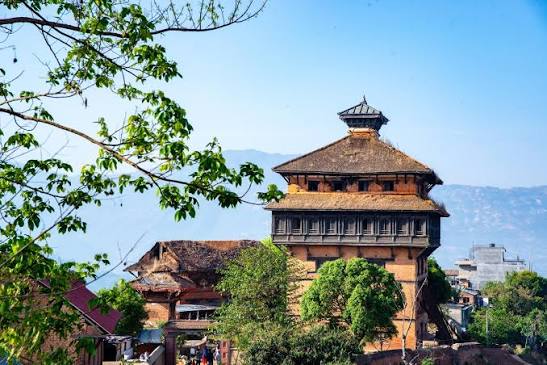
Hill towns give a gentler version. The old palace town of Nuwakot, a few hours north-west of the capital, plays on the same day at a fraction of the intensity. In the Terai, the bazaar towns around Chitwan celebrate a day later with processions and drums rather than water fights, which is easier to watch and easier to join.
The western Terai around Lumbini is quieter again. The monastic zone itself is not a Holi venue, but the farming villages around it observe the day fully, and the contrast between the two within a few kilometres is one of the more interesting things about Holi in that district.
What to wear and what to expect
Wear clothes you will throw away. Synthetic colour stains permanently and no amount of washing fixes white cotton. Cover your hair with oil beforehand, which makes the powder wash out instead of setting in. Leave phones and cameras in a sealed bag, because water balloons are thrown from balconies without warning and accuracy is not the point.
Some practical caution is warranted. Alcohol and bhang are both common by the afternoon, crowds get dense in the narrow lanes of the old cities, and unwanted contact is a real complaint, particularly for women. Playing in the morning and leaving by early afternoon avoids most of it. Playing in a residential neighbourhood or a hotel rather than a city square avoids nearly all of it.
FAQ
Why is Holi celebrated on two different days in Nepal?
The hill districts play colour on the full moon of Falgun, immediately after Holika Dahan. The Terai districts follow the convention of the neighbouring plains, where the bonfire burns on the full moon night and colour is thrown the next morning. Both days are officially recognised.
When is Holi in Nepal?
On the full moon of the Nepali month Falgun, which falls in February or March. The date is lunar and shifts each year, so check a current Nepali calendar.
What is the chir in Nepali Holi?
A tall bamboo pole hung with strips of coloured cloth, raised in Kathmandu Durbar Square about a week before the festival and burned on the eve of the full moon. It marks the start and end of the Holi period in the valley.
Is Holi safe for foreign visitors?
Generally yes, with sensible limits. Play in the morning, stay with a group, keep valuables sealed and leave before the afternoon when drinking increases. Women travelling alone often prefer neighbourhood or hotel celebrations to the crowds in the old city squares.
How do you get Holi colour off?
Oil your hair and exposed skin before playing, then wash with oil rather than soap first. Cheap synthetic colours can stain skin for a day or two and clothes permanently, so wear nothing you want back.