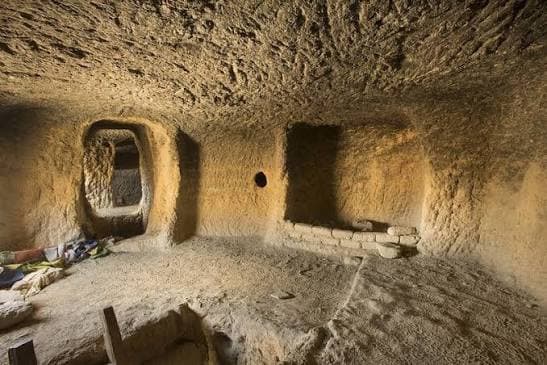
The cliffs of Mustang district in Gandaki Province are honeycombed with thousands of man-made caves cut into vertical faces of conglomerate and sandstone, some of them far up sheer faces above the valley floor. A handful contain Buddhist shrines and wall paintings, and the district's gateway is the airstrip at Jomsom, at about 2,720 metres in the Kali Gandaki gorge.
How old the caves really are
Travel copy routinely calls these caves ten or even fourteen thousand years old. Published archaeology does not support that. Excavations of Mustang cliff burials have recovered human remains, textiles and grave goods dated to roughly three thousand years before the present, with later burial phases continuing into the first millennium of the common era. The painted monastic chambers are later again, medieval rather than prehistoric.
Three thousand years is remarkable enough. It puts organised communities living and burying their dead in vertical cliff faces at high altitude, in a place with no obvious way up. Nobody has satisfactorily explained how the higher caves were cut or reached, which is the genuinely interesting part and is quietly lost when the number is inflated.
What is inside them
Most of the caves are empty chambers, sometimes in stacked multi-storey groups with connecting shafts, and were used for burial, storage, shelter or meditation at different periods. A small number hold surviving murals and clay work. The best known are the cave gompa at Luri near Yara, with a painted chorten in a natural chamber, and the Chungsi or Ranchung cave associated with Padmasambhava, which is a pilgrimage site rather than an archaeological one.
Near Lo Manthang, the Jhong cave complex at Chhoser is the most accessible large multi-storey site, with wooden ladders between levels and enough intact structure to make the scale obvious. None of these are managed as museums. Lighting is a torch, the floors are dust and there is no interpretation on site, so a guide who knows the specific cave is worth more here than in most of Nepal.
Restricted and unrestricted Mustang
This is the practical division that decides your trip. Lower Mustang, up to and including Kagbeni, Jomsom and Muktinath, requires only the Annapurna Conservation Area permit and the trekker registration card. It has cliff caves visible from the trail and the monastery complexes at Jharkot and Kagbeni.
North of Kagbeni is Upper Mustang, a restricted area. Entry needs a restricted-area permit issued only through a registered trekking agency, charged per person for a fixed initial block of days with a daily rate thereafter, and it requires a minimum of two trekkers plus a licensed guide. That is where the famous sky caves and Lo Manthang are. Our guide to restricted area permits explains how the system works across Nepal.
The landscape and the wind
Mustang lies in the rain shadow north of the Annapurna and Dhaulagiri massifs, which is why it is dry ochre desert while the south side of the same range is subtropical forest. The Kali Gandaki has cut the deepest section of its gorge between two 8,000-metre peaks, and the pressure difference that produces drives a ferocious valley wind from late morning every day. Flights into Jomsom operate in the early morning only for that reason, and afternoon walking is done into a headwind carrying grit.
Because the rain falls south of the range, Mustang is one of the few parts of Nepal that is pleasant during the monsoon. May to October is the practical season here, the reverse of most of the country. See how the Himalaya formed for why the gorge is where it is, and the trans-Himalayan salt trade routes for what this valley carried for a thousand years.
| Detail | Mustang caves |
|---|---|
| District | Mustang, Gandaki Province |
| Gateway | Jomsom airstrip, about 2,720 m |
| Lo Manthang | About 3,840 m, in the restricted zone |
| Earliest dated remains | Roughly 3,000 years before present, from published excavations |
| Lower Mustang permits | Annapurna Conservation Area permit and trekker registration card |
| Upper Mustang permits | Restricted area permit via a registered agency, minimum two trekkers, licensed guide required |
| Best season | May to October, including the monsoon months |
| Access | Flight Pokhara to Jomsom, mornings only; or jeep road from Pokhara over one to two days |
If your interest is the caves specifically rather than Upper Mustang generally, the lower valley delivers a great deal without the restricted permit: cliff faces riddled with openings above Kagbeni, the old fortified villages, and the monastery at Jharkot. Nobody should climb into a cave unaccompanied. The rock is friable, the drops are lethal and several sites are actively venerated. Our Annapurna Conservation Area guide covers the permits for the lower valley.
Frequently Asked Questions
Are the Mustang caves really 10,000 years old?
No. Published excavation dates the oldest human remains recovered from these cliff caves to roughly three thousand years ago, with later phases after that. The larger figures circulate in travel writing but are not supported by the archaeology.
Can I see cave sites without an Upper Mustang permit?
Yes. Cliff caves are visible from the trail throughout the lower valley around Kagbeni and Jomsom, and the monastery complexes at Jharkot and Kagbeni need only the standard Annapurna permits. The Lo Manthang and Luri sites lie inside the restricted zone.
What does the Upper Mustang permit involve?
It is issued only through a registered trekking agency, needs a minimum of two trekkers and a licensed guide, and is charged per person for a fixed initial period with a daily rate after that. Rates change, so confirm current figures with the agency.
When is the best time to go?
May to October, which includes the monsoon. Mustang sits in the rain shadow, so it stays dry when the rest of Nepal is wet. Winter is severe and many villages empty out; flights are unreliable then.
Why do flights to Jomsom only run in the morning?
A strong valley wind builds in the Kali Gandaki gorge from late morning almost every day, driven by heating on the plateau. Airlines schedule around it, and afternoon flights are simply not attempted.
Can I go inside the caves?
Some, with a guide. Chhoser near Lo Manthang has ladders and defined access. Many other caves are unstable, unreachable without technical equipment, or actively used as shrines, and climbing into them unaccompanied is both dangerous and unwelcome.